Vertical Grain Facilities Eliminate 95% Water Footprint in First Harvest
An indoor aeroponic wheat facility says its first harvest used a small fraction of the water needed in open fields. Electricity, not water, is the catch that will decide whether grain can move indoors.
boltCore Drivers
- check_circle95% less water, operators reportThe facility recycles almost all of the mist used to feed roots, according to its operators.
- check_circleGrain is harder than greensWheat needs far more light and space per calorie than lettuce or herbs.
- check_circleEnergy decides the economicsLED lighting and climate control make indoor grain costly unless power is cheap and clean.
Vertical farms have mostly grown the same few crops: lettuce, herbs, microgreens and strawberries. Those plants grow fast, stay small and sell at high prices. Staple grains have been considered out of reach. In this illustrative launch-edition report, an indoor facility on the edge of a large city says it has completed its first harvest of wheat grown aeroponically, with roots suspended in air and fed by a nutrient mist, using about 95% less water than a typical field crop.
The water figure is impressive, and it comes from the operators. But the more important number for the future of indoor grain is one they have shared less readily: how much electricity each kilogram of wheat required.
How aeroponic wheat works
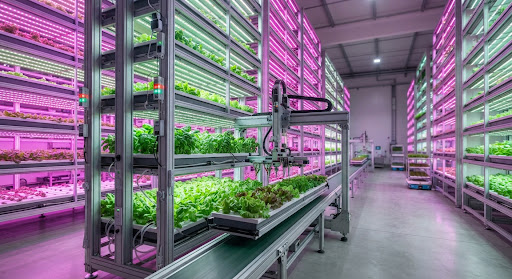
The wheat grows in stacked trays inside a sealed building. Its roots hang below each tray in a chamber where nozzles spray a fine mist of water and nutrients at intervals. Excess mist condenses and is collected, filtered and reused, which is why water use is so low. Overhead, LED panels supply light tuned to the wavelengths plants use most efficiently, and the lighting schedule is adjusted to shorten the time from sowing to harvest.
- Water: recirculated almost entirely; losses come mainly from what the plants take up.
- Light: LEDs running long hours to drive rapid growth.
- Climate: controlled temperature, humidity and carbon dioxide levels.
- Cycles: several harvests a year instead of one or two in a field.
Why grain is so much harder
A head of lettuce is mostly water and leaves, and it sells for a decent price. Wheat is valuable for its seeds, which are only a small part of the plant, and it is one of the cheapest foods in the world per calorie. To grow wheat indoors, a facility has to provide enough light for the whole plant to mature and fill its grains, then sell a commodity that competes with crops grown under free sunlight on enormous fields.
Researchers have shown for years that indoor wheat can achieve very high yields per square meter, because the stacked trays and multiple harvests multiply output. The problem is the energy bill that comes with it.
You can grow wheat almost anywhere if you are willing to pay for the sun. The question is who pays, and why. — an agricultural economist who studies controlled-environment farming
The energy question
The operators say their facility runs largely on electricity from a nearby wind farm under a long-term contract, and that much of the heat from the lights is recovered to warm neighboring buildings. They have not published the facility’s total electricity use per kilogram of grain. Independent estimates for indoor wheat in general suggest that, with current lighting technology, the energy cost per kilogram is many times higher than for field wheat. Even with improving LEDs, closing that gap entirely looks unlikely in the near term.
That does not necessarily make the project pointless. In places where water is scarce, where farmland is degraded, or where supply chains are fragile, the trade-off may look different. Indoor grain could also serve specialty markets, such as seed production for breeding programs or crops grown to precise quality specifications.
Why the project still matters
Climate change is making harvests more volatile, with droughts, heat waves and floods hitting major growing regions. Facilities like this one serve as test beds for how food might be produced under tighter constraints. They also generate useful science: plant breeders can run several generations of wheat a year indoors, speeding up the development of varieties suited to harsher field conditions. Some researchers argue that this “speed breeding” role may prove more valuable than indoor grain production itself.
There is a local angle, too. The facility employs technicians, plant scientists and maintenance staff, and the operators say they want to supply a regional bakery cooperative with a traceable, locally milled flour. That kind of premium, story-driven market could help cover costs while the technology matures.
What is not yet known
Beyond the electricity question, there are other unknowns. One harvest is not enough to judge whether yields are consistent, whether disease can be controlled in a dense indoor crop over many cycles, or whether the equipment holds up. The grain’s baking quality has not yet been independently assessed. And the facility’s financial model, including how much it depends on grants or a premium price, has not been disclosed.
What to watch next
The operators plan to publish more detailed data after their third harvest, including energy use. Watch for that figure, for independent tests of the flour, and for whether the bakery cooperative signs a lasting supply deal. If indoor grain finds a niche in breeding, specialty flour or water-scarce regions, this first harvest will be remembered as a useful step. If not, the lesson will still be valuable: some crops belong under the open sky.
About this story: this is an illustrative launch-edition scenario. Organizations and people in it are fictional or unnamed, and figures are attributed within the story. Our standards.
Written by
Tariq Al-Mansoor
Agriculture & Water Reporter — launch-edition house byline. About our bylines • Report an error