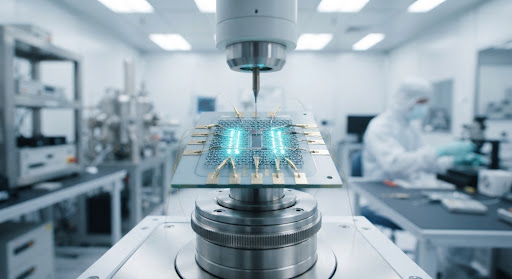
Light-Speed Logic: Optical Microchips Slash Datacenter Wattage by 78%
Chips that move and process data with light instead of electrons are reaching pilot scale. Their developers say one prototype rack cut power and cooling demand sharply. Here is what that claim rests on.
boltCore Drivers
- check_circle78% lower power in one rack testThe developers report the saving for a specific prototype workload, not for a whole data center.
- check_circleLight carries more data with less heatOptical links move huge volumes of data without the resistive losses of copper wires.
- check_circleManufacturing is the bottleneckIntegrating lasers and optics onto chips at scale remains difficult and costly.
Every time a chatbot answers a question or a video service recommends a film, enormous amounts of data move between processors inside a data center. Much of the electricity those buildings consume goes not into computing itself but into shuttling bits around through copper wiring, and then into cooling away the heat that wiring produces. In this launch-edition feature, a team developing silicon photonic chips, which use light rather than electrons to move and partly process data, says a prototype rack built around its technology cut power and cooling demand by 78% for a specific workload.
That is a striking number, and it comes with important qualifications. But the broader trend it represents, a shift toward light inside computers, is real and accelerating.
Why light instead of electricity
Electrical signals traveling through copper lose energy as heat, and the losses grow as speeds increase. Light traveling through optical waveguides, essentially microscopic channels etched into silicon, loses far less. It can also carry many signals at once on different wavelengths, like several radio stations sharing the air without interfering.
- Bandwidth: optical links can carry far more data per second than copper of a similar size. The developers report prototype interconnects passing 100 terabits per second.
- Heat: less energy lost in transmission means less heat to remove.
- Distance: light keeps its strength over longer runs, which lets designers spread components out.
Computing with light, not just connecting
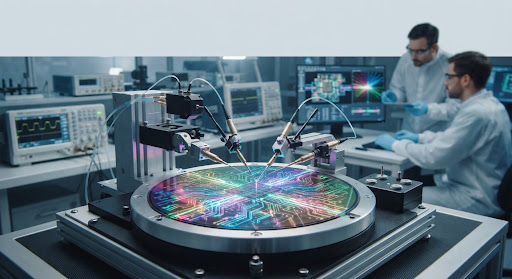
Most photonics in data centers today is about connections: cables between servers and racks. The newer frontier is putting optics directly onto or beside processor chips, and even performing some calculations optically. Certain operations at the heart of AI models, especially large matrix multiplications, can in principle be done by passing light through carefully designed patterns of interference. The developers say their chip handles a portion of these operations optically while conventional electronics handle the rest.
Reading the 78% figure
The number comes from the developers’ own test of one prototype rack running a specific AI inference workload, compared with a conventional rack of similar capability. Several caveats apply:
- It covers one workload chosen to suit the technology. Other tasks may see much smaller gains.
- It compares a new prototype with existing hardware, while conventional chips keep improving too.
- It measures a rack, not an entire data center, where lighting, networking, storage and building systems also use power.
The physics advantage is real. The question is how much of it survives contact with real software, real factories and real budgets. — a semiconductor analyst who reviewed the published materials
The manufacturing hurdle
Silicon photonics can use many of the same factories as ordinary chips, which is a major advantage. But integrating light sources is still difficult, because silicon itself is a poor emitter of light, so lasers usually have to be made from other materials and bonded on. Optical components are also sensitive to temperature and tiny alignment errors. Yields, the share of chips that work as designed, tend to be lower than for mature electronic chips, which raises costs.
The developers say they have solved enough of these problems to begin pilot production, and that early customers will test the chips in live environments. They have not published yield figures or pricing.
Software is another hurdle. AI frameworks are built around conventional processors, and optical sections of a chip behave differently, with their own precision limits and noise. The developers provide tools that translate models automatically, but customers will want to know how much accuracy, if any, is lost along the way.
Why it matters for AI energy demand
Electricity demand from data centers is one of the fastest-growing loads on power grids in many regions, driven largely by AI. Utilities and local communities are increasingly worried about whether supply can keep up. Technologies that cut the energy per computation, even by a fraction of the headline claim, could ease that pressure. They will not eliminate it, though; history suggests that when computing gets cheaper, people tend to use more of it.
What to watch next
Look for independent benchmarks across a range of workloads, published yield and cost figures, and whether large data center operators move from evaluation to volume purchases. Also watch the conventional chip makers, many of which are developing their own optical interconnects. The most likely future is not a sudden switch to all-optical computers, but a steady spread of light into the places where copper struggles most.
About this story: this is an illustrative launch-edition scenario. Organizations and people in it are fictional or unnamed, and figures are attributed within the story. Our standards.
Written by
Kaito Tanaka
Compute & AI Reporter — launch-edition house byline. About our bylines • Report an error