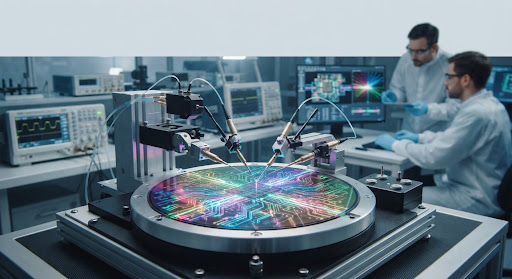
Quantum Battery Density Breakthrough: 800-Mile Range Enters Pilot Factory Trials
A university spin-out says its synthetic-electrolyte cells reach 80% charge in ten minutes and barely degrade over thousands of cycles. A pilot factory line will now test whether the lab results survive mass production.
boltCore Drivers
- check_circle10-minute charge to 80%, developers sayThe team reports fast charging in lab cells without the heat damage that usually follows.
- check_circle3,000 cycles with little degradationTest cells kept most of their capacity after thousands of heating and cooling cycles, per the developers.
- check_circlePilot factory is the real testScaling from hand-built cells to production lines is where many battery breakthroughs stall.
Battery announcements arrive almost weekly, and most of them never reach a car. The claim from a small university spin-out in this launch-edition scenario is getting more attention than usual, partly because of its numbers and partly because it has moved past the lab bench. The company says cells built around a new synthetic electrolyte can charge to 80% in about ten minutes, survive 3,000 thermal cycles with little loss of capacity, and, packed into a test vehicle, deliver a range of roughly 800 miles. Those cells are now entering trials on a pilot factory line.
Every one of those figures comes from the developers. None has yet been independently reproduced. That does not make the work unimportant, but it does shape how it should be read.
What the team says it built
The cell is a solid-state design, meaning the liquid electrolyte found in most lithium-ion batteries is replaced with a solid material that lets ions move between electrodes. Solid electrolytes have long promised two things: higher energy density, because they allow lithium-metal anodes that store more charge, and better safety, because there is no flammable liquid to leak or ignite.
The problem has always been the interface. Solid materials do not wet the electrode surfaces the way a liquid does, so tiny gaps form, resistance rises, and needle-like lithium growths called dendrites can short the cell. The spin-out says its synthetic electrolyte is engineered at the nanoscale to stay in contact with the anode as it swells and shrinks during charging.
Why the word “quantum” needs a footnote
The company markets the product as a quantum battery. That label is partly branding. The team used quantum-mechanical simulations to screen thousands of candidate materials before synthesizing a handful, and the electrolyte’s behavior depends on effects at the atomic scale. But the cell does not store energy in quantum states, and it is not related to the theoretical “quantum batteries” studied in physics labs. Readers should treat it as an advanced solid-state lithium cell.
Reading the numbers
Each headline figure answers a different question, and each has limits.
- 800-mile range depends as much on the vehicle as the chemistry. The developers’ test pack sat in an efficient, lightweight prototype; the same cells in a heavy SUV would go much less far.
- Ten minutes to 80% requires a charger that can deliver very high power. Most public chargers today could not take full advantage of it.
- 3,000 thermal cycles is a stress test of heating and cooling, not the same thing as 3,000 full charge-discharge cycles in a real car over many years.
Lab cells are hand-built by people who know exactly what can go wrong. A factory has to make millions of them that all behave the same way. — a battery manufacturing engineer not involved in the project
Why the pilot line matters
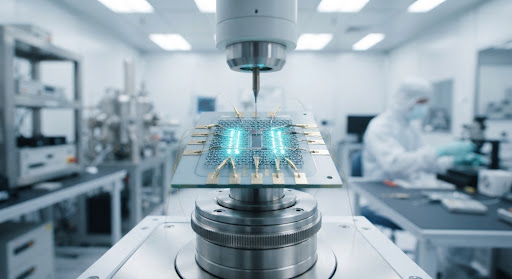
Battery history is full of chemistries that dazzled in coin cells and faltered in production. Solid electrolytes can be brittle, sensitive to moisture, and hard to deposit in thin, uniform layers at speed. A pilot line, typically producing thousands rather than millions of cells, is where those problems show up: yield rates, defects, and the cost of the raw materials at scale.
The spin-out says the line will run for about a year before any decision on a full plant. It has not disclosed expected costs per kilowatt-hour, which is the number carmakers will care about most.
What is still unknown
The biggest open question is reproducibility. Until independent labs test cells from the pilot line, the performance claims remain the developers’ own. There are also unanswered questions about cold-weather behavior, safety under crush and puncture tests, and how the electrolyte holds up after years rather than months. The team says it plans to publish a peer-reviewed paper and send samples to outside testers, but has not given a timeline.
What to watch next
Watch for three signals: independent test results on pilot-line cells, a disclosed cost target, and any agreement with a vehicle maker to run real-world fleet trials. If all three arrive, this could be one of the solid-state efforts that makes it to the road. If they don’t, it will join a long list of promising chemistries that taught researchers something useful along the way.
About this story: this is an illustrative launch-edition scenario. Organizations and people in it are fictional or unnamed, and figures are attributed within the story. Our standards.
Written by
Dr. Aris Thorne
Hardware & Labs Correspondent — launch-edition house byline. About our bylines • Report an error