Non-Invasive Neural Sleeves Bring Tactile Telepresence to Remote Surgery
Wearable sleeves that read muscle signals and return a sense of touch are being trialled in surgical training, raising hopes for remote procedures and hard questions about safety.
boltCore Drivers
- check_circleReads muscles, returns touchSensors track the wearer’s muscle signals while actuators recreate pressure and texture on the skin.
- check_circleUsed in training, not routine careCurrent trials involve simulators and practice models at a teaching hospital.
- check_circleLatency and regulation decide the futureRemote procedures need near-instant, reliable links and approval from medical regulators.
Robotic surgery is already common in many hospitals. A surgeon sits at a console a few meters from the patient and guides robotic instruments with hand controls. What surgeons often say is missing is touch: the subtle resistance of tissue, the feel of a suture tightening. In this illustrative launch-edition report, a research group at a teaching hospital is trialling non-invasive neural sleeves, wearable bands packed with sensors and tiny actuators, that aim to restore that sense, and eventually to let a specialist operate from a different city.
The technology is at an early stage. Current trials use simulators and practice models, not patients, and nothing here should be read as medical advice or as a sign that remote surgery with touch feedback is routinely available.
How the sleeves work
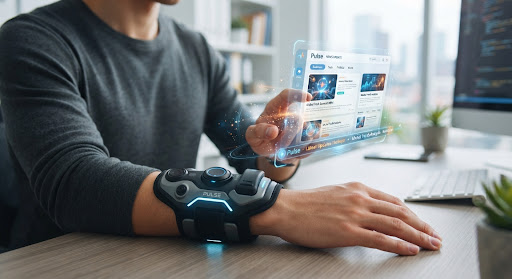
The sleeve wraps around the forearm. On its inner surface, a dense array of electrodes picks up the electrical signals produced when muscles contract, a technique called myoelectric sensing. Software translates those signals into precise movements of a robotic instrument, sometimes anticipating the motion a fraction of a second before the hand fully moves.
Going the other way, sensors on the robotic instrument measure force and texture. The sleeve recreates those sensations through small vibrating and pressing elements against the skin, so the wearer feels a version of what the instrument touches.
- Input: high-density electrodes reading forearm muscle activity.
- Output: haptic actuators that apply patterns of pressure and vibration.
- Processing: software that maps signals to instrument movement and filters out tremor.
What the trials are testing
The research group is running the sleeves in a surgical skills lab. Trainees practice tasks such as suturing and handling delicate tissue on synthetic models, some with touch feedback and some without. Early observations reported by the team suggest that trainees using feedback apply more consistent pressure and damage practice tissue less often, though the study is small and results have not yet been peer-reviewed.
Even a rough sense of resistance changes how people move. They stop pressing harder to find out what they’re touching. — a surgical educator involved in the trials
The distance problem
Operating across oceans, as the most ambitious proponents imagine, depends on network latency, the delay between an action and its effect. For touch feedback to feel natural and for movements to be safe, delays need to be very small and, crucially, consistent. A sudden spike in delay during a delicate step could be dangerous. The trials so far have kept the sleeve and the robot in the same building, with only simulated delays added to test how much lag trainees can tolerate.
Any real remote procedure would also need backup plans: a local surgical team ready to take over, redundant network connections, and clear rules on who is responsible if something goes wrong.
Regulation and ethics
Medical devices that guide surgery must pass rigorous approval processes, and touch-feedback systems add new questions. How accurate does the sensation need to be? What happens if the feedback is wrong, giving a surgeon false confidence? Who owns and protects the detailed muscle-signal data the sleeves collect? Patient advocates also stress informed consent: patients should know when a remote surgeon is involved and what safeguards exist.
There are equity questions too. Supporters argue that remote surgery could bring specialist skills to rural or underserved hospitals. Skeptics worry it could become a reason not to train and fund local specialists.
What is not yet known
The trial is small and early. It is not known how well results from synthetic models translate to living tissue, how durable the sleeves are under daily use, or how they compare with other approaches to haptic feedback, such as force-feedback hand controls. Long-term studies with clear outcome measures will be needed before any clinical use.
What to watch next
The group plans a larger, multi-site training study and has begun discussions with regulators about what evidence would be needed to move toward clinical trials. Watch for peer-reviewed results, independent replication, and transparent reporting on latency limits. If touch can be reliably restored at a distance, it would be a meaningful step for both surgical training and access to care; if it can’t, the sleeves may still find a valuable role in teaching hands what tissue feels like.
About this story: this is an illustrative launch-edition scenario. Organizations and people in it are fictional or unnamed, and figures are attributed within the story. Our standards.
Written by
Sarah Jenkins
Medical Tech Reporter — launch-edition house byline. About our bylines • Report an error