
Sally Field’s New Netflix Drama With Lewis Pullman Captivates Fans As A Hidden Hollywood Family Connection Comes To Light
Think about this for a second. Sally Field and Bill Pullman both built long, respected Hollywood careers over the same decades, moving through different eras of film and television, crossing paths with the same directors, studios, and awards seasons — and yet they never once appeared in a movie together. Not even a small ensemble drama, not a supporting cameo, nothing.

It is the kind of Hollywood coincidence that feels almost deliberate in hindsight. Field delivered landmark performances in films like Norma Rae, Steel Magnolias, Mrs. Doubtfire, and Forrest Gump. Pullman carved out his own lane with titles such as While You Were Sleeping, Independence Day, and Lost Highway. Their careers ran in parallel for decades, orbiting the same industry without ever intersecting in a meaningful on-screen way.
The closest they ever came was a 1997 PBS Christmas special, Merry Christmas, George Bailey, a one-off appearance that barely registers in either of their filmographies. For two actors of that stature, the absence of a shared project is, at the very least, surprising.
Now, however, the connection has finally arrived — just not in the way anyone expected.
Instead of a long-overdue Field–Pullman pairing, the bridge between their careers comes through the next generation. Field stars opposite Lewis Pullman, Bill Pullman’s son, in Netflix’s new drama Remarkably Bright Creatures, a film that has quietly become one of the platform’s most talked-about recent releases.
It is not a blockbuster release or a heavily marketed prestige rollout. It arrived without much noise and slowly built momentum as viewers discovered it, recommended it, and then recommended it again.
And that pattern matters, because Remarkably Bright Creatures is not designed to overwhelm the audience. It does not rely on spectacle or high-concept twists. Instead, it leans into character, silence, and emotional accumulation. The kind of storytelling that depends entirely on whether the audience believes the people on screen are real.
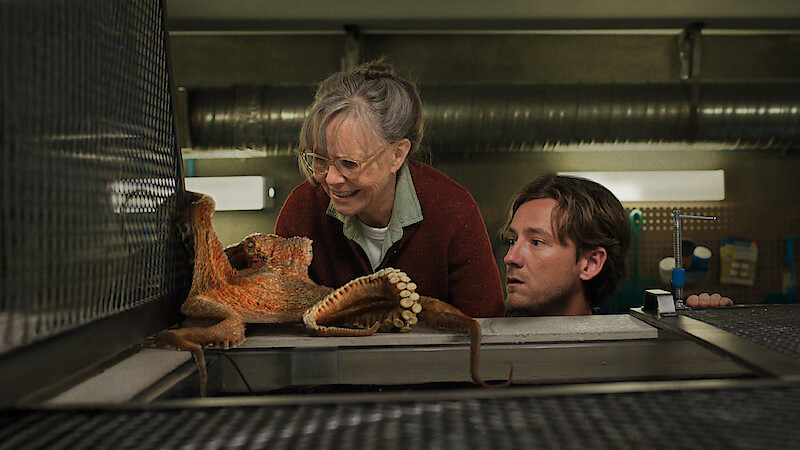
The film pairs Field with Lewis Pullman in a story that begins with distance and gradually builds toward connection. Pullman plays Cameron, a young man drifting through life after a series of personal setbacks. He takes a temporary job working in maintenance at an aquarium, a setting that feels almost suspended from the rest of the world. Field’s character, meanwhile, is dealing with her own physical and emotional limitations, forcing her into a quieter, more constrained version of her life than she is used to.
There is no dramatic inciting incident that forces them together in a traditional sense. Instead, the film allows their paths to cross naturally, the way real lives sometimes overlap without explanation.
What develops between them is not framed as romance or spectacle, but something more subtle: a friendship shaped by grief, humor, and the shared experience of trying to move forward when life has already shifted in unexpected ways.
The emotional core of the film depends heavily on restraint. Nothing is overstated. Conversations are often ordinary on the surface, but layered with unspoken history and personal weight. That approach is what gives the performances their impact.
Field, in particular, anchors the film with the kind of presence that has defined her career for more than six decades. Across her filmography — from The Amazing Spider-Man to Norma Rae and beyond — she has consistently played characters who feel grounded, even when the world around them is not. That same quality is central here. She does not play emotion as performance. She simply exists within it.
That authenticity is a major reason audiences continue to respond to her work across generations. Viewers who discovered her through earlier classics recognize the same emotional clarity today, while younger audiences encountering her for the first time see a performer who never feels artificially constructed for the camera.

The result is a kind of continuity few actors maintain over such a long career.
Opposite her, Lewis Pullman is shaping a different kind of trajectory. Rather than following a conventional leading-man path, he has built a career defined by selective, character-driven roles. Films like Top Gun: Maverick and Bad Times at the El Royale, along with his performance in Lessons in Chemistry, show a consistent interest in emotionally complex material rather than straightforward star vehicles.
That approach continues in Remarkably Bright Creatures, where Cameron is not written as a traditional protagonist with clear ambitions and easy resolutions. Instead, he is uncertain, reactive, and quietly vulnerable. Pullman’s performance leans into that ambiguity without over-explaining it.
The dynamic between Field and Pullman is what ultimately holds the film together. There is a generational contrast built into their scenes, but it never becomes the point of the story. Instead, it adds texture. Two people at different stages of life, both carrying different forms of emotional weight, gradually finding a way to exist in the same space without forcing resolution.
It is that gradual shift — from distance to familiarity — that gives the film its emotional rhythm.
What has surprised many viewers is how naturally the connection unfolds. There is no attempt to manufacture chemistry or push emotional peaks too early. The film trusts the actors to carry the relationship through subtle changes in tone, expression, and timing.

That trust pays off.
Much of the conversation around the film since its release on Netflix has focused on how understated it feels compared to most streaming-era dramas. In a landscape often driven by high-intensity hooks and rapid pacing, Remarkably Bright Creatures moves in the opposite direction. It slows down. It lingers. It lets moments breathe.
That choice is part of what makes Field and Pullman’s performances stand out even more.
While promoting the film, Field has spoken warmly about working with Lewis Pullman, noting the ease of their collaboration and the natural rhythm they found on set. She has also acknowledged the unusual generational connection at the center of the project — a veteran actress sharing the screen with the son of an actor she never actually worked with herself, despite decades of parallel careers.
It is the kind of Hollywood alignment that feels almost poetic in hindsight.
For Lewis Pullman, the film continues a pattern of carefully chosen projects that emphasize character over spectacle. For Field, it is another reminder of why she remains one of the most consistently compelling screen presences in modern film.
And for audiences, Remarkably Bright Creatures offers something increasingly rare in contemporary streaming releases: a quiet story about connection that does not rush, does not shout, and does not try to impress — it simply unfolds.
Sometimes, that is exactly what makes it impossible to look away.