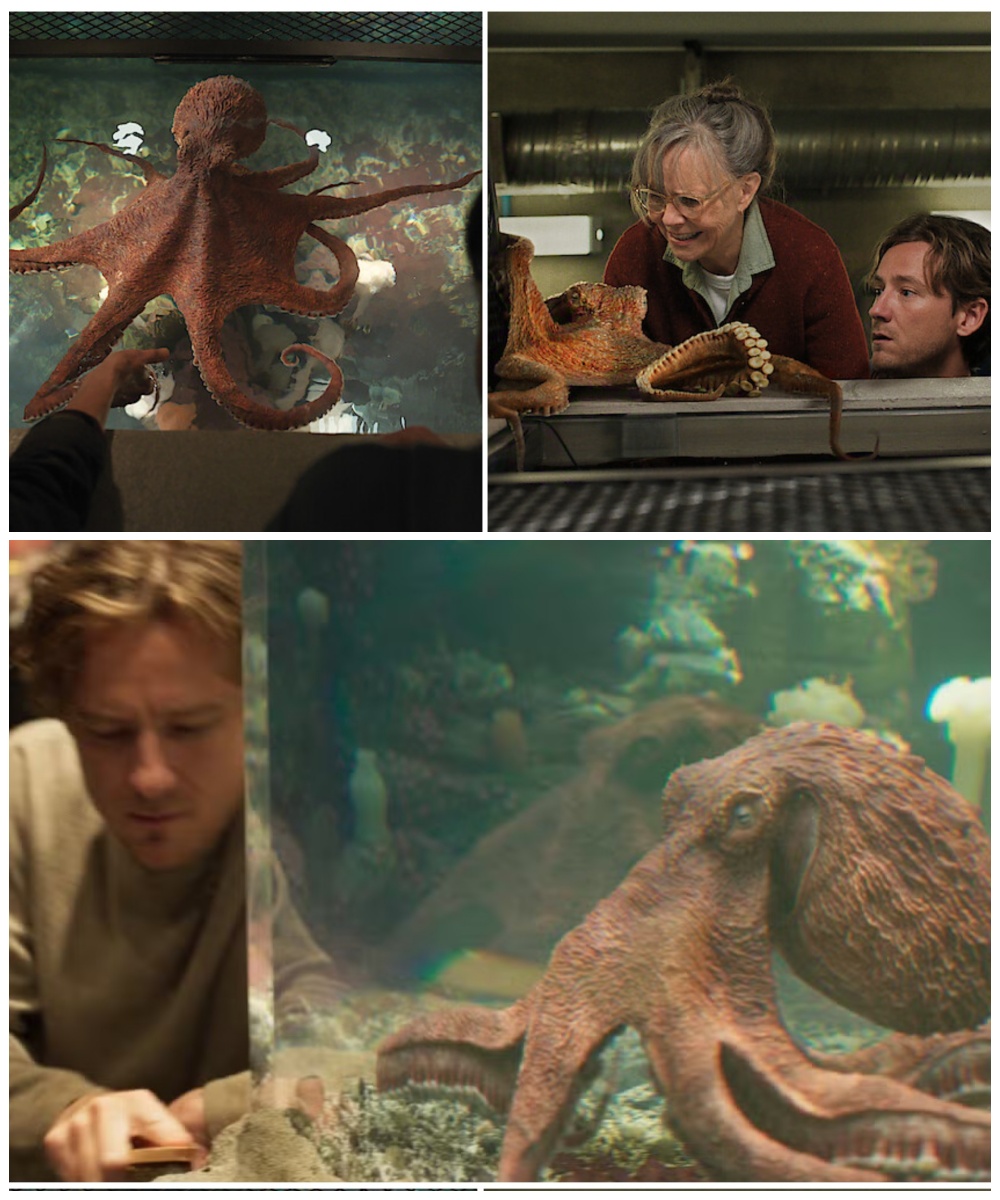
Remarkably Bright Creatures Dominates Netflix As Behind-The-Scenes Secrets Reveal The Massive VFX Gamble That Made Marcellus Feel Real
Following its breakout debut on Netflix, Remarkably Bright Creatures has quickly become one of the platform’s most talked-about releases, holding the number one position on the Netflix film charts just days after launch. The adaptation of Shelby Van Pelt’s bestselling novel has drawn attention not only for its emotional storytelling, but also for its quietly ambitious visual effects work—centered on the creation of Marcellus, a highly intelligent giant Pacific octopus who serves as the emotional core of the narrative.
To bring Marcellus to life, Netflix partnered with Untold Studios and director Olivia Newman, reuniting Newman with senior VFX supervisor Chris Ritvo following their previous collaboration on Where the Crawdads Sing. Known for blending grounded realism with subtle character animation, Untold Studios was brought into the project during early development, ensuring that Marcellus would not be treated as a traditional “creature effect,” but as a fully realised performance character.
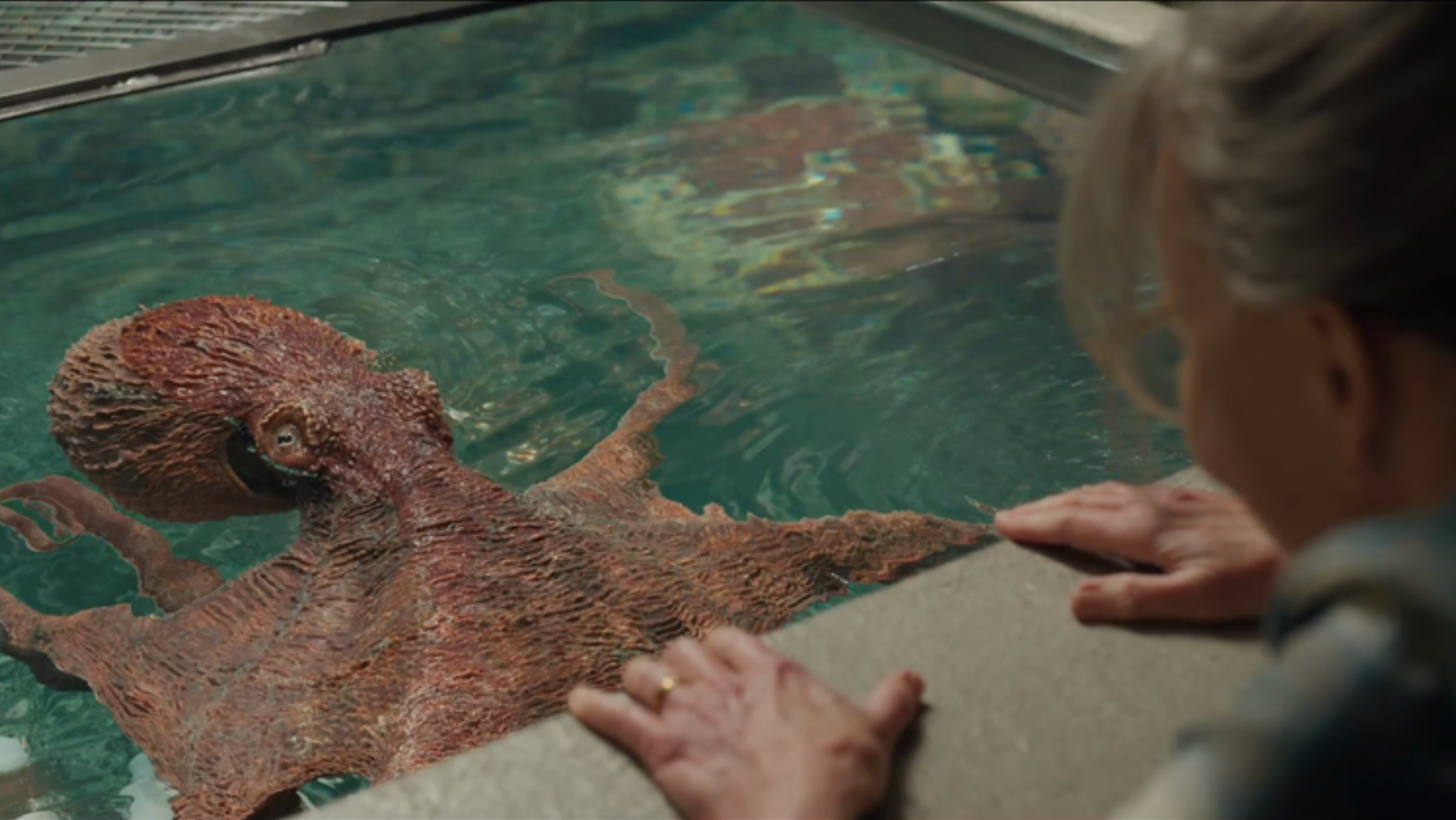
From the outset, the production team agreed on a clear creative constraint: Marcellus could not feel like a fantasy octopus. He had to behave like something that might genuinely exist in the real world, even while performing emotionally expressive actions that no real octopus could be trained to do.
“Before we even started prep, we spent around six months researching how we could bring Marcellus to life,” said Newman. “We learned pretty quickly that there was no way to train an octopus to perform in the way the story required. So we knew the bar for our CG Marcellus had to be as photoreal as possible.”
That emphasis on realism shaped every stage of the pipeline. Early R&D focused on biological motion studies, underwater lighting references, and extensive scanning of real octopuses in controlled aquarium environments. The goal was not just visual accuracy, but behavioural authenticity—how an octopus changes shape when alert, curious, defensive, or resting.
Head of animation at Untold Studios, Ross Burgess, described the challenge as one of the most complex creature builds the studio had attempted.
“Octopuses are among the most complex creatures to recreate in VFX,” Burgess explained. “Their soft-body anatomy, constant micro-movement, changing skin texture and colour, and highly dexterous arms make them a formidable CG challenge. Marcellus also needed to interact naturally with water, tank glass, props, and live-action environments, often moving between underwater and above-water states within the same sequence.”

Unlike more rigid CG creatures, Marcellus required a simulation-first approach. Every tentacle was treated as both a muscular system and a performance limb, capable of independent expression while still feeling physically connected to a central body mass. The rigging team built a layered system that allowed animators to switch seamlessly between macro motion—such as swimming or clinging to surfaces—and micro motion, including subtle sucker adhesion and skin response.
One of the earliest breakthroughs came from an internal proof-of-concept shot: Marcellus hiding on a shelf within a kitchen environment. The scene was intentionally simple, designed to test whether the creature could hold up under neutral lighting conditions with no cinematic enhancement. The result was a turning point for the production.
“The test gave everyone confidence that we weren’t just building a creature—we were building a character,” said Chris Ritvo. “It proved that Marcellus could exist in the world without drawing attention to the VFX itself.”
From that moment, Marcellus was developed as a full performance asset rather than a collection of shot-specific fixes. His design included multiple adaptive states: camouflage patterns, emotional colour shifts, and subtle texture changes across the mantle and arms. The asset featured more than 270 individually simulated suckers per tentacle, enabling highly specific interaction with surfaces like glass, ceramic, and wood.
On set, the production used a practical puppet version of Marcellus, scaled and textured to match the CG build. This provided essential lighting reference and gave actors something tangible to interact with, particularly in scenes where emotional timing depended on eye lines and physical proximity. However, the puppet was deliberately limited in motion, ensuring that final performance flexibility remained entirely in the digital domain.
“When you look at a real octopus, everything is moving all the time, in every direction,” said Ritvo. “Our CFX team created the skin and tentacle movement that really made Marcellus come alive underwater.”
The Creature FX (CFX) pipeline became one of the most technically demanding aspects of the production. Multiple simulation layers were developed to handle tentacle elasticity, suction adhesion, fluid resistance, and skin micro-displacement. These layers interacted dynamically with environmental factors such as water pressure, glass surfaces, and object contact.

Underwater behavior was treated as its own sub-system. Buoyancy, drag, and particulate water interaction were simulated separately, allowing Marcellus to feel physically grounded even in highly stylised narrative moments. In scenes where he transitions above water—such as lifting an arm out of a tank—the simulation seamlessly blended between fluid and rigid motion models.
The project also benefited from Untold Studios’ prior experience on creature-heavy campaigns, including award-winning work for Disney and automotive visual storytelling for BMW. That background provided a strong foundation in balancing realism with stylised performance, particularly in the context of close-up character work.
“Every project teaches you something about restraint,” Burgess noted. “With Marcellus, the challenge wasn’t just making him move correctly—it was deciding how little movement was needed to communicate thought.”
As development progressed, animation teams increasingly leaned into subtlety. Eye-like focal shifts, slight arm reorientation, and micro texture changes became the primary tools for expressing emotion. Rather than relying on exaggerated motion, Marcellus communicates through hesitation, curiosity, and spatial awareness—behaviours drawn directly from observational studies of real octopus cognition.
Beyond the film itself, Marcellus has also become a central figure in the broader marketing campaign for Remarkably Bright Creatures. The character appears across promotional materials, including the film tie-in edition of Van Pelt’s novel and a large-scale billboard installation in Times Square, where the CG octopus is displayed interacting with underwater-themed environmental graphics.
This cross-media presence reflects a growing trend in VFX-led storytelling, where digital characters extend beyond their narrative origins into marketing ecosystems. For Untold Studios, Marcellus represents a culmination of years of iterative creature work—combining biological study, high-end simulation, and performance-driven animation into a single cohesive character.
As streaming platforms continue to invest in visually ambitious adaptations, Marcellus stands as a reminder that some of the most compelling digital effects are not the loudest or most fantastical, but the most carefully observed.