My Brother Abandoned Me at O’Hare Airport With a Wrinkled $100 Bill So His Fiancée’s Family Could Vacation Without Me—I Never Saw the Truth Coming

“You’ll figure it out.”
My brother said it like he was telling me to remember to turn off a light.
Not like he was abandoning a fifteen-year-old girl in the international terminal at O’Hare with no house key, no ride, no food at home, and a phone battery blinking red at four percent. Not like he was my legal guardian. Not like he had promised our mother on her last good day that he would take care of me.
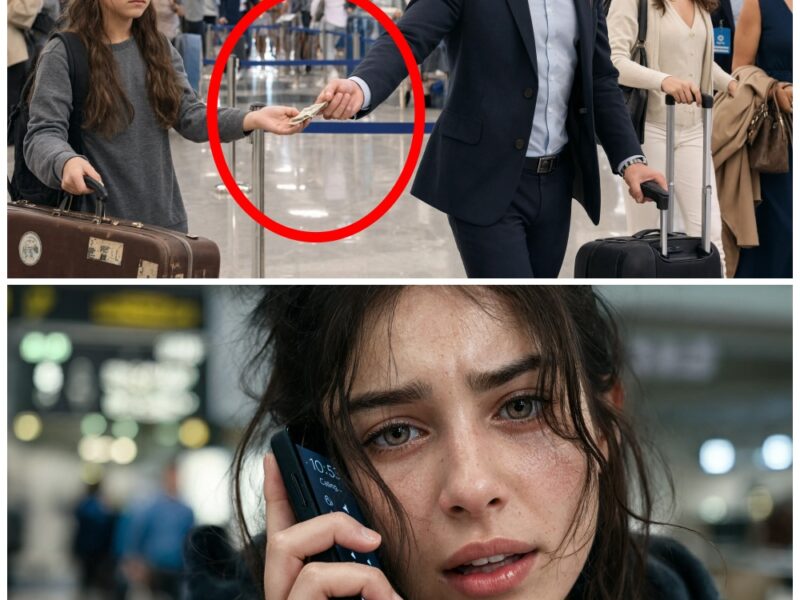
He slid my old blue suitcase toward me with the side of his designer loafer, pressed a crumpled hundred-dollar bill into my palm, and glanced over his shoulder at the first-class security line where his fiancée, Lauren, was waiting with her parents.
Her mother stood beside a stack of white leather luggage, watching me with the same polite disgust people reserved for gum stuck to the bottom of a shoe.
“Ethan,” I whispered, because my throat had closed around every other word. “I don’t have a key.”
His jaw tightened. For one small second, I thought something human might break through his face. The brother who had once made boxed macaroni for me at midnight when I couldn’t stop crying. The brother who had held my hand in the cemetery while they lowered our mother into the ground.
Then Lauren called his name.
And whatever softness had almost appeared in him disappeared.
“Don’t embarrass me,” he said quietly. “Lauren’s family paid for this trip. They want real family time. You’re old enough to manage one situation without making it dramatic.”
“I am your family.”
His eyes flicked over me, over my thrift-store cardigan, my worn sneakers, the suitcase with one broken wheel, and he looked away as if the sight of me had confirmed something he had already decided.
“You’re a complication,” he said.
Then he turned and walked back to them.
I stood in the middle of the terminal while people moved around me in streams: couples with passports in hand, families pulling sleepy children, businessmen talking into wireless earbuds, airline workers calling gate changes over speakers. The whole world kept going while mine stopped.
Ethan didn’t look back once.
I watched him laugh at something Lauren said as they stepped into the priority security lane. I watched her slip her hand through his arm. I watched the five of them disappear toward a flight to Maui that I had spent two weeks believing I was taking, too.
My palm hurt. I looked down and realized I was squeezing the hundred-dollar bill so hard that my fingernails had bitten half-moons into my skin.
That was what my safety was worth to him.
One hundred dollars.
For a long time, I couldn’t move.
I sat on a metal bench near the food court, close enough to smell burnt coffee and fryer grease, far enough from the crowds that people had to make an effort to notice me. A man in a Cubs hat glanced at me twice. A woman with two toddlers gave me a concerned look before hurrying away. Two airport security officers passed slowly, their eyes lingering on my suitcase, my tears, my phone clutched in my shaking hand.
My screen flashed again.
Four percent.
Then three.
I had one person left to call.
call.
The problem was, I had been told my whole life that he would not answer.
My father’s contact sat buried in my phone under a name I never used: Dad—Texas. Ethan had put the number there years ago after a school counselor insisted I needed emergency contacts besides him. He had laughed when he typed it in.
“Call him if you want,” he had said. “He won’t come.”
For five years, that was the story I believed.
Our mother died when I was ten. It happened fast, the kind of sickness adults described in careful voices because the truth was too brutal for a child. One month she was making soup in our tiny kitchen on the North Side of Chicago, humming along to old Motown songs. The next month she was in a hospital bed with tubes in her arms and a scarf tied around her head.
Ethan was twenty-one then, old enough to become my guardian and young enough to still look scared in hallways when doctors spoke to him. At her funeral, he held me against his coat and promised, with tears running down his face, “It’s us now, Harper. You and me. I’ve got you.”
For a while, he did.
He learned how to sign school forms. He burned pancakes on Saturday mornings. He took the bus across town to parent-teacher conferences after working late shifts. We lived in a cramped apartment with bad heat and thin walls, but he made it feel like a place where grief could survive without swallowing us whole.
I missed my father, but Ethan made missing him feel foolish.
“He chose Texas over us,” he told me the first time I asked why Dad never visited. “Your mom begged him to help. He sent excuses.”
On Christmas, when no package came, Ethan said, “See? I told you.”
On my birthday, when the mailbox held only grocery coupons and bills, he said, “Some people aren’t built to be parents.”
When I cried at night, angry and confused, he would sit at the edge of my bed and speak gently.
“I know it hurts,” he said. “But I’m here. He isn’t.”
Children believe the person who feeds them dinner. Children believe the person who shows up at school plays and emergency rooms and winter coat drives. Children do not imagine that love can be used as a lock.
So I believed him.
For three years, we were poor but close. Then Lauren arrived, and everything changed with a quietness that made it worse.
She came into Ethan’s life like a polished window into a world he had always wanted to enter. Her family lived in a Gold Coast condo with a doorman who wore white gloves. Her father knew judges and CEOs. Her mother chaired charity boards and spoke in a soft, cutting voice that could make a waitress apologize for breathing too loudly. Lauren dressed like every room was expecting her.
At first, Ethan seemed proud to introduce me.
“This is my sister, Harper,” he said the first time she came to our apartment.
Lauren smiled without showing her teeth. “Oh. You’re younger than I expected.”
I didn’t understand then that she meant inconvenient.
After that, small things began disappearing.
Ethan stopped asking about my school day when Lauren was around. He started correcting how I spoke at dinner.
“Don’t say ‘yeah,’” he muttered once, after Lauren’s parents invited us to brunch at a country club in Winnetka. “Say ‘yes.’ And don’t order the cheapest thing like you’re trying to make a point.”
I had ordered pancakes.
He bought himself new suits but told me we had to wait another month for winter boots. He traded his used Honda for a leased BMW and said it was “necessary for client optics.” He forgot to put money on my school lunch account, then snapped when I reminded him in front of Lauren.
“Maybe learn to manage yourself a little,” he said.
I did.
I learned to eat breakfast slowly so I could skip lunch without getting dizzy. I learned to wash the same two sweaters at night and hang them near the radiator so they would dry by morning. I learned to make myself smaller when Lauren visited, staying in my room with the door almost closed, listening to their voices through the wall.
The Maui trip was Lauren’s mother’s idea.
Two weeks at a private villa. Oceanfront. First-class flights. Family dinners on the beach. Engagement photos in white linen. A chance, Lauren said, for “both families to bond before the wedding.”
I was in the kitchen when she said it. Ethan was pouring wine into glasses we never used before her.
Lauren glanced at me and lowered her voice just enough to pretend she wasn’t speaking to me. “Of course, we need to think about the dynamic. My parents are very particular about privacy.”
Ethan said, “I’ll handle it.”
I thought he meant he would help me feel comfortable.
That was how badly I still wanted to believe in him.
For two weeks, he told me to pack light. He told me not to ask too many questions. He said Lauren’s parents were “generous but traditional” and that I should be grateful to be included at all. I folded my best clothes into my suitcase with ridiculous care: a blue dress from a resale shop, sandals with repaired straps, a swimsuit I had bought on clearance.
The morning of the flight, I woke before dawn because I was too nervous to sleep.
In the back seat of Ethan’s BMW on the way to O’Hare, I watched Chicago blur past the window: apartment buildings, expressway signs, early commuters, gray sky. Ethan didn’t speak. Lauren sat beside him, applying lip gloss and taking selfies, her diamond catching light every time she moved her hand.
“My mom said the villa staff can arrange flowers for the welcome dinner,” she said. “But not tacky tropical ones. Something clean.”
Ethan nodded. “Whatever she wants.”
I waited for him to ask if I had my passport.
He didn’t.
At the airport, Lauren’s parents were already waiting near the premium check-in area. Her father wore loafers without socks and checked his watch like the rest of us had personally delayed time. Her mother looked at my suitcase, then at Ethan.
No one introduced me.
At the counter, the airline agent smiled and asked for passports. Ethan handed over a neat leather folder. The printer began spitting out boarding passes.
One.
Two.
Three.
Four.
Five.
Then it stopped.
The agent stacked them and passed them to Ethan. He handed one to Lauren, one to her mother, one to her father, kept one for himself, and tucked the last into the leather folder.
My hands were empty.
“Ethan?” I said. “What about mine?”
The look on his face told me everything before he said a word.
He took my elbow and steered me away from the counter. Not gently. Not like a brother. Like a man moving an object out of sight.
Near a gift shop selling Chicago snow globes and overpriced neck pillows, he told me the truth.
I was never on the ticket.
There had never been a plan for me.
Lauren’s family did not want me there. Ethan had agreed. He had let me pack. He had let me ride to the airport. He had let me stand in line like a fool so the humiliation would happen too late for me to argue without making a scene.
That was the detail I kept coming back to later.
He could have abandoned me at home.
Instead, he staged it where I would be surrounded by strangers, too shocked and ashamed to fight.
After he walked away, I sat in that food court until my fear became heavier than my pride. I looked at my father’s number. My thumb hovered over the screen while Ethan’s voice repeated in my head.
He won’t come.
The security officers passed again.
One of them slowed. “Miss, are you traveling with someone?”
My lungs tightened.
I pressed the call button.
It rang four times. Each ring felt like a door closing.
Then a man answered.
“Harper?”
His voice was deep, controlled, and unfamiliar. But when he said my name, something in it cracked open a place inside me that had been frozen for years.
“Is that you?”
I tried to speak. What came out was a sob so raw that people at the next table turned.
“I’m at O’Hare,” I managed. “Ethan left me. He went to Maui. I don’t have a key. I don’t know what to do. I’m sorry. I know you probably don’t—”
“Stop,” he said.
One word. Firm, not cruel.
I froze.
“Harper, listen to me very carefully,” he said. “Are you hurt?”
“No.”
“Are you alone?”
“Yes.”
“Where exactly are you?”
I looked around, trying to focus through tears. “International terminal. Food court. Near a coffee place. My phone is almost dead.”
“Put the phone on the table. Do not hang up. Ask the closest employee for a charger if you can. I am going to stay with you until someone I trust reaches you.”
The certainty in his voice steadied me enough to breathe.
“I thought you didn’t want me,” I whispered.
There was a silence on the line, and in that silence I heard something I had not expected.
Pain.
“Who told you that?”
“Ethan.”
My father inhaled once, slowly. When he spoke again, his voice had changed. It was quieter, but something dangerous lived underneath it.
“Harper, I have spent five years trying to get to you.”
I pressed the phone harder against my ear.
“I sent money every month,” he said. “I sent letters. Birthday cards. Christmas gifts. I paid lawyers. Your brother told the court you were traumatized and didn’t want contact. He sent messages from your email saying you needed space.”
My stomach turned cold.
“I never wrote those.”
“I know that now.”
My vision blurred again, not from panic this time, but from the first sharp edge of understanding.
“Did Mom know?” I asked.
“Your mother and I were separated when she got sick,” he said, and his voice broke on the word mother. “But we were not enemies. I loved her. I loved you. I never stopped.”
For five years, Ethan had fed me a story so often that I mistook it for memory. My father had abandoned me. My father had resented me. My father had chosen money and Texas and his own life.
But sitting there under the fluorescent lights at O’Hare, listening to a man I barely knew sound like his heart was being torn open, I felt the first brick fall out of the wall Ethan had built around me.
“I’m scared,” I said.
“I know,” my father said. “But you are not alone anymore. My name is Richard Hayes. I am your father. I am getting on a plane in Austin, and I am coming for you. Until I arrive, people from the airport will take care of you. If anyone asks, you tell them your father is on the way.”
“Ethan said you were broke.”
A humorless breath left him. “Your brother has lied about many things.”
Fifteen minutes later, the airport changed around me.
A woman in a navy blazer approached with two security officers and a man wearing an airport operations badge. She crouched beside my chair so she would not tower over me.
“Harper Hayes?” she asked gently.
I nodded.
“I’m Marisol Grant, terminal operations manager. Your father contacted us. We’re going to move you somewhere private and safe until he lands.”
I stared at her. “He can do that?”
Her expression softened in a way that made me understand she knew more than she was saying.
“Yes,” she said. “He can.”
They escorted me through a service door I never would have noticed on my own, down a quiet hallway, and into a private lounge with thick carpet, soft chairs, and windows facing the runway. Someone brought me a phone charger, soup, a blanket, and a bottle of water. A security officer stood outside the door, not like I was in trouble, but like I mattered enough to protect.
I sat there wrapped in warmth, watching planes move through the rain-gray afternoon, and felt my whole childhood tilt.
If my father was the kind of man who could make airport managers appear with one phone call, then why had Ethan said he couldn’t afford birthday cards?
If my father had been sending money, why had I been wearing shoes with cardboard tucked under the insole?
If he had sent letters, where were they?
By the time my father arrived, my tears had dried into tight salt on my cheeks.
They took me out to a private tarmac after sunset. Floodlights shone on the wet pavement. A sleek corporate jet waited with its stairs down. Men in suits stood nearby, but I barely noticed them because of the man at the bottom of the stairs.
He was tall, with dark hair threaded gray at the temples, wearing a charcoal suit and no coat despite the cold. For one second, he looked like a stranger from a magazine article. Then he saw me.
His face changed.
All the power dropped out of him.
He ran.
Not walked with dignity. Not approached like a businessman. He ran across the tarmac and stopped in front of me like he was afraid moving too fast would frighten me. His eyes were wet.
“Harper,” he said.
I didn’t know whether to hug him. I didn’t know what daughters did with fathers when five years had been stolen between them.
He solved it by lowering himself to one knee on the wet pavement so his face was level with mine.
“I am so sorry,” he whispered. “I should have found a way sooner.”
That was when I broke.
I stepped forward, and he wrapped his arms around me like he was trying to shield me from every cold room, every empty mailbox, every lie I had been given. He smelled like rain, leather, and something clean. I cried into his jacket until my throat hurt.
On the plane to Austin, he did not overwhelm me with questions. He gave me a blanket, hot tea, and space. Then, when my breathing had steadied, he opened a leather briefcase and placed a folder on the table between us.
“I don’t want to put this on you tonight,” he said. “But you deserve the truth. Not pieces of it. All of it.”
Inside were bank records, court filings, copies of checks, certified mail receipts, emails, letters, cards.
My father owned a technology company headquartered in Austin. Not a small company. Not the struggling repair business Ethan had described. The articles in the folder called him a founder, a CEO, a major investor in education software and medical data systems. There were photographs of him speaking at conferences, standing beside governors, opening a campus with his company’s name on the building.
But the money mattered less than the dates.
Every month after my mother’s hospitalization, he had wired funds for my care. Child support. Education expenses. Health insurance premiums. Trust allocations. There were notes attached to some transfers.
For Harper’s winter clothing.
For Harper’s school fees.
For Harper’s therapy, if needed.
For Harper’s birthday.
The amounts blurred as my eyes filled.
“This can’t be right,” I said. “We were always behind on rent.”
My father’s jaw tightened.
“The funds went to Ethan as your guardian,” he said. “He was legally required to use them for you.”
I turned another page.
There were signatures on forms I had never seen. My signature. Or something pretending to be it. Consent forms. Acknowledgments. Statements saying I did not wish direct contact with my father at that time.
My handwriting did not look like that.
Ethan had signed for me.
A sound came out of me that did not feel like crying. It felt older than crying.
My father reached across the table but stopped short of touching my hand, as if he wanted permission even for comfort.
“I’m sorry,” he said again.
I read letters my father had written when I was eleven.
I know you may not be ready to talk, but I hope school is going well. I still remember how much you loved science projects. I found a robotics camp in Chicago and asked Ethan if you would like it.
When I was twelve.
Happy birthday, Bug. I don’t know if you still like being called that, but I don’t know what else to write. I miss you every day.
When I was thirteen.
I am not angry. I will never be angry at you for needing time. But please know there is always a room for you here.
Ethan had hidden them all.
He had let me think silence meant rejection while he used my father’s money to buy suits, a luxury car, Lauren’s bracelet, dinners at restaurants where one meal cost more than my groceries for a week.
The last piece came from O’Hare itself.
My father’s legal team obtained the airport security footage before we even landed in Austin. It showed the check-in counter clearly. It showed me waiting. It showed Ethan pulling me aside. It showed the hundred-dollar bill.
The audio was grainy but understandable.
Lauren’s voice came first. “Is it handled?”
Then Ethan’s, low and smug.
“Relax. The baggage is taken care of.”
Baggage.
I stared at the screen until my reflection floated over his face in the dark monitor.
That was the moment the last loyal part of me went quiet.
Not dead. Not cruel.
Just finished.
For the next two weeks, Ethan posted photos from Maui like a man who believed he had won. I saw them because Lauren’s account was public. Ethan in sunglasses beside turquoise water. Ethan raising champagne on a boat. Ethan smiling with Lauren’s parents at a white-tablecloth dinner overlooking the ocean.
The captions were unbearable.
Family is everything.
Building our future.
Grateful for people who lift me higher.
I did not comment. I did not call. I did not send angry messages he could twist into proof that I was unstable. My father taught me the first rule of power during those two weeks.
“Never interrupt someone while they are documenting their own arrogance,” he said.
So we let Ethan document.
While he posed beside palm trees, attorneys filed emergency petitions in Cook County family court. While he toasted Lauren’s parents, forensic accountants traced every transfer from my father’s accounts into Ethan’s personal spending. While he rented jet skis, investigators entered our apartment with a court order and found the locked plastic storage bins in the back of his closet.
Inside were five years of my life.
Cards still sealed. Packages never opened. Letters stacked by date. A silver bracelet my father had sent for my thirteenth birthday. A small stuffed rabbit with a note attached: I know you’re too old for this, but your mother bought you one just like it when you were little.
I held that rabbit in Austin and finally understood that grief could be stolen in more than one way.
Ethan had not only taken money.
He had taken the comfort I might have had.
He had taken the chance to know I was wanted.
He had taken my father from me and sold the empty space back to me as loyalty.
My belongings were removed from the apartment the morning Ethan landed in Chicago. Not secretly. Not dramatically. Lawfully. Under court supervision, with a building manager present and two officers documenting everything. My clothes, school papers, photographs of my mother, books, the little ceramic dish she used for earrings—all packed and shipped to Austin.
My old bedroom was left bare.
On the kitchen island, beside Ethan’s expensive espresso machine, the legal courier placed a thick envelope.
Petition to Terminate Guardianship.
Notice of Financial Misappropriation.
Emergency Protective Order.
Demand for Accounting.
Intent to Pursue Civil and Criminal Remedies.
Ethan called me seventeen times before dinner.
I watched the phone light up and go dark.
Then he called my father.
My father answered on speaker while three attorneys sat in his office and I sat beside him, my hands folded in my lap.
“Richard,” Ethan said, breathless. “There’s been some misunderstanding.”
My father did not raise his voice.
“Do not use my first name like we are colleagues.”
“I can explain.”
“You will explain in deposition.”
“I made sure she was taken care of.”
I closed my eyes.
My father looked at me, then back at the phone.
“You left my minor daughter alone at an airport and called her baggage.”
Silence.
Then Ethan said the sentence that sealed him for me.
“You don’t understand the pressure I was under.”
Not Harper must have been terrified.
Not I’m sorry.
Pressure.
Lauren’s pressure. Her parents’ pressure. The pressure of pretending to be richer, freer, cleaner than the family he came from. The pressure of having a sister who reminded him of cracked linoleum and grief and unpaid bills.
My father ended the call.
But the legal consequences did not end.
Ethan worked for a consulting firm downtown, one of those glass-tower places where people used words like leadership and integrity in recruitment videos. On his professional profile, he had written about raising me after our mother’s death. He had spoken about “sacrifice” in an internal leadership essay. He had used me as evidence of character while stealing the money meant to feed me.
My father’s lawyers did not send rumors. They sent documents.
Bank records. Forged signatures. Copies of intercepted mail. The guardianship filings. The O’Hare footage. A formal notice that Ethan’s employer might want to review whether his public claims aligned with his private conduct.
By the end of his first week back, Ethan was suspended.
By the second, terminated.
Lauren lasted three days after that.
Her parents, who could tolerate cruelty as long as it stayed elegant, could not tolerate scandal with filings attached. They met Ethan at a restaurant on the Gold Coast. Someone who worked there later told an investigator that Lauren removed her engagement ring before dessert and placed it on the table like she was returning a borrowed item.
I did not celebrate that.
I thought I would. I thought revenge would feel hot and bright. Instead, it felt like watching a building collapse after years of rotten beams finally gave way. Loud, yes. Deserved, maybe. But mostly inevitable.
The main confrontation happened in a conference room forty-five floors above Chicago.
I had been back in the city for the hearing and related deposition. My father wanted me protected from as much as possible, but I asked to be there for the part where Ethan had to look at what he had done.
The room had a long mahogany table, city views, pitchers of water, microphones, a court reporter, and the kind of silence that made every chair movement sound guilty.
Ethan arrived ten minutes late.
He looked smaller than I remembered.
Not physically, exactly. He still wore an expensive suit, though it was wrinkled at the cuffs and too loose at the shoulders. But the confidence had drained out of him. His eyes were red. His hair was uncombed. He kept glancing at my father’s attorneys like they were exits he might run through.
Then he saw me.
For a second, his face did something strange. It folded inward, as if he had expected a crying child and found someone else in her place.
I was wearing a navy dress my father’s assistant had helped me pick, simple and neat. My hair was pulled back. In front of me sat copies of the letters he had hidden.
“Harper,” he said.
I did not answer.
He took one step toward me before his own attorney touched his sleeve.
“Sit down,” the attorney whispered.
Ethan ignored him.
“I need to talk to my sister.”
My father’s voice was calm. “You will address her through counsel.”
That was when Ethan broke—not with remorse, but with fear.
“Harper, please,” he said, and his voice cracked. “I made mistakes. I know that. But you have to understand, I was young when Mom died. I had no help. I was drowning. Lauren’s family—there were expectations. I thought if I could just get stable, if I could just marry into something secure, then things would be better for both of us.”
I looked at him for a long moment.
“Better for us?” I asked.
He seized on the fact that I had spoken.
“Yes. Yes, exactly. I know it looked bad at the airport, but I knew you were smart. I knew you’d find a way home.”
“You didn’t leave me a key.”
His mouth opened, then closed.
“You didn’t buy me a ticket.”
“I panicked.”
“You packed my suitcase into your car.”
His eyes darted away.
“You watched me stand at the counter waiting for a boarding pass you knew would never print.”
The room went still.
Ethan swallowed. “I didn’t want a scene.”
“No,” I said. “You wanted an audience small enough that I would be ashamed, and public enough that I would stay quiet.”
His face reddened.
“That’s not fair.”
I almost smiled then. Not because anything was funny, but because the word fair sounded absurd in his mouth.
I reached into the folder and took out one photograph printed from the airport footage. It showed him walking away while I stood behind him holding the bill.
I slid it across the table.
“You told me to figure it out,” I said. “So I did.”
He stared at the image.
I placed the next page on top of it. A bank transfer. Then another. Then a copy of my forged signature. Then a birthday card still sealed in its envelope.
His breathing changed.
“Harper,” he whispered.
“You called me baggage.”
He flinched.
“That was a stupid joke.”
“No,” I said. “A joke is when both people are allowed to laugh.”
His attorney murmured something, but Ethan wasn’t listening anymore. His eyes had moved to the stack of evidence like he was watching water rise in a locked room.
“I’m your brother,” he said.
The words might have worked on the girl at the airport. They might have worked on the girl who still kept a corner of her heart reserved for the boy who made macaroni after the funeral.
They did not work on me anymore.
“A brother protects,” I said. “You managed.”
His face crumpled. “I’m going to lose everything.”
For the first time, I heard the truth in him.
Not I lost you.
Not I hurt you.
I’m going to lose everything.
My father leaned back in his chair, his expression unreadable. The attorneys waited. The court reporter’s fingers hovered above the machine.
I looked at Ethan and saw him clearly, maybe for the first time. Not as the hero he had once been. Not as the monster my pain wanted him to be. But as a weak, vain man who had chosen admiration over duty so many times that the choices became his character.
“You already lost everything,” I said. “You just didn’t notice while you were spending it.”
The family court judge terminated Ethan’s guardianship permanently. The order was precise and devastating. He was required to repay the stolen funds, including the money he had diverted from my care. His accounts were frozen pending accounting. The forged documents were referred for further investigation. He was barred from contacting me except through attorneys.
When the judge spoke directly to him, the courtroom was silent.
“You accepted legal authority over a child,” she said. “That authority was not a title, a convenience, or a source of income. It was a duty. You failed that duty in nearly every measurable way.”
Ethan stared at the table.
I did not feel joy.
I felt air.
Clean, cold air after years in a room with no windows.
A year later, people liked to ask whether I forgave him.
They asked it carefully, usually after hearing some softened version of the story. Adults loved the idea of forgiveness because it made pain look tidy. It gave suffering a moral ending. It let everyone leave the room comfortable.
But my life did not become beautiful because I forgave Ethan.
It became beautiful because I stopped carrying him.
I lived in Austin with my father in a house that still felt too large sometimes, all glass and limestone and sunlight, perched above the Hill Country with live oaks bending in the wind. It did not overlook an ocean, no matter how dramatically people imagined Texas wealth. It overlooked rolling green, a ribbon of river, and sunsets that turned the sky copper.
My room had shelves for books, a desk by the window, and a framed photograph of my mother that my father kept in his office for years because he said it hurt too much to put away and too much not to see.
At first, I walked through the house quietly, waiting to be too much.
Too expensive.
Too emotional.
Too inconvenient.
My father noticed.
One night, when I apologized for needing new running shoes, he set down his fork and looked at me across the kitchen table.
“Harper,” he said, “you are not a bill.”
I cried harder at that than I had at some of the court hearings.
Healing was not cinematic most days. It was awkward. It was therapy appointments with Dr. Eleanor Wilson, who taught me that betrayal by a caregiver did not only break trust in other people. It broke trust in your own judgment. It made kindness feel suspicious. It made safety feel temporary.
I learned to sleep without keeping my phone under my pillow. I learned to accept rides without memorizing bus routes as backup. I learned that when my father said he would be at my school event, he meant he would be in the second row fifteen minutes early, wearing a suit and holding a program like it was a contract with God.
I enrolled in a private school outside Austin. At first, I hated how clean everything was, how casually students talked about ski trips and internships and college counselors. Then I found the robotics lab, the debate team, and a history teacher who wrote “excellent analysis” on my essay about legal guardianship and power.
I was not magically fearless.
But I was no longer shrinking.
With my father’s support, I helped build something called the Gate 24 Initiative. The name was mine. At first, adults tried to soften it.
“Maybe something more hopeful,” one consultant suggested.
“No,” I said. “Gate 24 is where he left me. It’s also where I stopped waiting to be saved by the person hurting me.”
The nonprofit connected vulnerable minors with legal resources, financial audits, and advocates who understood that abuse was not always bruises. Sometimes it was a stolen check. A hidden letter. A guardian who smiled in public and emptied your future in private.
The first time we helped a sixteen-year-old in Ohio recover money an aunt had taken from survivor benefits, I sat in my father’s office after the call and cried for a girl I had never met.
My father handed me tissues.
“Good tears or bad?” he asked.
“Both,” I said.
He nodded like that made perfect sense.
Ethan did not go to prison immediately, though the legal process continued longer than I wanted to care about. His life, however, became exactly what he feared: small, ordinary, and stripped of applause. He lost the BMW. He lost the apartment. He lost the career built on lies. Lauren married someone else less than a year later. I knew because someone sent me a screenshot, and I deleted it without opening the article.
Ethan emailed me once.
It came from an address I did not recognize and slipped past a filter because he spelled his name differently. The subject line was: Please, Harp.
No one had called me Harp since my mother died.
For a few seconds, I could not open it.
Then I did.
He wrote that he was cold. That he was behind on rent. That no firm would hire him. That people who had once praised him would not return his calls. He wrote that Mom would hate seeing us divided. He asked for three minutes on the phone. Three minutes so he could apologize. Three minutes so he could have closure.
Closure.
I read the email twice.
There were apologies in it, technically. I’m sorry things happened this way. I’m sorry you felt abandoned. I’m sorry Dad turned you against me.
Not once did he write: I chose myself over your safety.
Not once: I stole from you.
Not once: I let you believe you were unloved because it made my life easier.
I sat at my desk in Austin with sunlight falling across my hands and felt nothing sharp. No rage. No shaking. No urge to answer and wound him back.
That was how I knew I was free.
I deleted the email.
Then I blocked the address.
Afterward, I walked downstairs, where my father was on the back patio reading quarterly reports with a pair of glasses low on his nose. He looked up as soon as he saw my face.
“Bad day?” he asked.
I thought about it.
“No,” I said. “Actually, I think it was a good one.”
He made room beside him on the patio couch. We sat together while the Texas evening settled around us, cicadas buzzing in the trees, the sky turning gold behind the hills.
For years, Ethan had taught me that family was the person who stayed because blood required it.
He was wrong.
Family was the person who came when the call was inconvenient. Family was the person who told the truth even when the truth hurt. Family was not a shared last name or a childhood promise made beside a grave.
Family was action.
Family was proof.
Family was a father crossing states because his daughter whispered, “I’m scared,” into a dying phone at O’Hare.
Sometimes I still dreamed about the airport. In the dream, I was back on the bench with the hundred-dollar bill in my hand, watching the security line swallow my brother whole. But the dream changed over time.
At first, I was frozen.
Then I was crying.
Then I was reaching for my phone.
Now, when I dream it, I stand up before Ethan disappears. I do not chase him. I do not beg. I do not ask why I was not enough.
I pick up my suitcase, turn toward the glass doors, and walk toward the life waiting for me beyond the terminal.
Ethan once left me with a bill and a sentence.
You’ll figure it out.
He was right about that.
He was wrong about everything else.