Billionaire Husband Forced His Wife to Accept His Mistress… But Her 4 Words Shocked Everyone
PART 1
The chandelier’s light caught the crystal glass in Adriana’s hand and froze there, halfway to her lips, not from shock but from the sudden, cold calculation blazing through her mind. Eight years of playing the devoted wife, the woman who’d made herself smaller to fit inside her husband’s ambitions — all of it dissolving under the Grand Meridian’s golden light while six hundred guests watched Marcus Whitfield parade his mistress like a trophy he’d won.
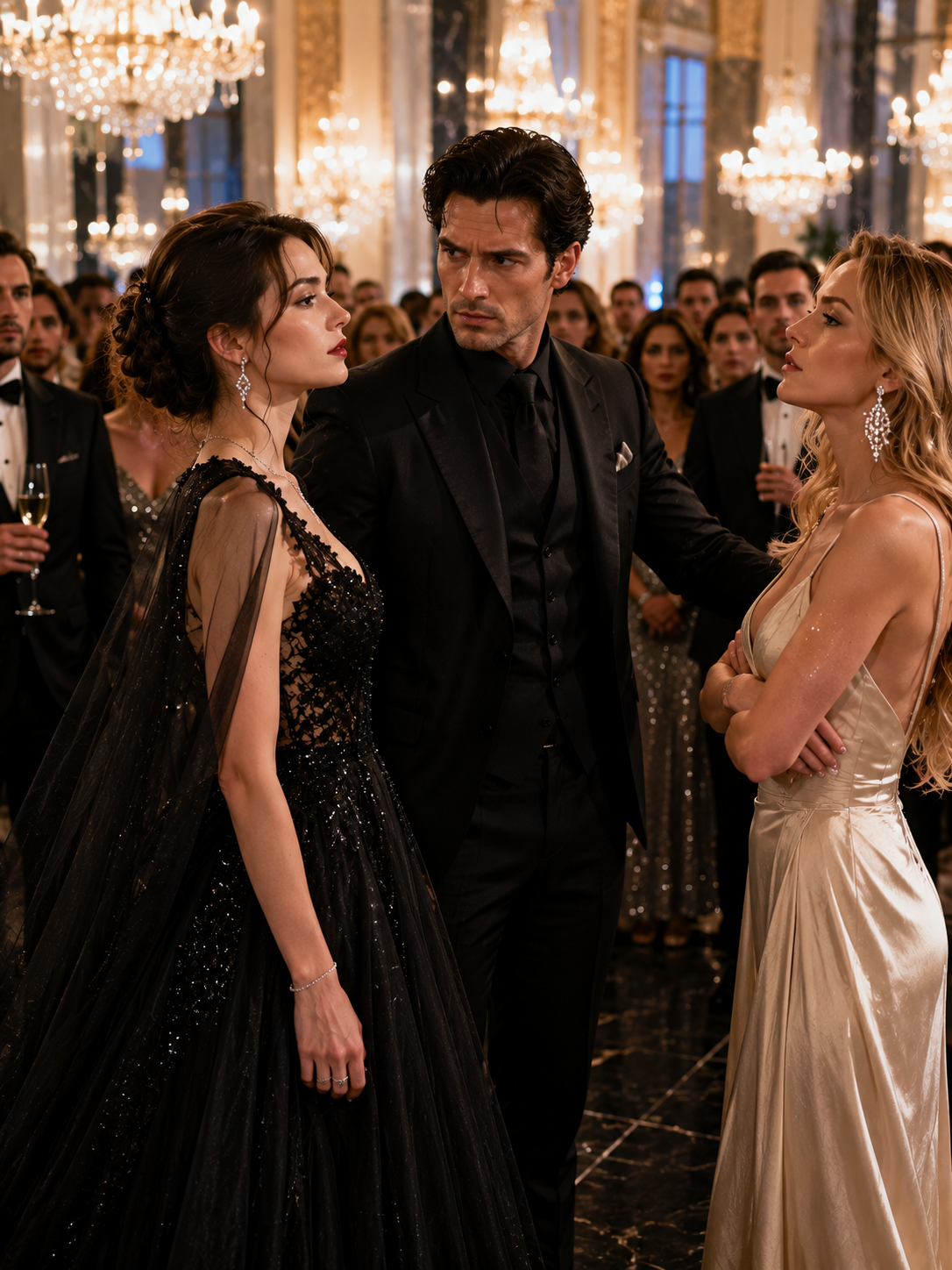
“Ladies and gentlemen,” Marcus’s voice rolled through the microphone, smooth as the Italian leather shoes she’d bought him last Christmas. “Tonight is about honesty. About living authentically.”
Adriana set her glass down with fingers that never trembled, though the emerald gown she wore — the one Marcus had chosen, claiming it matched her eyes — suddenly felt like a costume in someone else’s play.
“My wife, Adriana,” Marcus continued, gesturing toward her without quite looking at her, “has been an adequate partner. But adequate isn’t extraordinary, and I’ve built my life on refusing to settle for anything less.”
*Adequate.* The word landed like a slap. Her face stayed perfectly serene — seventeen years of her father’s training kicking in like muscle memory. Never let them see you bleed. She’d learned that at fourteen, the year her mother died and photographers swarmed their home like locusts.
“Adriana couldn’t give me an heir,” Marcus said, his voice carrying practiced sympathy that turned her stomach. “She’s been too focused on her charity work, too independent, too unwilling to prioritize our family’s future.”
*The miscarriage.* He was using the miscarriage — the child she’d lost at twelve weeks, mourned alone in a hospital room he’d been too busy to visit. Her nails found the crescent moons already worn into her palms, but her expression didn’t move.
Bianca stepped closer to Marcus, her red dress clinging to curves Adriana knew her husband had financed through “networking” sessions he swore were purely professional. The younger woman couldn’t have been older than twenty-six. Her diamond bracelet caught the light — the same one Adriana had once admired in a boutique window, the one Marcus had called too extravagant.
“Which is why,” Marcus said, chest puffing with misplaced pride, “I’m asking you all to witness Bianca as my second wife. Powerful men have always understood that legacy requires more than one partnership. I’m simply being honest about what I need to build my empire.”
The silence lasted exactly three seconds. Then the laughter started — small at first, a chuckle from the corner where the young tech founders had clustered, the ones with no patience left for old-money pretension. It spread fast, gaining teeth.
Adriana traced the source: Damian Osei, a venture capitalist she’d introduced to Marcus three years ago, holding up his phone, disgust written across his face. “That’s her,” he said, voice cutting through Marcus’s speech like a blade. “The woman from those escort listings that went around last month. Someone sent me screenshots as a joke. I thought it was fake.”
The ballroom erupted. Phones came out of pockets and purses like weapons drawn. Adriana watched Bianca’s face drain of color, watched Marcus’s confidence crumble into confusion, watched the whole carefully staged evening implode in real time.
“This is a coordinated attack,” Marcus sputtered, his voice losing all its authority, every tremor picked up by the microphone. “Someone’s trying to sabotage—”
“There are reviews, man,” a voice called from the investor section. “Dates, timestamps, hotel names.”
“Five-star ratings for discretion,” someone else added, dripping acid. “Really moving up in the world, Marcus.”
Adriana had known about Bianca for fourteen months. She’d watched Marcus turn from the man who once left her handwritten notes in Italian into a stranger who came home smelling like unfamiliar perfume and easy lies, who stopped noticing when she left the room and stopped noticing, eventually, when she came back into it. She’d waited, watched, documented every unexplained charge, every trip with no matching itinerary, every late meeting that left no trace in any calendar he thought she never checked. Her father had taught her patience. *Wait until your enemy commits fully. Let them build their own gallows before you hand them the rope.*
“Everyone, please,” Marcus tried, hand raised for a silence that wouldn’t come. “This is my anniversary. My moment of truth.”
“Your moment of humiliation,” a woman’s voice rang out — Vivian Cross, a pharmaceutical CEO who’d lost her own husband to a younger woman years back. “We’re watching you destroy your marriage for an escort. That’s not power, Marcus. That’s pathetic.”
The room’s mood curdled from shocked amusement into something uglier. Contempt. Marcus had miscalculated catastrophically — he’d assumed his success made him untouchable, forgetting that the city’s elite stayed elite by protecting appearances, and he’d just set his own on fire.
Her father’s business partner, Julian Cross, materialized at her side, voice pitched beneath the roar. “Your father’s had eyes on her for six months,” he murmured. “Halcyon Technologies planted her at that Singapore conference. They wanted Marcus’s facial recognition algorithm — eight hundred million in IP. She’s been photographed entering their headquarters seventeen times. Wire transfers through three shell companies. The whole operation.”
Adriana’s breathing steadied as the pieces clicked into place with brutal clarity. Marcus hadn’t just betrayed her for passion. He’d been played, used as a soft target by rivals who’d correctly identified his one weakness — vanity dressed up as ambition — and he’d chosen this exact stage, in front of six hundred people, for his own downfall.
She moved toward the exit, not toward him. The crowd parted before she reached it, recognizing a shift in power before they understood it. Six hundred people watched a woman walk away from her own execution with the grace of a queen abdicating by choice.
“Adriana, wait.” Marcus’s voice, real panic in it now. “This isn’t — we can discuss—”
She stopped. Turned. Let him see, for the first time in eight years, the daughter of Lorenzo Vaughn — a girl trained since birth to command rooms and dismantle enemies.
“I release you from our marriage, Marcus,” she said, and her voice carried to every corner of the suddenly silent ballroom. “Consider yourself free to pursue whatever extraordinary future you believe you deserve.”
She pulled off her wedding ring — three carats, proposed with on a beach in Positano back when his startup was worth nothing and his promises were everything, the metal having worn a permanent groove into her finger over eight years of wearing someone else’s promise — and placed it deliberately atop the champagne tower, platinum ringing against crystal.
“The ring stays,” she said, final and measured. “Just like your dignity. May they both dissolve as beautifully as your reputation.”
Her father’s security detail — four men in impeccable suits, always close and never visible — formed a corridor at the exit doors. Adriana walked through it into the night, spine straight, heart splintering into pieces she’d reassemble later, in private, where Marcus would never see.
Behind her, the ballroom exploded with sound — accusations, Bianca’s voice rising into a shriek, Marcus fighting to reclaim a room that no longer recognized his authority. The social equivalent of blood in the water, and the sharks already circling.
Adriana pulled out her phone and dialed a number she’d sworn she’d never call again — the number that meant surrender, the number that meant walking back into a world she’d left behind for love.
Her father answered on the first ring, as if he’d been waiting eight years for exactly this call.
“I’m coming home,” she said, voice steady as stone. “Activate the protocol, Papa.”
Ice clinked in a glass on the other end. A leather chair creaked. Then Lorenzo Vaughn’s voice came through, heavy with satisfaction and something like sorrow.
“Welcome back, daughter. Let me show you how empires bury their mistakes.”
PART 2
Marcus came home at dawn to an apartment that smelled like someone else’s perfume — except the unfamiliar scent wasn’t Bianca’s. It was absence. Every trace of Adriana was gone: her books, her reading glasses, the framed photo from their honeymoon in Florence, the yellow sticky notes she used to leave in Italian on the refrigerator. He’d dismissed them for years as clutter. Now he’d trade anything to find just one.
Her number was disconnected. Her email bounced. Her social media had vanished entirely. His assistant Garrett arrived at seven looking like he’d aged a decade, carrying a tablet like it held a bomb. “You need to sit down,” Garrett said. “Jennifer — Adriana — her maiden name is Vaughn. As in Lorenzo Vaughn. He controls forty percent of this city’s commercial real estate. This building. Your office tower. The warehouse where your servers live. All Vaughn Holdings.”
Marcus’s vision blurred. He’d married into an empire and never known it — she’d used her mother’s maiden name for a decade to see if he’d love her without it. The prenup he’d barely read protected his company, but every property gifted in her name — the vacation home, the art collection, the cars — belonged to her outright. She hadn’t been protecting her assets. She’d been protecting her heart.
His phone rang. Bianca’s face filled the screen, and for the first time her voice had lost its breathy performance. Beside her stood Preston Halcyon, Marcus’s biggest competitor, smiling like a shark. “Thanks for the algorithm,” Preston said. “Took eighteen months to extract it, but Bianca’s very good at her job.” Bianca laughed — nothing like the giggle she’d used when he bought her jewelry. “You really thought a woman like me fell for a man like you? You’re not that charming.”
The pieces assembled themselves with sickening precision — every question that had felt like genuine interest, every night she’d claimed to be checking email on his laptop. She’d been paid to destroy him from the inside, and the public humiliation had been the bonus round. “The algorithm alone was worth five million,” Preston said. “But destroying his marriage to Lorenzo Vaughn’s daughter — that’s priceless. Vaughn will crush him. We won’t have to.”
By morning, the story was everywhere: Vaughn Ventures had completed a hostile takeover of Halcyon Technologies for two point one billion dollars — every asset, every patent, every employee, including the woman who’d stolen Marcus’s code and the man who’d paid her to do it. Adriana hadn’t just walked away. She was systematically dismantling everyone who’d touched her, one foreclosure notice at a time — his lease, his financing, his office, all of it tangled in Vaughn-controlled companies, all of it called in within forty-eight hours.
Marcus stood in his emptying apartment as dawn broke fully over the skyline, understanding with total clarity that he hadn’t lost a wife. He’d lost a queen who had been playing peasant to make him feel like a king — and kingdoms, once abandoned, do not wait patiently for fools to wise up.
PART 3
By month two, Marcus had been voted out of his own company, his shares diluted to nothing in an emergency funding round that saved the business he’d built and erased his stake in it. Bianca vanished with the last two hundred dollars in his wallet, no note. He moved from a motel on the industrial edge of the city into a shelter bunk, then eventually a six-hundred-square-foot studio he could barely afford, in a building full of people who knew what real struggle looked like.
He found work with a construction crew rebuilding affordable housing downtown. The foreman, a man named Ray who’d done time in his twenties for a robbery he never talked about, didn’t care who Marcus used to be. “You show up, work hard, keep your mouth shut, you’ve got a place here,” Ray told him on the first morning, handing him a hard hat two sizes too big. “Everyone bleeds the same when they nail their thumb.”
A veteran on a waterfront bench had told him, in the first raw week, that the world doesn’t give back what you lost — you just figure out what to build with what’s left, one day at a time, sometimes one hour at a time, until the hours start adding up to something. Marcus took the advice literally. He started therapy with Dr. Alvarez at a sliding-scale clinic, paying twenty dollars a session, all he could afford. “You’re here because losing everything forced you to see yourself clearly,” she told him in their first session. “That’s not the same as wanting to change. That’s wanting to stop hurting.”
She was right, and the months that followed were an excavation — his arrogance, his entitlement, the small daily cruelties he’d never once registered as cruelties, the way he’d used Adriana for eight years without ever noticing he was doing it. He started volunteering three evenings a week at a soup kitchen run by a formidable woman named Rosa, who knew his whole humiliating story and responded to it with total bluntness. “You screwed up spectacular,” she told him once. “Now you live with it.”
During lunch breaks he started going to the library, where he found Adriana’s name on a donor plaque and spent an afternoon discovering the life she’d actually lived — Tuesday evenings at a women’s shelter reading to children, two hundred scholarships funded yearly in her mother’s name, free translation work for immigrant families navigating court systems, a graduate degree from Milan she’d never once mentioned. She’d built an empire of quiet generosity while he complained about her wasting time on “charity theater.”
“She was always more than you saw,” Dr. Alvarez said, when he told her. “People usually are. You just chose not to look.”
Around this time, Lorenzo Vaughn summoned him — a lawyer appeared at the construction site and Marcus was driven to Vaughn Holdings’ top floor, still in his work clothes, smelling of sawdust and sweat. Lorenzo didn’t offer him a seat right away. He slid a cashier’s check across the desk instead. A hundred thousand dollars. “Take it. Leave the city. Never contact my daughter again.”
Marcus left it untouched. “I’m not taking your money.”
“Don’t be stupid. This is more generosity than you deserve.”
“No. I’m not leaving because I’m not trying to manipulate her anymore. I’m staying because this is where I need to be — where I’m learning to be better.”
“Better for whom? She doesn’t want you.”
“I know. This isn’t for her. It’s for me.”
Lorenzo studied him the way he studied hostile takeovers, searching for the angle. Then, unexpectedly, he asked whether Marcus remembered what Adriana’s sticky notes used to say — the ones in Italian she’d left on the refrigerator for years.
“Some of them,” Marcus admitted.
“She stopped leaving them when she found the ones you’d thrown away without reading, crumpled in the trash. That’s when she knew you’d stopped seeing her.” Lorenzo’s voice didn’t soften. “You were cruel without even noticing you were cruel. That’s worse than being cruel on purpose.”
Marcus sat with that for a long moment before he answered. “You’re right. I was.”
“She’s marrying Wesley Ashford in two weeks. Harvard law, federal prosecutor, from a good family. He reads what’s put in front of him. Go home, Whitfield. Move on. She has.”
Marcus left the check on the desk and walked out, past forty-three floors of an empire he’d never once understood he’d married into, back to a job site where concrete needed pouring by morning. He didn’t chase the meeting with an apology. He simply went back to work, because work, lately, was the only thing that still made sense.
It was Rosa, weeks later, who finally said the thing that reorganized everything. He’d told her, over onions and coffee, that Adriana’s wedding to Wesley was eleven days off, and that some part of him had quietly hoped he’d have more time to become someone worth a second chance.
“Time’s not the issue, boy,” Rosa said, unimpressed. “You’re still thinking about deserving her. That’s your problem. You can’t earn people. You can only be worth choosing — and you can’t be worth choosing if you’re still performing worthiness for an audience of one.”
“I don’t understand.”
“You’re working construction. Volunteering here. Going to therapy. All of it, still aimed at her, at her father, at proving something. That’s not manipulation with a bad name. That’s manipulation with a humbler outfit on.” She refilled his coffee without asking. “Figure out who you want to be when nobody’s watching. When there’s no reward, no applause, no second chance on the table. That’s when it actually counts.”
He walked to the waterfront that night and sat on the same bench where the veteran had once found him, and for the first time in months he stopped thinking about Adriana entirely, and started thinking instead about the onions he’d chop tomorrow, the lumber he’d haul, the studio apartment nobody but him would ever see. If he only changed to win her back, Rosa was right — he hadn’t changed at all. For the first time, he wasn’t thinking about redemption. He was thinking about becoming someone he could actually respect in a mirror, whether or not Adriana was ever there to see it.
He’d written her letters for months, mailed some, kept the last one folded in his wallet instead — not begging, just acknowledging that she’d been enough, always, and he’d been the inadequate one. He never sent that one. He burned it in the studio’s kitchen sink the night after the fire at Harbor House. No more letters. No more hoping. Just the long, unglamorous work of becoming someone he could live with.
*
Eight months in, a fire broke out at Harbor House, the shelter where Marcus volunteered at the affiliated food bank. He was loading a delivery truck when the alarm went off and the director, Angela, went pale — a five-year-old named Theo was still in the second-floor playroom, and she’d gone back inside for her own phone instead of him. Marcus didn’t think. He soaked a jacket under the outdoor faucet and ran in before anyone could stop him, took the stairs three at a time through smoke that burned his lungs, kicked open the playroom door, found the boy frozen in a corner surrounded by scattered toys, wrapped him in the wet jacket, and carried him back down through flames already licking up through gaps in the floorboards, his palm searing on a hot railing he grabbed to keep from falling.
He made it outside as the first fire truck arrived. His hand blistered badly enough to need a paramedic. Theo’s mother, Sophia, sobbed with relief and, later, thanked him in rapid Spanish that Adriana — who’d arrived by then, and translated without being asked — said amounted to a promise to pray for him every day for the rest of her life. A reporter tried to get his name for the story; he pointed her toward the forty-three displaced families instead and gave nothing else.
That was when Adriana’s Tesla pulled up. She was on the shelter’s board — had been for six years, though he’d never once known it during their marriage — and she took command of the chaos with the same fluent authority he now understood she’d hidden from him the whole time they were together: emergency housing at the Grand Meridian’s extended stay wing, fast-tracked reconstruction funding approved on the spot from her mother’s foundation, a city inspector leaned on through a single fifteen-second phone call. Watching her work, stripped of pretense, commanding a crisis instead of hiding from one, Marcus thought she was the most impressive person he had ever seen, and understood exactly how much of her he had spent eight years failing to notice.
She saw him sitting on the ambulance bumper, hand bandaged, and something crossed her face — not forgiveness, but something she clearly hadn’t expected to feel, something closer to the way a person looks at a stranger who has just, without knowing it, answered a question they’d been carrying for years. “You went inside,” she said. “That was reckless.”
“It was necessary.”
“You volunteer here. Two afternoons a week.” She studied him, still keeping three careful feet of distance. “Angela mentioned someone who never gave his full name, never asked for recognition, just showed up and worked. I didn’t realize it was you.”
“Wasn’t trying to impress anyone. Needed to do something useful.”
“You’ve changed,” she said finally.
“I’m trying to. I heard about the money I turned down. My father-in-law — I mean, your father — told you, I assume.”
“He tells me everything he thinks will change my mind.” A ghost of the old dry humor crossed her face and vanished again. “It doesn’t usually work.”
She told him she was getting married in eleven days — to Wesley Ashford, a senator’s son her father had chosen, stable and safe and everything Marcus hadn’t been. He told her he hoped Wesley read her notes, actually listened when she played piano, saw her the way he himself never had until it was already far too late. She drove him, without quite asking permission, to her mother’s grave, and asked him, standing in the fading light beside a headstone she visited whenever she needed clarity, what he actually wanted.
“I can’t give you the grand gesture,” he told her. “It would just be manipulation with better packaging. All I can give you is the truth — I’ve spent eight months becoming someone better, but I did it aimed at you. Winning you back. Rosa called me on it, and she was right. Real change happens when there’s no audience. I’m not there yet. But I’m trying.”
She didn’t stop him when he walked to the bus stop that night. He didn’t look back.
*
Eleven days later, forty minutes before her wedding was supposed to start, Adriana stood in the bridal suite with an unfinished letter and a $30,000 dress she’d never wear down an aisle. Her father found her there. “The ceremony starts in thirty-seven minutes,” Lorenzo said carefully.
“I can’t marry him, Papa.”
“Explain.”
“I respect Harrison — Wesley. I admire him. I could probably build a decent, comfortable life with him. But I don’t love him the way a wife should love her husband, and he deserves someone who does.” She met her father’s eyes. “You married Mama despite every business complication, every family objection. You chose love. I chose it once, with Marcus, and it nearly destroyed me. But choosing safety with Wesley would destroy me differently, just more slowly.”
“He hasn’t fought for you. Refused my money. Walked away completely. What future are you imagining?”
“None. I’m not choosing Marcus, Papa. I’m choosing not to marry Wesley. Those are different things.”
Lorenzo studied her the way he studied merger contracts, hunting for hidden weaknesses, and found none. “Your mother would be proud of this decision,” he said finally, quietly, the businessman in him briefly giving way to something more fragile. “I’m terrified by it.”
“Why?”
“Because you’re strong enough to walk away from security. That kind of strength either builds empires or burns them down. I don’t yet know which one you’re choosing.”
She told Wesley herself. He took it with more grace than Marcus would have managed. “It’s him, isn’t it,” he said, without real anger in it.
“It’s me. I’m not ready — maybe not for you, maybe not for anyone, but definitely not today.” She took his hand gently. “You deserve someone whose heart races the second you walk into a room. Someone who chooses you wildly, not wisely. I’m sorry I couldn’t be her.”
“Do you love him still?”
She considered the question honestly, the way she considered everything. “I love who he’s becoming. I love that he ran into a burning building for a child with no cameras there to see it. I love that he turned down my father’s money. But loving someone isn’t the same as choosing them. Sometimes it means letting them keep growing without you.”
*
She found him the next day at Harbor House’s rebuilt entrance, directing the finishing touches on the landscaping, his bandaged hands still functional, more tired and more solid than she’d ever seen him. She told him the wedding was off.
“Because Wesley deserved someone who loved him wildly. I only respected him safely.” She climbed out of the car. “Now I’m going to figure out who I am when I stop testing men to see if they’ll love me without my name.”
“You’re not going to fight for me?” he asked, when she made it clear she wasn’t there to reconcile.
“No,” he answered honestly. “Fighting for you would still be about me — my redemption, my need to prove I’ve changed. You deserve someone who chooses you without needing anything back.”
It was the most honest either of them had ever been with the other, and it hurt exactly as much as it should have.
*
Six months after that, she saw him in the audience at a leadership conference where she was keynoting — not front row, just a man in the middle section taking notes on actual paper, the way someone takes notes when they genuinely care about the content rather than being seen caring. She stumbled slightly over a sentence in her speech, recovered, and finished to a standing ovation. He didn’t approach her right away. She found him near the exit, talking with other attendees about the session’s ideas.
“You came,” she said.
“Your talk was important. Wanted to hear it properly, not on a stream.”
“You could have watched from home.”
“Some things deserve showing up for.”
He told her about the small company he’d started — security software for domestic violence shelters, free for nonprofits, launched the month before, built in the evenings after construction shifts using skills he’d taught himself from library books because no coding bootcamp would touch his name anymore. “It’s small. Probably always will be. But it matters.” She told him it was beautiful work. “It’s honest work,” he corrected gently. “Turns out I’m better at honest than I ever was at impressive.”
“How’s therapy?”
“Hard. Good. Ongoing. Dr. Alvarez says I’ve graduated from self-hatred to self-improvement. Progress, apparently.”
She laughed — real laughter, the kind that felt like sunlight after a long stretch of rain. “Coffee?” she asked, before she could stop herself.
“I don’t think that’s wise.”
“Why not?”
“Because I still love you. Because coffee would be me hoping for more, and you deserve someone who shows up without hoping for anything back.”
“What if I want more?”
He smiled then — the smile from the Vespa, from the Tuscan village, from before everything broke. “Then ask me again in six months. If we’re supposed to rebuild what we destroyed, it won’t disappear just because we waited.”
He left. She stood watching him go, feeling simultaneously devastated and, for the first time in a long while, genuinely hopeful.
Six months later, almost to the day, she asked him to coffee. He said yes. They talked for four hours about everything except their shared past, and when they parted, neither asked for the other’s number, and neither needed to. Three months after that, they ran into each other again at a Harbor House fundraiser, danced once, laughed twice, and said goodbye without a single promise attached.
Two years after the fire, Marcus flew to the same small Tuscan village where they’d once fixed a dead Vespa together and fallen in love without last names, and asked her to marry him with no ring and no plan, only the truth, standing in the same church courtyard where a stranger had once kissed her at sunset and called it summer. “I love you without needing you,” he told her. “I choose you without requiring you. Not as redemption. Not as a second chance I’ve earned. Just because we’re finally both people worth choosing, and I’d like to spend the rest of my life proving that wasn’t a fluke.”
She said yes before he’d finished the sentence.
They married with thirty guests — her father, Ray and the whole construction crew in borrowed suits that fit them badly and happily, Rosa in her best church dress, Angela and a handful of Harbor House residents including Sophia and a much taller Theo, Dr. Alvarez sitting quietly near the back. Lorenzo walked his daughter down the aisle wearing her late mother’s favorite smile, the one Adriana had only ever seen in old photographs until that morning. The rings were plain gold, no diamonds, nothing that could be mistaken for a trophy. Their vows were short, almost embarrassingly so, after everything it had taken to get there.
*I see you clearly. I choose you freely. I love you honestly.*
When they kissed, it didn’t taste like a fairy tale rescued at the last minute. It tasted like two people who had once destroyed each other completely, and had spent years afterward — separately, honestly, without an audience — learning how to build something worth keeping the second time around.
“Took them long enough,” Ray murmured to Rosa in the front row, not quietly enough.
“Good things take patience,” she said, not bothering to lower her own voice either. “Great things take transformation.”
Later, at the small reception in the same trattoria where a nineteen-year-old Adriana had once eaten pasta with a stranger and called herself Jennifer for the last time, Marcus found her by the window watching the vineyards go dark. He didn’t say anything at first. He just took her hand.
“What are you thinking?” she asked.
“That I spent eight years building an empire I thought I needed, and it took losing all of it to learn the only thing that ever actually mattered was this. You. No performance. No audience. Just us.”
And somewhere in that small stone village, an empire that had once nearly broken two people quietly, finally, became something much smaller and much more valuable than anything either of their families had ever built: a home neither of them had to hide inside, and neither of them ever wanted to leave.
THE END