The Tarot Reader Predicted the Mafia Boss’s Next Love… But His Smile Changed Her Destiny Forever
PART 1
I shuffled my sister’s deck one last time before wrapping it in its silk cloth, the October rain drumming steady against the canvas awning over my booth.
The Portland River Market always ran late on Fridays, but by half past ten most of the crowd had scattered toward bars and warm apartments, leaving me to pack up alone. The vendor stalls around me had already gone dark, and the only sounds left were distant traffic and rain hammering canvas. I folded the velvet table cloth carefully, running my fingers over the embroidered moons and stars Sage had stitched three years ago, back when she still teased me for believing in anything at all.
The cards had been hers first — a gift from our grandmother before she passed. Now they were mine. My inheritance, my burden, the only thread I still had connecting me to a twin I’d never stopped missing, three years on and still not used to the silence where her laugh used to be.
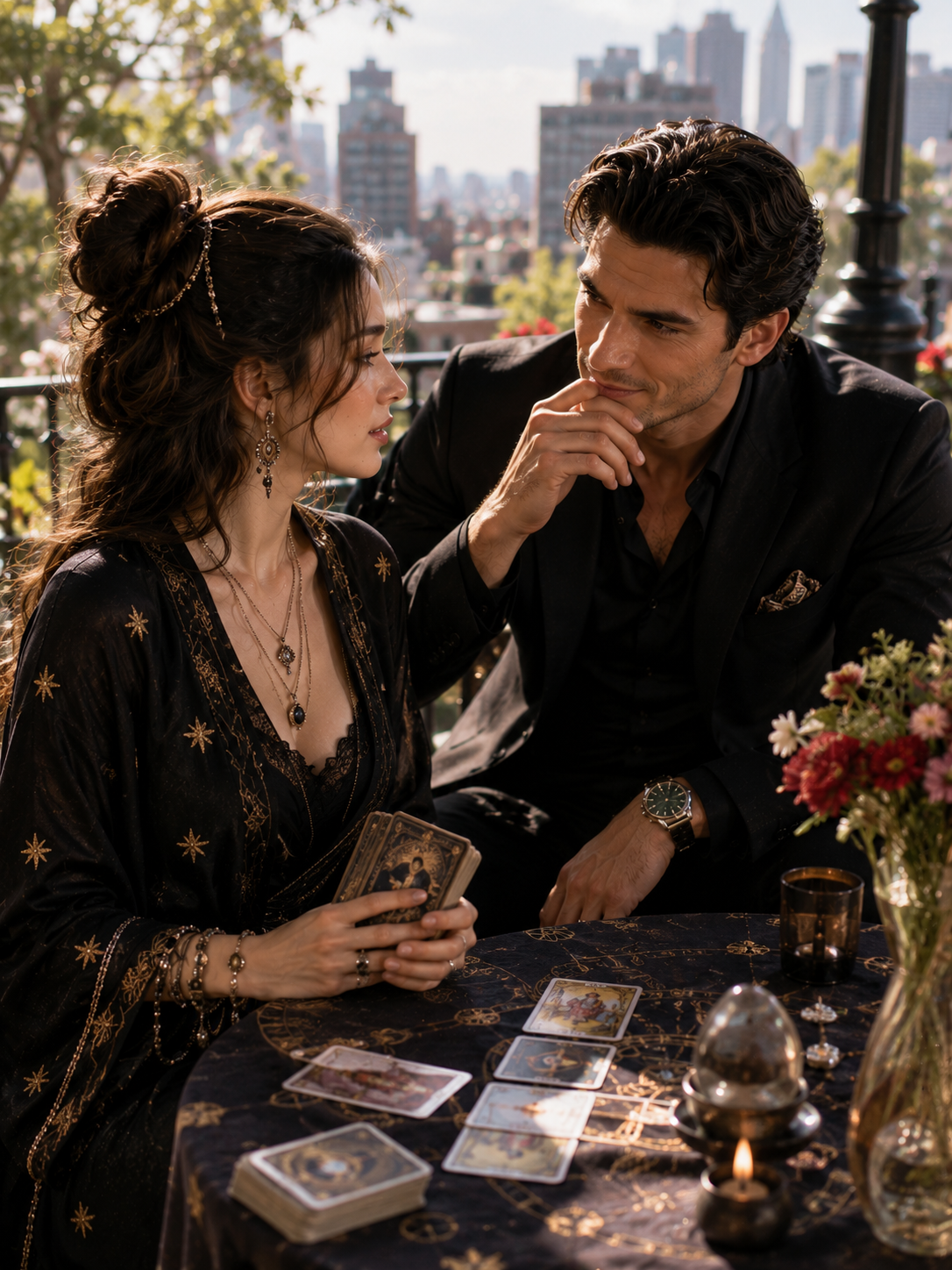
“Excuse me. Are you still reading tonight?”
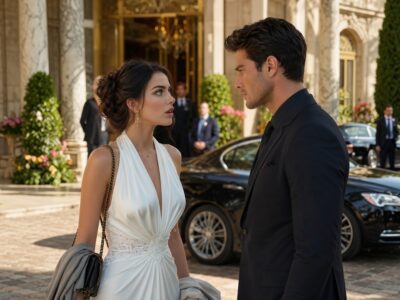
The voice cut through the rain like something deliberate, deep and faintly accented. I looked up from my bag. A man stood at the edge of my booth, water dripping from the shoulders of a charcoal suit that had never seen a department store rack. Tall, maybe six foot three, dark hair slicked back from a face built from sharp angles and shadow. His eyes caught the last string light still glowing overhead — dark brown, nearly black, with an intensity that made me want to step backward without quite knowing why.
“I’m closed,” I said, keeping my voice steady. Twenty-six years old, and certain kinds of men still made something in me go quiet and careful. “There’s another reader Saturdays. I can give you a card for an appointment next week.”
“I don’t have until next week.” He stepped under the tarp, out of the rain. Up close I catalogued the details my instincts insisted on collecting — a thin scar near his ear, hands that looked built for either breaking things or building them. “I need a reading tonight. I’ll pay double your rate.”
Something in his tone wasn’t quite a request I should refuse — not from fear exactly, but from that quieter instinct that whispers when something important is about to happen.
“A hundred dollars,” I heard myself say. My rate was fifty for half an hour.
He pulled out a money clip without hesitating and counted five crisp bills onto my damp table, fresh enough to have come straight from an ATM. “That’s five hundred,” I said, not touching it.
“I know.” His gaze didn’t leave mine. “For your time. And your discretion.”
I should have told him to leave, packed my cards, and gone home to my cramped apartment with its temperamental heater and the upstairs neighbor’s heavy metal. Instead I unfolded my cloth again. “Sit.”
He took the folding chair across from me, moving with a grace that didn’t match his size. I unwrapped Sage’s cards, feeling their familiar weight settle into my palms — three years of readings, and they still smelled faintly of her lavender and vanilla perfume, memory tangled up with grief.
“What’s your question?” I asked, beginning to shuffle.
“I don’t have one.” He leaned back, entirely at ease despite the rain now drumming harder against the tarp. “I want to know what you see.”
That wasn’t how tarot was supposed to work, but I’d learned not to argue with clients who paid this well. I shuffled until the deck felt ready and laid a Celtic cross across the velvet — the spread Sage had taught me on our sixteenth birthday, back when we practiced on each other and laughed at every dramatic prediction.
The Lovers, present situation. The Tower, reversed, recent past. The Ten of Swords, what lies beneath. My hands slowed as I turned the fourth card. Death — not literal, but heavy all the same, surrounded by these particular neighbors. The Seven of Cups, possible future. The Two of Cups, near future. The Devil, how he sees himself. Justice, how others see him. The Moon, hopes and fears.
I paused before the final card, fingers hovering. The outcome — the one that would tie everything together or blow it all apart.
“Go ahead,” he said softly. “I can handle it.”
I flipped it. The Ace of Cups.
For a long moment I just stared at the spread. Then I looked up at this stranger with his expensive suit and dangerous stillness, and something tightened in my chest.
“You’re in the middle of a war,” I said slowly, reading what the cards showed me. “The Tower in your past means something you built came crashing down violently. You’re still dealing with the betrayal that caused it.” I gestured to the Ten of Swords. “Someone close to you. Maybe more than one.” He didn’t confirm or deny it, just watched with that unnerving stillness. “Death here doesn’t mean you’re going to die. It means transformation, an ending that leads to a beginning. But the Devil suggests you’re caught in a cycle of power and control — you think you’re in charge, but something has its claws in you.” I touched the Two of Cups, then the Lovers. “And the rest points to love. Soon, maybe already happening without you fully realizing it. A connection. A partnership. The Ace of Cups as your outcome confirms it — something pure showing up in the middle of all this darkness.”
The rain thickened, drowning out the city. We sat in a small bubble of lamplight and storm, and I realized my heart was racing.
“You’re going to fall in love,” I said, meeting those dark eyes. “Soon. Maybe tonight.”
He was quiet a long moment. Then his mouth curved into something that wasn’t quite a smile but held far too much certainty to be anything else.
“I know,” he said, and the way he said it sent something cold down my spine — not a threat, just conviction, like a man who’d already seen this future and made his peace with it.
“The Moon,” I pressed on, needing to finish and get away from him, “shows your fear. You’re afraid of illusion, of not seeing clearly, of being deceived again. And Justice means the world sees you as someone who demands balance — an eye for an eye. You have power, but you use it by your own code.”
“Very perceptive.” He stood, buttoning his jacket with one hand. “Your name?”
“Nora.” I didn’t know why I answered. “Nora Blake.”
“Nora Blake.” He repeated it like he was committing it to memory. “I’m Dante.” Just a first name, no last one offered. I should have pressed. Something told me I didn’t want to know more than he was willing to give.
He reached out, and I flinched before realizing he was only offering his hand. I took it, and the moment our palms touched, an electric current I’d been fighting the whole reading crashed through me like lightning. His skin was warm, slightly rough. For three heartbeats we just stood there, hands clasped, rain falling around us.
“Thank you, Nora Blake,” he said. “I’ll remember this.”
Then he released my hand and stepped back into the rain, walking toward two black SUVs idling with their lights off at the edge of the lot. He climbed into the back of one and both vehicles pulled away smoothly, like sharks gliding through dark water.
I stood alone under my tarp, hand still tingling, and looked down at the spread across my table. Danger. Love. Transformation. Choice.
I gathered the cards quickly, wrapped them in their silk cloth, and tucked them into my bag alongside the five hundred dollars, my hands shaking slightly as I collapsed my table. Something had changed. I could feel it in my bones — that shift meaning life was about to get complicated. I just didn’t know how complicated until Monday morning, when everything I thought I understood about safety and danger would come apart like glass.
PART 2
By Monday I’d nearly convinced myself to forget the man with the dark eyes.
Almost.
I was at my usual corner table in the Hollow Bean Café, three blocks from my apartment, laptop open, pretending to update my website while actually scrolling apartment listings I couldn’t afford. The café was one of those neutral spaces where everyone coexisted peacefully — students cramming, artists sketching, the owner Patricia keeping a strict no-loud-calls policy that made the place feel safe.
The bell chimed at quarter past eleven. Four men walked in, and every instinct I’d built over years of reading people went on high alert. They moved with purpose, scanning the room before settling near the window — business casual that somehow looked more dangerous than protective. One was older, silver threading his dark hair. The others were younger, built like gym regulars.
Then Dante walked in behind them, and my breath caught.
I ducked behind my laptop, cursing my choice of table with its direct line of sight to where they sat. He didn’t seem to notice me, or didn’t acknowledge it if he did. I should have left right then, closed my laptop and walked out before whatever was coming could unfold. Instead I sat frozen, watching them order espressos and bend their heads together over a map spread across the table. The silver-haired man did most of the talking. Dante listened, his expression unreadable. One of the younger men kept checking his phone with a nervous, twitchy energy that didn’t match the others’ calm.
I caught fragments through the café noise — territory, expansion, a street name I recognized from the industrial district, names spoken with a weight that suggested they mattered to people I’d never met.
Then the nervous one stood abruptly, muttered something about a call, and headed toward the bathroom. Dante watched him go, and for just a moment suspicion flickered across his face.
That was when I heard the tires screech outside. Car doors slamming. Then the front window exploded inward — glass everywhere, screaming, the world going to cotton and chaos under the crack of gunfire.
I hit the floor without thinking, my laptop clattering off the table. Someone nearby was crying. Patricia was shouting for everyone to get down. Through the haze I saw Dante on his feet, the table overturned, his men forming a barrier with practiced precision. More gunshots. Wood splintering. The espresso machine erupted in steam and metal.
Then his eyes found mine across the wreckage, and he crossed the room in three strides and dropped beside me just as another volley tore through what remained of the window. His body covered mine, one arm around my shoulders, the other braced against the floor.
“Don’t move,” he said against my ear, voice steady despite the hell breaking loose around us.
PART 3
I felt the impact of something hitting my right arm — sharp, burning. When I looked down, blood was already spreading dark across my cream sweater, a long shard of glass protruding just below my elbow.
The gunfire stopped as suddenly as it had started. Engines roared away outside. Sirens rose in the distance, growing closer.
Dante pulled back, assessing the wound with a clinical eye that suggested he’d seen far worse. “You’re hit.”
“I’m fine,” I said, my voice betraying the lie entirely.
A silver-haired man appeared at his side, speaking rapid Italian. Dante answered in kind, then switched to English. “Enzo — the car, now. Bring her with us.”
“Wait — what?” I tried to pull away, and the movement sent fire shooting up my arm. “I’m not going anywhere with you. I need an ambulance. The police are coming.”
“The police can’t help you.” His eyes locked onto mine, and I saw something there that frightened me more than the bullets had. “You saw their faces. How many were there?”
My mind replayed those awful seconds — three men, matching jackets, one with a tattoo on his neck I hadn’t recognized.
“Three,” I whispered.
“Three witnesses they’ll need to eliminate.” He pulled me to my feet. “Enzo — the car. I’ll handle the rest.”
The mansion sat ninety minutes northeast of Portland, deep in the Cascade foothills, glass and stone rising out of pine like something dreamed rather than built. I’d spent the drive pressed against the leather seat, watching trees blur past while Enzo made calls in Italian and Dante kept one hand on my uninjured shoulder, anchoring me to consciousness through the shock settling in.
Dr. Reyes arrived within twenty minutes of our reaching the house, a steady-handed woman in her fifties who looked like she’d seen far worse than a glass shard in someone’s arm. Twelve stitches, she announced, extracting the glass with efficient movements. Lucky — deeper and there’d have been nerve damage. Dante stayed near the window through the whole procedure, close enough to watch, far enough to give her room to work. His presence was oddly steadying, a solid point in a world that had gone entirely sideways.
Enzo appeared in the doorway once Dr. Reyes had gone, silver hair disheveled from the chaos at the café. “Your friend is secure,” he told me. “Two of our men are stationed outside her shop. She’s been informed and advised to stay inside for the next forty-eight hours.”
Relief flooded through me. “Thank you. She’s all I have left. Her and the cards.”
He held up my leather bag, retrieved before the police had sealed off the café. “Everything’s intact.”
I took it with my good hand, clutching it to my chest. The weight of Sage’s cards inside felt like an anchor to whatever sanity I had left.
“I need you to understand what happened today,” Dante said once Enzo had gone, settling into the chair across from the bed, elbows on his knees. “The organization that hit us is called the Kestrel Syndicate. They’re expanding aggressively into Portland, trying to take territory my family has controlled for sixty years. They don’t care about rules, about civilians, about anything except power and profit. And you saw their faces.”
The medication was starting to blur the edges of everything. “So now they want me dead.”
“Yes.” No sugarcoating it. I appreciated that more than false comfort would have deserved. “You can’t go home. Not until we resolve this, which might take several days.”
The practical concerns crashed down all at once. “My rent is due Friday. I’m already short. My booth at the market — if I’m not there this weekend, I lose my spot. They have a waiting list.”
“I’ll handle it.” His tone brooked no argument. “Your rent will be paid. You’ll be compensated for the work you miss. Not as charity,” he added, seeing my expression. “As restitution. You helped me Friday night. This is my responsibility.”
Sleep wouldn’t come despite the medication. At midnight I gave up, pulled on a robe from the closet, and wandered the quiet mansion until I found the library on the second floor — three walls of real, well-read books, a fireplace glowing low, and Dante in an armchair by the windows, having traded his suit for jeans and a black sweater that somehow made him look more dangerous, not less.
“Can’t sleep either,” I said.
“Sleep is a luxury I rarely afford.” He gestured to the chair beside him. “How’s your arm?”
“Hurts. But I’ve had worse.”
“Have you?”
Maybe it was the medication, or the shock, or the simple fact that I’d nearly died that day and nothing seemed to matter the way it used to. Whatever the reason, I found myself answering honestly. I told him about Sage — the drunk driver on the interstate, the collarbone I’d broken, the forty-two stitches that had been nothing compared to losing her. I told him the cards had been hers first, that I’d taught myself to read them after she was gone because I couldn’t let that last piece of her disappear.
“Perhaps she’s still guiding you,” he said, no mockery in it at all. “I’ve seen too much of the world to dismiss anything as impossible.”
“What about you? Enzo called you boss at the café. And all this—” I gestured at the library. “This isn’t ordinary wealth.”
He told me about his grandfather arriving from Naples with nothing but a suitcase and stubborn pride, about an empire built on connections and favor and refusing to bend. About his mother, dead of cancer when he was twelve, and a father who threw himself into the business afterward and never quite recovered. About inheriting two hundred families’ worth of livelihoods and protection at twenty-eight, when his father’s heart finally gave out.
“That’s a heavy weight for someone that young.”
“Thirty-four isn’t that young.” A ghost of humor crossed his face. “But yes. Heavy. Every decision I make touches hundreds of lives. Every mistake costs someone their safety. Or worse.”
We sat in companionable silence, watching embers glow, and I told him what the cards had shown me Friday night — love, transformation, a choice that would change everything. “I thought I was reading for you. Maybe I was reading for both of us.”
“I knew,” he said quietly. “The moment you looked up from those cards and told me I’d fall in love soon. I didn’t want to. Didn’t plan to. But knowing doesn’t stop it from happening.”
“This is insane,” I whispered. Three days. I’d known this man three days.
“Yes,” he agreed. “That doesn’t make it less true.”
The following morning, a new spread warned me of betrayal from within — the Seven of Swords, fallen beside the Lovers. I sat with it on the terrace, turning it over in my mind, before Dante found me there.
“There’s a traitor,” I told him. “Someone close to you. The Seven of Swords falling with the Lovers means deception happening because of a connection.” I thought about the café, the nervous man checking his phone. “The one who left right before the attack. What do you know about him?”
“Marco Vitale,” Dante said, jaw tightening. “Been with the family three years. His father worked for mine.” He was quiet a moment. “If he sold us out, if he’s responsible for what happened to you—”
“What will you do to him?”
“What needs to be done.” His tone left no room for softening. “Exile at minimum. Death if he cost us lives. I won’t pretend this world has room for mercy when someone betrays the people depending on them for safety.”
That night a warehouse in the industrial district burned, deliberately set. Dante went to handle it personally, against my protest that it might be exactly the trap the cards were warning against — a fire built to draw him out into the open. He left anyway, security orders to keep me at the mansion trailing behind him like an afterthought I had no intention of honoring.
I found a young guard patrolling the terrace and told him plainly I needed to get to that warehouse. He blinked at me like I’d asked him to fly, cited explicit orders, then — after I made clear I’d find my own way there with or without him — arranged a controlled escort instead of a flat refusal.
The warehouse district looked exactly like what it was, industrial buildings hunched under a smoke-stained sky, fire trucks painting everything red and white. I found Enzo near a black SUV, his expression sliding from surprise to resignation the moment he saw me.
“He’s going to be very unhappy you’re here,” Enzo said.
“He’ll get over it. Where is he?”
“Inside. The fire was deliberate, but whoever set it is long gone.”
“Or still inside,” I said quietly. Something in my tone made him look at me harder. “The cards warned me. Betrayal from within. It’s Marco Vitale, isn’t it? You’ve been investigating him.”
His silence was confirmation enough. I followed him in before he could stop me, my reluctant guards trailing like shadows.
Inside, smoke hung thick between shipping containers. We found them deeper in — Dante and three of his men surrounding Marco, who was backed against a container with nowhere left to run, blood at his nose, shirt torn, terrified but alive.
“I didn’t have a choice,” Marco was saying, words tumbling over each other. “They had photos of my sister. They knew where she worked. Said they’d hurt her if I didn’t cooperate.”
“So you sold out your own people,” Dante said, voice like ice. “Three of our associates are dead because of you. And Nora—” He stopped, seeing me. “You’re supposed to be at the house.”
“The cards said you’d need someone here,” I said, stepping forward despite Enzo’s attempt to stop me. “They were right, weren’t they?”
Dante’s jaw tightened, but he turned back to Marco instead of arguing with me. “Finish it. Your sister. The Syndicate.”
“Six weeks ago they approached me. Showed me pictures of Elena leaving her apartment, her office, the gym. Said it would be easy — just tell them my schedule, small things. I thought I could control it. Thought I could protect her. But they kept asking for more.”
“And tonight?” Enzo asked.
“They told me to disable the alarms. Make sure the building would be empty.” Marco looked directly at Dante. “I swear I didn’t know they’d try to trap you inside. When I realized what they were planning I tried to warn you, but my phone was already confiscated.”
“Your sister,” I said suddenly. “Elena. Where is she now?”
“Home, I think. They said if I cooperated tonight, they’d leave her alone.”
“Enzo,” Dante said without looking away from Marco. “Send men to Elena Vitale’s address. Protective detail, round the clock, until this resolves.”
Relief flooded Marco’s face, followed immediately by confusion. “I don’t understand. You called me a traitor.”
“You are one,” Dante said flatly. “But you’re a coward who loves his sister. I can work with that.” He stepped closer. “You’ll give Enzo every detail about your contact with the Syndicate. Then you’ll deliver a message for me — that this family doesn’t negotiate with people who threaten civilians. They brought Nora into this. That changes the rules entirely. After that, you and Elena leave Portland tonight. Enzo will set you up somewhere safe with enough to start over. But you’re done with this family. If I ever see you again, there won’t be a second chance.”
Marco nodded rapidly, something like hope flickering through the fear. Enzo pulled him away to arrange the details, and the warehouse emptied around us until it was just Dante and me and the smoke.
“You shouldn’t have come,” he said finally.
“You needed someone here who’d remind you that mercy is possible.”
“My father would have killed him.”
“Maybe mercy is what keeps you from becoming exactly like the people you’re fighting against.”
He studied me in the dim, smoke-hazed light. “You see things in me I’m not sure actually exist.”
“I see who you’re trying to be,” I said, touching his chest, feeling his heartbeat under my palm. “That’s more real than who you were born to be.”
The kiss that followed felt inevitable, like something gravity had been arranging since a rain-soaked market stall the week before.
The retaliation came fast. The Syndicate hit two safe houses overnight, then ambushed the car carrying me and Enzo on a supply run to check on Nadia. Enzo took the bullets meant for me, and years of first-aid training I’d earned the hard way after Sage’s accident kept him alive long enough to reach Dr. Reyes. Dante arrived hours later with cracked ribs from a separate confrontation with the Syndicate’s second-in-command, who’d delivered an ultimatum — hand over the industrial district, or Dante would be executed publicly as a show of force.
“There has to be another way,” I said, wrapping his ribs.
There was. A new reading pointed toward the Hierophant — mediation through respected, neutral authority. I remembered a name Enzo had mentioned once in passing: the Ferris family, Irish, neutral, controlling the docks both organizations depended on.
Dante’s council was skeptical at first. Ten men gathered around a table at six that morning, most of them looking like they hadn’t slept in days. “Since when do we care about moral authority?” one older man asked bluntly.
“Since we became the family that protects its people instead of just profiting from them,” Dante answered. “My father taught me power without honor is tyranny. I won’t become what we’re fighting against.”
Someone else pointed out that this whole plan had come from a tarot reader. “Why should we trust cards to guide strategy?”
“Because those cards predicted everything that’s happened so far,” I said before Dante could answer for me. “They showed betrayal, and we found Marco. They showed violence escalating, and three safe houses burned. They showed a path through alliance and mediation. That’s what I’m suggesting now. You don’t have to believe in tarot to recognize a pattern when you see one.”
The man studied me a long moment, then surprisingly smiled. “Fair point. If the cards have been right about everything else, might as well listen this time too.”
The vote went through unanimously. Declan Ferris agreed to mediate, and the following Saturday we stood in a neutral warehouse on the waterfront — Dante and Enzo on one side, arm still in its sling, healing but present, deliberate proof the Syndicate’s bullets hadn’t broken anything that mattered. The Syndicate’s own delegation assembled across the floor, eight men in sharp suits led by their strategist Deng Wei, gray threading his hair, eyes that missed nothing. Between us sat Declan and his second, Rory, at a folding table that looked almost comically plain given what was riding on it.
“Gentlemen,” Declan began, his accent thick despite decades in America, “and lady,” with a nod toward me that carried genuine surprise. “We’re here because this war is costing everyone money and bringing unwanted attention to operations that thrive on discretion. The docks can’t function when bodies keep turning up in shipping containers.”
“The Marchesi family holds territory that should be available to all organizations,” Deng Wei said, precise and unhurried. “Their monopoly prevents fair competition.”
“Fair competition,” Dante repeated, level. “Is that what you call attacking civilians and attempting assassination in a public café?”
“We would not have needed such measures if negotiation had been possible,” Deng Wei countered. “Your proposals amounted to us receiving nothing in return for sixty years of your operations.”
“That’s not negotiation,” Enzo said. “That’s extortion.”
Declan raised a hand. “We’re not here to debate history. We’re here to find a solution. Both organizations use my family’s shipping routes. Both benefit from stable docks. This war threatens that.” He looked to Dante. “What are you willing to compromise on?”
Dante’s posture gave nothing away — the leader his father had trained him to be, controlled and strategic. “The industrial district remains ours. Non-negotiable. But we’re willing to discuss shared access to shipping and distribution under proper supervision.”
“Ours,” Rory said, speaking for the first time. “Both families keep their current territories, but shipping routes and distribution channels become shared resources we manage — schedules, conflict prevention, no monopolizing access. You pay a facilitation fee. Everyone profits. Everyone stays in their lane.”
Calculations passed silently around the room. Deng Wei conferred quietly with his lieutenants before naming his price. “Fifteen percent of shipping revenue,” Declan answered instead, “split between both families, with five percent to us for administration and enforcement.”
“That’s robbery,” one of the Syndicate lieutenants objected.
“That’s peace,” Declan said coldly. “And cheaper than war. Count the cost of your burned warehouses, your lost product, your dead men. Then tell me fifteen percent isn’t a bargain.”
More tense conferring. I held my breath, fingers wrapped around Sage’s cards in my pocket. The reading that morning had shown the Three of Cups — alliance, celebration — but cards showed possibilities, never certainties. Free will could still derail everything.
“We accept,” Deng Wei said finally. “With one condition. Any violation by either family results in immediate loss of access. No warnings.”
“Agreed,” Dante said. “And the attacks stop immediately. Any retaliation against my people voids the entire arrangement, and the Ferris family sides against you.”
“Acceptable,” Declan said. “War is bad for everyone’s business. But understand — the moment this arrangement becomes more trouble than it’s worth, we withdraw entirely, and you can tear each other apart without neutral ground to stand on.”
The meeting ran another hour through the details — schedules, territories, dispute procedures. I watched the whole impossible negotiation and understood, finally, that peace in this world was never born from righteousness. It was born from the plain arithmetic of what a war actually cost.
“Your cards predicted alliance,” Dante said as we walked out into pale autumn sunlight.
“The cards showed a possibility,” I corrected him. “You chose to take it.”
The days after brought a strange, careful quiet. The Syndicate’s attacks stopped. Nadia’s protection detail thinned to almost nothing. Enzo’s shoulder healed under Dr. Reyes’s care. I moved back into my apartment, which Dante had apparently kept cleaned and guarded the entire time without asking my permission — a presumption I was too exhausted to be properly angry about.
Nadia came over with wine and every question I still couldn’t fully answer. “You’re in love with him,” she said. Not a question.
“Yes.”
“And when he has to do something you can’t understand or forgive?”
I thought about Marco Vitale, spared instead of buried. About a negotiation chosen over a war everyone else expected. “Then I’ll face that when it comes,” I said. “But I won’t judge him by hypothetical darkness. Only by the choices he actually makes.”
One week to the night after that first rain-soaked reading, I reopened my booth at the River Market. The owner had held my spot, some anonymous donation smoothing the way. I set up my table, unwrapped Sage’s cards, and waited under October’s cooling sky.
He appeared at half past ten exactly, dressed down in jeans and a leather jacket, looking almost like a man who belonged in an ordinary life.
“Are you reading tonight?” he asked, that familiar dry humor in his voice.
“For the right client.” I gestured to the chair. “What’s your question?”
“I don’t have one. I want to know what you see.”
I shuffled, feeling the deck hum with something warmer than it had that first night, and laid the same Celtic cross. The Lovers, still in the present. The Two of Cups, still in the near future. The Ace of Cups, still the outcome — but new cards had joined them now. The Ten of Cups. The Four of Wands. Celebration. A stable foundation. The kind of future I hadn’t dared imagine a week earlier.
“Well?” he asked, watching my face instead of the cards.
“I see happiness,” I said, touching the Ten of Cups. “The kind that survives because it’s built on truth instead of illusion.” I moved to the Four of Wands. “I see a home — not a place. A person who becomes the foundation.” I touched the Ace of Cups last. “And I see it’s already here. Not waiting anymore.”
Dante reached across the table and covered my hand with his. “I told you I already knew. That first night.”
“You did. I’m only just catching up.”
“I love you,” he said simply. “I choose this. I choose you. Whatever it becomes.”
Around us the market kept its Friday rhythm — vendors closing their stalls, a busker finishing a last song, rain beginning to fall soft and steady over Portland. I thought about Sage, about every reading and lesson and stubborn belief in magic she’d handed me before she was gone, as if she’d spent her whole short life preparing me for exactly this choice.
The cards had never promised safety. They had only ever promised truth — that love worth having usually arrives already tangled up with danger, that some beginnings only exist on the far side of everything falling apart first, and that the bravest thing a person can do is choose the terrifying path anyway, with both eyes open.
I chose it. I would choose it again, in every future the deck could ever show me.
THE END