The Secret Behind Remarkably Bright Creatures’ Most Emotional Character Wasn’t Acting — It Was a Stunning VFX Transformation
Creating a convincing emotional octopus for Remarkably Bright Creatures was never going to be a straightforward VFX assignment. But for supervisor Chris Ritvo, it became one of the most intricate and unexpectedly emotional challenges of his career.
Ritvo, who previously collaborated with director Olivia Newman on Where the Crawdads Sing, already had experience building digital animals for grounded, emotionally driven storytelling. That earlier film required subtle CG birds integrated into a naturalistic world. But when Newman returned with Shelby Van Pelt’s bestselling novel about a grieving widow and a highly intelligent giant Pacific octopus, the scale—and ambition—of the visual effects jumped significantly.

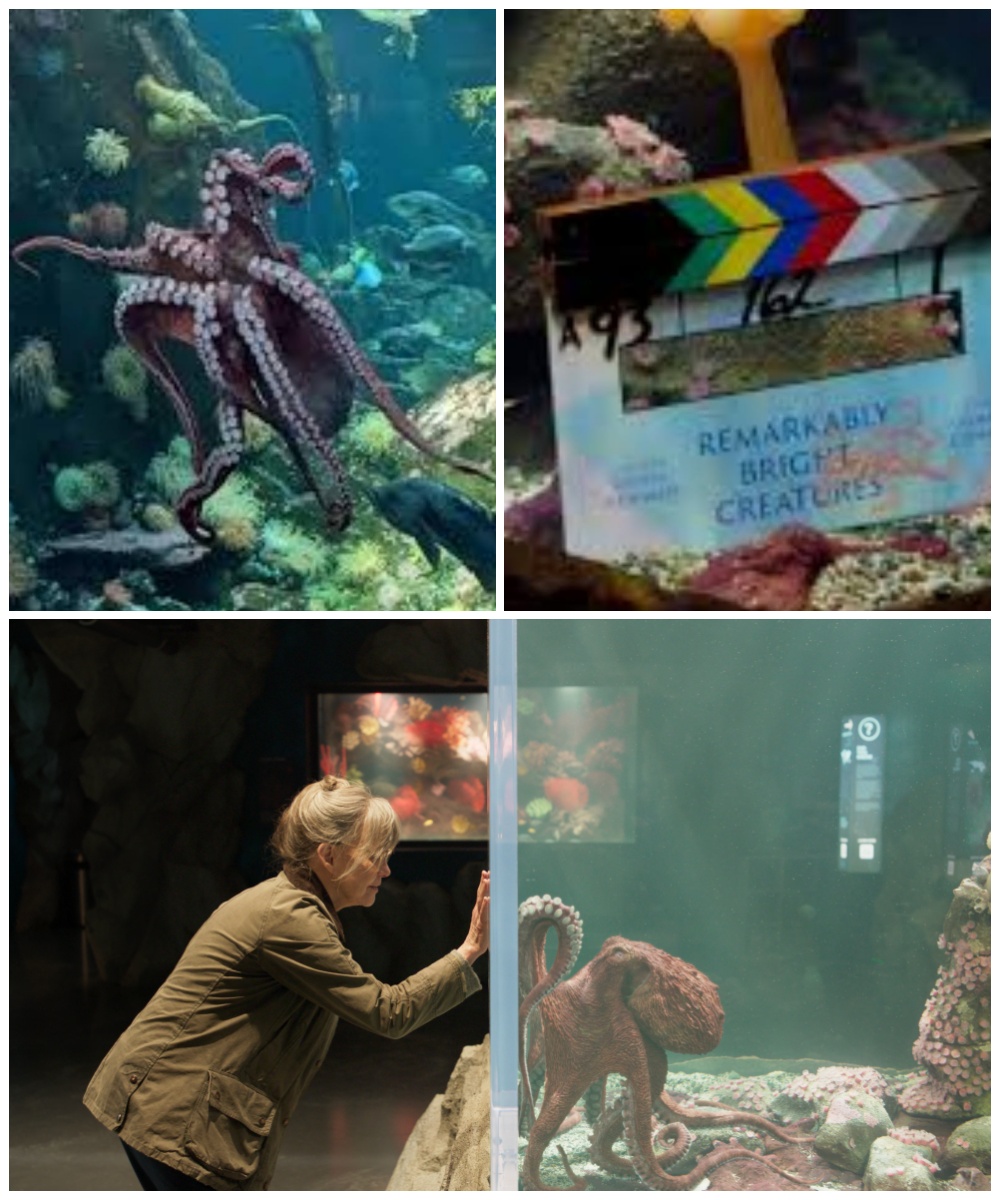
At the center of the project was Marcellus, the octopus who forms an unlikely emotional bond with Tova Sullivan, played by Sally Field. While the character exists behind the glass of an aquarium tank, his presence had to feel fully alive, expressive, and capable of carrying narrative weight without ever falling into cartoon territory.
One of the earliest stages in the process, Ritvo explains, was simply proving that audiences could emotionally connect with a digital octopus at all.
“We took a basic asset and animated a short CG scene of Marcellus on the shelf, reaching out and touching Tova, to show what was possible,” Ritvo says. “It was very rough, but it showed that you empathize with a digital octopus, and that kind of sold it.”
That initial test became the foundation for what would eventually evolve into more than 200 visual effects shots centered on Marcellus alone. Across the entire film, Ritvo’s team delivered approximately 450 VFX shots in total, blending practical footage, digital augmentation, and fully computer-generated environments.
But before any of that could be built, Ritvo needed a real-world reference point. That search led him to the Vancouver Aquarium, where he encountered Agnetha, a giant Pacific octopus who would ultimately become the primary inspiration for Marcellus.

“The first time I saw her in the tank, you get to see her so up close, and the amount of complexity you see in everything about them,” Ritvo says. “Their skin is always moving, there are eight tentacles going in every which direction, and there are thousands of suckers moving around at any given time.”
Agnetha’s presence was so visually rich and constantly shifting that Ritvo decided to treat her almost like a performance artist rather than an animal subject. Over the course of roughly 20 hours, he filmed and photographed her extensively, setting up cameras around the tank to capture behavior from multiple angles.
“I set up cameras all around her tank, and I would walk around, filming and photographing her, and just try to collect as much reference as possible,” he explains. “That helped dictate the look.”
From that footage, the VFX team began building a digital model of Marcellus that could replicate not only physical movement but behavioral nuance. Every tentacle motion, skin texture shift, and subtle environmental interaction was grounded in real observations of Agnetha’s behavior.
“We took scenes that she did, and we mimicked that digitally for Marcellus,” Ritvo says. “And we always gave Olivia a reference, or a one-to-one, so everything you see Marcellus do in the film is directly referenced either to Agnetha or another reference we found online that an octopus could really do.”
One of the most visually complex aspects of the character was camouflage. Octopuses are known for their ability to rapidly shift skin tone and texture, blending into their surroundings in ways that are both scientifically complex and visually striking.
Ritvo and Newman studied Agnetha’s natural coloration patterns closely. “It’s very subtle,” he notes. Together, they settled on a baseline look for Marcellus that featured deep red tones, black frills, and bright white suckers.
From there, the team developed a system of evolving camouflage patterns that would allow Marcellus to adapt visually to different environments throughout the film, whether resting against rocks, interacting with aquarium surfaces, or transitioning between water conditions.
That adaptability also became a storytelling device. As the narrative progresses, Marcellus visibly changes with time.
“As he’s aging, you see his color kind of diminish a little bit,” Ritvo explains. “It’s getting more and more towards white until you finally see him at the back door, and he’s like quite white, but then he flourishes again when he gets back in the ocean.”
Beyond color and texture, one of the most technically demanding aspects of the character was tentacle animation. With eight fully articulated limbs constantly in motion, the simulation required extreme precision.
“They have to touch the glass, and they had to attract and detract from objects because they’re also alive,” Ritvo says. “Those were also the hardest to calibrate and art direct.”

Each tentacle had to function independently while still feeling part of a unified organism, interacting believably with physical surfaces like aquarium glass, rocks, and props. Even small inconsistencies in timing or pressure could break the illusion of life, making the animation process both time-consuming and highly iterative.
Water simulation added another layer of complexity. Depending on Marcellus’ location, the surrounding environment had to shift between controlled aquarium fluid dynamics and natural ocean currents.
When Marcellus is in the open ocean, Ritvo’s team created full digital water systems to match lighting, movement, and particulate behavior. In one particularly complex sequence—when Marcellus emerges from a bucket—the entire water interaction was generated digitally.
“That’s all digital water,” Ritvo confirms.
Despite the technical challenges, the biggest hurdle was not simulation or rendering. It was emotion.
“The biggest challenge was making Marcellus a character audiences could empathize with,” Ritvo says. “They don’t have a traditional face and eyes. They’re otherworldly.”
To solve that, the team leaned heavily into performance design rather than anthropomorphism. Instead of forcing human traits onto Marcellus, they studied how real octopuses interact with their environment and used audience perception as the emotional bridge.
“When you watch Agnetha in the tank, you’re projecting your own emotions onto it,” Ritvo explains. “I don’t know what she’s actually feeling; she’s probably in a whole different world to us, but she’s looking at you, or she’s curious, and you’re projecting emotions.”
That idea—projection rather than expression—became central to Marcellus’ design philosophy. The character doesn’t need a human face to feel alive. Instead, he exists in a space where human emotion meets animal behavior, allowing viewers to interpret meaning through subtle movement and timing.
Sally Field’s performance played a crucial role in that illusion. Her emotional timing and physical proximity to the invisible creature allowed the VFX team to sync Marcellus’ responses directly to her performance.
“A lot had to do with Sally Field,” Ritvo says. “She’s so good, and a lot of that was mirroring her emotion back onto Marcellus, that projection. A lot of that was dictated by Sally.”
In the end, Remarkably Bright Creatures became more than a technical showcase for digital animation. It became a study in emotional translation—how human grief, curiosity, and connection can be reflected through the movements of a non-human character built from millions of lines of simulation code.
And for Ritvo and his team, the success of Marcellus wasn’t measured in render quality or technical complexity, but in something far simpler: whether audiences believed, even for a moment, that they were looking into the eyes of a creature that understood them back.