UNEXPECTED MOMENT — The Princess of Wales Leaves Crowds Stunned With Heartwarming Gesture Toward Children During Italy Visit
The Princess of Wales has visited a pre-school in Reggio Emilia after arriving in the city earlier today, where she heard about its emphasis on creativity, relationships and the learning environment
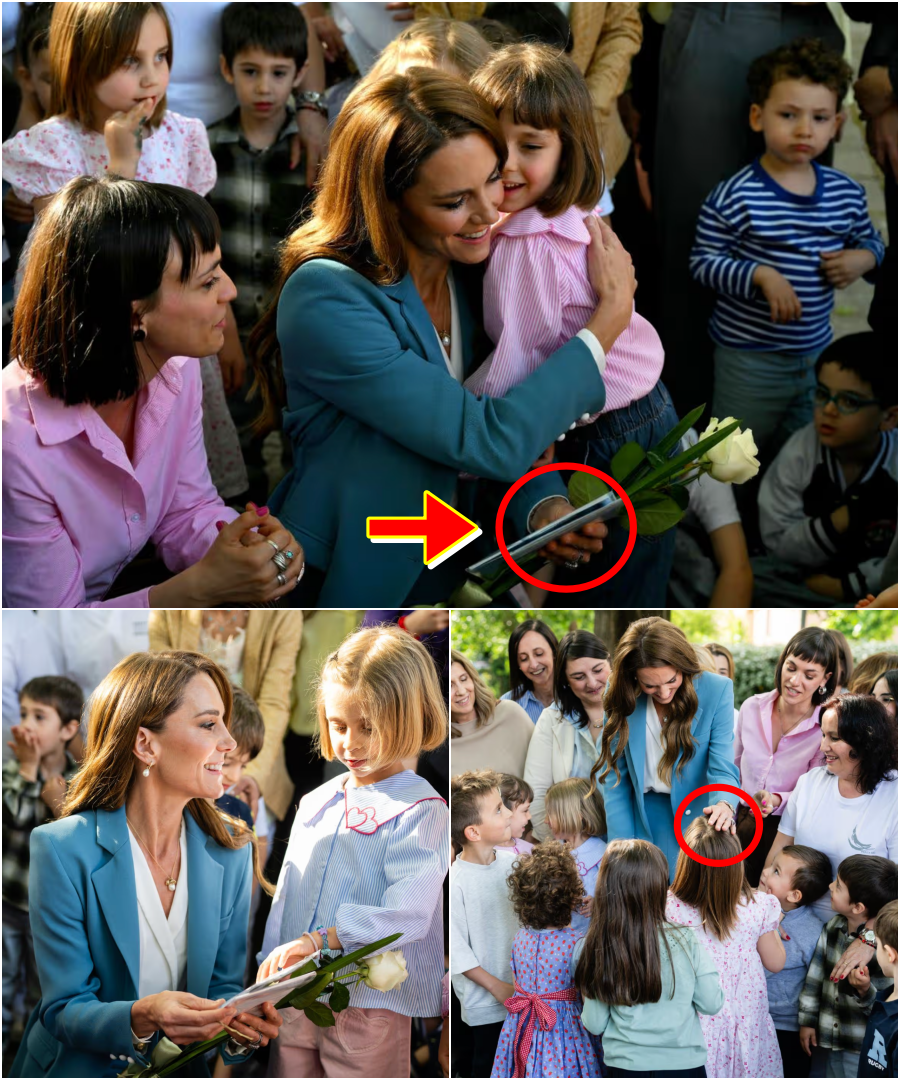
The Princess of Wales said she had an “inspiring day” learning about the Reggio Emilio approach to early years as she visited a pre-school in the city to have adopted the philosophy, where she hugged children and left teachers emotional.
Arriving at the Anna Frank school (Scuola Comunale d’Infanzia) today, which is named after the Jewish girl who famously wrote a diary of her time hiding from the Nazis, Catherine was greeted by Federico Ruozzi, President of the Infant Toddler Centres and Nandi Rinaldi, Director of the Infant Toddler Centres.
They then led her through the outdoor area that includes a wooden tree house, clay artwork and decorative tree stumps, and Catherine said, “It’s so fascinating and even just seeing the environment, it feels different and so inclusive of the natural world.”

View 8 Images
Kate hugs a little girl during a visit to a school (Image: AP)
Having been introduced to Elisa Di Benedetto, a Pedagogista (an educator who helps develop the curriculum) from the school, the princess asked: “How long have you been teaching her?”
The teacher told her for two years, and explained that she was educated in one of the Reggio Emilio schools and is proud to be teaching at a similar municipality. The school for children aged three to six places a particular emphasis on creativity, relationships and the learning environment.
Catherine was then told about the school’s history, which was the second Reggio Emilio school to open over 60 years ago, after locals in the neighbourhood asked for one to be built. She was also told that the name Anna Frank was chosen by a public assembly involving children and people of the neighbourhood.
“It was a symbolic choice but a message to future generations who have lived in peace,” the princess was told before heading to a creative session with the atelierista (an art and education professional), Daniela Casali, and a group of children, marking the first time the princess had seen the Reggio Emilia approach in practice.
Five youngsters were sat around a table working on projects for the storytelling festival taking place in the city next week. The theme is ‘Winds of Stories’ and the group were drawing what they felt wind represented. Sitting down to join them, Catherine said “ciao” before asking each child what their name was in Italian.

View 8 Images
Kate toured the Scuola Comunale d’infanzia Anna Frank and met the young pupils(Image: Samir Hussein/PA Wire)
She was shown pieces of paper with animal names written by the children. The princess quickly spotted that one of them read “Lupo” – wolf in Italian – and said: “That was the name of our dog, our dog was called Lupo.” “Oh really, did you know the Italian meaning?” Ms Di Benedetto asked.
Nodding and saying “yes” in response, the teacher said: “It must have been a big dog?” “No, it wasn’t actually,” Catherine said, laughing. “It had a big personality.” The princess was then asked to write a word herself and chose “dreams”.
Looking closer at the children’s drawings, she said: “The world children are growing up in is so fast-paced and actually encouraging them to slow down and really engage in these creative activities.
“It’s so important and to explore language in the way that you’re doing, creatively, in a really expressive way through storytelling. It really connects to them.”
In a second classroom, a group of children were painting flowers. Sitting down to join them at their table, the princess pointed to the red bud, touching it and saying: “It’s so soft, have you felt it?”
She then stood to speak to some of the parents and told them and after listening to their experiences with the school, Catherine said: “These are really special places and really special environments. If only more educational settings had this approach.”

View 8 Images
Children crowd around the princess to say hello (Image: Samir Hussein/PA Wire)

View 8 Images
A young girl gives Kate gifts(Image: Getty Images)
Before leaving, the princess was told about the school’s strong emphasis on food, serving freshly cooked meals full of fruit and vegetables every day.
“Wow look at this, it looks amazing!” Catherine said when shown an impressive spread of fruit, biscuits, and vegetable pastries. The princess was told that the children learn about where food has come from and about taste, which is one of the 100 languages of the approach.
Asked if she’d like to try some, she said, “I’d love to,” and tried Erbazzone, a special regional dish made with spinach, Parmesan, and ricotta. “Delicious,” she said and took two sweet rolls home with her to have with a cup of tea later.
Heading back outside, the princess told Ms Di Benedetto: “It’s been such an inspiring day for me. To see the history, where it started, to where it is now, and to see how it’s stood the test of time. The city should be proud, you’re leading the way globally.”
She joined staff and students gathered outside for a group photograph, before the excited youngsters swamped her with hugs and high-fives.

View 8 Images
Kate said her first day in Reggio Emilia had been ‘inspiring’(Image: POOL/AFP via Getty Images)
Chanting the Italian word for “gift”, the princess was then presented with a white rose before turning to wave goodbye to the children. Two youngsters bravely went up to her and asked for one last hug, which Catherine readily agreed to, prompting more of the group to toddle over to her.
Moments after the princess left the school, many of the teachers started crying, showing just how much the royal visit means to the small Italian city.
Kate visited the school after stopping in on the world-renowned Loris Malaguzzi International Centre, where she met educators and practitioners leading work in the “Reggio Emilia approach”, hearing how it supports social and emotional development.
While walking through the centre’s “light atelier”, a room filled with hanging plastic waves and ornaments on the walls, the centre’s president, Maddalena Tedeschi, explained how it encourages children to interact and play.

View 8 Images
The Princess of Wales at the Loris Malaguzzi International Centre today(Image: WireImage)
Kate replied: “And also, it’s encouraging children these days to slow down because their world is so fast-paced now – it’s getting them to notice things, in their sensory environment as well.”
When shown a table covered with multi-coloured plastic objects for children to play with, she said: “I did this in lockdown with the children, we tried to find as many objects in the house as we could with as many colours in the rainbow as possible.”
The princess was hosted on her visit by Miss Tedeschi, and the centre’s international relations lead, Emanuela Vercalli, with Paola Ricco, the education area coordinator. Arriving at the centre, she greeted them with “Bongiorno!” and said was “looking forward to learning more,” adding: “I’ve been meaning to come here for quite some time, so to be here now is very exciting.”
Opened in 2006, the Loris Malaguzzi International Centre serves as a meeting place for international researchers, teachers, and families, focusing on creativity, research, and the documentation of children’s learning.
Each year, it is visited by over 130,000 people who want to learn more about the Reggio Emilia philosophy and embed this learning into their practice, and families who attend one of the specialist “ateliers”.

View 8 Images
Kate walks through the centre’s “light atelier”, a room filled with hanging plastic waves and ornaments on the walls(Image: WireImage)
It is named after Loris Malaguzzi – an Italian psychologist and educator who founded the Reggio Emilia municipal network of infant-toddler centres and preschools after World War II.
After a 15-minute private briefing with the centre’s team to hear more about their work, Kate was shown a pillar featuring the “100 languages poem”, written by Malaguzzi. The poem’s theme is that children have infinite ways to express, explore, and connect their thoughts, feelings and creativity.
After seeing several “light sensory” spaces that children engage with, Kate rolled up her suit sleeves and got stuck into the centre’s clay atelier workshop, led by atelierista, Marco Spaggiari, where she heard how an atelier works in practice, and how children benefit. Shaking hands with some of the other atlieristsas, she laughed as they apologised for smearing her with clay: “Don’t worry! I have children – I’m used to it.”

View 8 Images
Kate is on a two-day visit to Reggio Emilia (Image: WireImage)
Sitting down at the table covered with lumps of clay, Kate spoke of how beneficial it is for a child to “actually be able to stop and use your hands and pay attention…these simple things that are all around us.” Slicing herself a lump of clay with wire which she rolled into a long, thin shape, she joked about making clay pasta.
Kate also recalled the video used to promote the launch of her Shaping Us campaign: “We used clay to tell the story of early childhood,” and sounded delighted when the team said they had seen it: “Oh, you’ve seen it? It’s really interesting, this model is embedding connection and expression from the very beginning. Children can learn to draw on these throughout their lives.”
At the end of her tour of the centre, Kate sipped an espresso as she met a small group of delegates from a Latin American study group who travelled from Mexico, Brazil and Colombia to learn more about the Reggio Emilia approach.
She said: “It’s really interesting having a philosophy rather than just ‘a framework’. I really love the therapy approach, it’s not just projecting ‘this is who I am, this is what we do, this is how we tell people how to go through life’.”
As she left the centre, Ms Vercalli presented her with a bunch of flowers, thanking her for the visit and saying she wishes she could stay for longer. Kate told her: “I wish I could stay longer too, thank you so much, I’ve learned a huge amount.”