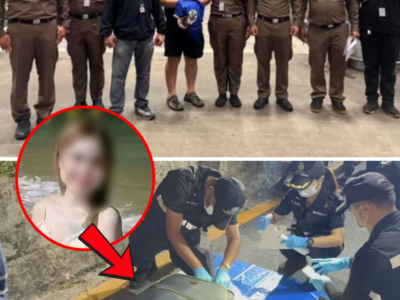
Tunchanok’s stepmother tearfully recounted the final days she spent with her daughter

The murder of 17-year-old Tunchanok Donholma—affectionately known as “Cake”—in Pattaya, Thailand, is more than just a personal tragedy; it serves as a chilling wake-up call regarding the dark underbelly hidden behind the glitz of major tourist centers. When a suitcase containing human remains was discovered near railway tracks, it not only ended the life of a young girl but also ignited a fierce debate regarding security, greed, and the systemic vulnerabilities faced by those on the margins of society.
The Paradox of Kindness and Greed
Behind this devastating death lies a humble life in Kalasin, where Tunchanok lived with her father and stepmother. Before that fateful day, the teenager had asked her family for permission to visit Pattaya to see the sea. Her stepmother, Oradee Bussarakum, shared with deep sorrow that she had given the girl a small amount of money for the trip. To her family, Tunchanok was a dutiful daughter who would often help her parents sell garlands or fruit at intersections during the Songkran festival. The modest sums they gave her—between 100 and 200 baht—represented all the care and trust a family could provide to a child still navigating the innocence of youth, one who had yet to encounter the harshness of the wider world.
The contrast between the image of the diligent girl who helped her parents and her tragic end in a Pattaya hotel room left her father, Thongchai Donholma, completely shattered. In an interview outside the police station, he could not hold back his tears as he spoke of his devoted daughter. This loss is not merely the agony of a modest farming family; it highlights a profound social divide, where young women from impoverished rural areas can so easily become prey to predators lurking in bustling tourist hubs.
Inhumanity and the Concealment of Crime
The claim made by suspect Simon Peter Carman that he acted in “self-defense” following a dispute over a payment of 500 baht (compared to the originally agreed-upon 1,000 baht) is a detail that sparks righteous outrage. That a human life was extinguished over such a trivial monetary difference reflects not only a moral collapse but also a callous disregard for human value in illicit transactions. Moving a large suitcase from a hotel to a remote area along the railway tracks was a calculated attempt to destroy evidence, exposing the suspect’s brutality when faced with the resistance of a vulnerable teenager. The scratch marks on the suspect’s body—dismissed by him with a flimsy excuse about “spider bites”—instead bear witness to the victim’s desperate struggle to cling to life.
A Costly Lesson in Safety
This incident raises urgent questions regarding the management of high-profile tourist destinations. When illicit transactions occur in the shadows of Pattaya, the risk is ever-present. That a teenager’s simple dream of “seeing the sea” would culminate in such a cold and lonely end is an irreparable heartbreak.
The investigation is ongoing, with an 84-day detention period allowed before formal charges lead to trial. Regardless of the outcome, the lesson from this case remains clear: safety cannot be left to chance. When the bright-eyed aspirations of a young girl are snuffed out and hidden within a cold suitcase, it serves as a painful reminder to society of the collective responsibility to protect the youth from the invisible perils lurking within an adult world rife with exploitation and calculated malice.
SOURCE: ABC NEWS
https://www.abc.net.au/news/2026-06-28/australian-man-charged-with-thai-teens-murder-addresses-family/106852274