Every year, a wealthy man returns to an old repair shop… just to thank the mechanic who once let him owe five dollars when he was down on his luck
Every year, on the same rainy afternoon, the rich businessman drove a different luxury car to the same old repair shop. The employees changed, the neighborhood around the shop changed, and even the faded sign above the garage had been repainted several times, but the reason for his visit never changed. He would park beside the rusted service bay, step out wearing an expensive suit, walk directly to the oldest mechanic in the building, shake his hand with unusual respect, and leave a crisp five-dollar bill on the counter. Then he would sit for an hour drinking cheap coffee from a paper cup while the old mechanic talked about ordinary things—the weather, baseball games, rising prices, aching knees, and memories that seemed increasingly important as the years passed. The younger workers found the ritual strange. Why would a man whose watch cost more than most cars return every year to give an old mechanic only five dollars? Some assumed it was a joke. Others thought the businessman was eccentric. Only the old mechanic understood that the five dollars had never been payment. It was a debt that could never truly be repaid.
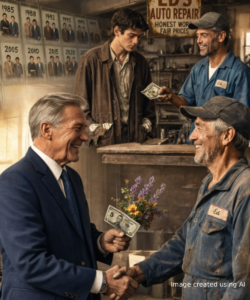
Thirty years earlier, the businessman had been a frightened twenty-year-old carrying everything he owned inside a torn backpack. He had arrived in a new city with a head full of dreams and pockets almost completely empty. For several weeks he slept on friends’ couches, skipped meals, and searched desperately for work. Every interview seemed to end the same way: no experience, no connections, no opportunity. One cold evening, after another rejection, he stood beside a gas station counting the coins in his hand. He had just enough money for a bus ride back to the tiny room he rented, but not enough for food. That was when his old car refused to start. He pushed it into the nearest repair shop and waited while a young mechanic examined the engine. The diagnosis was simple but devastating. A small part had failed, and even the cheapest repair cost five dollars more than he possessed. Embarrassed and exhausted, the young man admitted he couldn’t pay. He expected the mechanic to refuse service. Instead, the mechanic wiped his hands on a rag, looked at the hungry stranger standing beside the broken car, and quietly said, “Pay me when life gets better.” Then he fixed the car anyway.
Those five dollars changed everything. The repaired car allowed the young man to reach another interview the next morning, where he was finally offered a low-paying sales position. He worked harder than anyone else, stayed later than everyone else, and slowly climbed upward. Years later he started his own business, survived several failures, and eventually built a company worth millions. Journalists loved his story. They wrote about ambition, talent, and perseverance. They praised his intelligence and work ethic. Almost nobody asked about the old mechanic who had trusted a stranger for five dollars. Yet the businessman never forgot. He often wondered how many successful lives were built on tiny acts of kindness that history never recorded.
As his wealth grew, so did the distance between him and the world he came from. He moved into larger homes, attended expensive events, and surrounded himself with people who discussed investments more often than people. His wife adapted easily to that world, but he never felt entirely comfortable there. Their only son grew up with privileges his father had never imagined as a child. The boy attended excellent schools, traveled widely, and rarely heard the word “no.” The businessman tried teaching him the value of hard work, but lessons spoken from the driver’s seat of a luxury car often sounded less convincing than lessons learned through struggle. The son was polite and intelligent, yet he viewed success as something almost automatic, a natural result of being born into the right circumstances. Whenever his father told stories about poverty, the boy listened respectfully but with the distant curiosity of someone hearing about another century.
One summer afternoon, when the son was sixteen, he accompanied his father to the old repair shop for the first time. He stepped out of the expensive car, looked around at the oil-stained floor and worn tools, and asked quietly, “Why do we come here every year?” The businessman introduced him to the old mechanic and watched them shake hands. Then he explained the story of the five dollars. The son listened, but when they returned to the car, he shrugged. “Couldn’t you just give him a lot more money now?” he asked. The businessman smiled sadly. “I could,” he replied, “but that would miss the point.” The son frowned, clearly unconvinced. To him, five dollars seemed meaningless. To his father, it represented the moment a stranger chose trust instead of suspicion.
Years passed. The son entered college, then joined the family business. He was talented, ambitious, and eager to modernize everything. Under his influence, profits increased rapidly. Investors admired his confidence. Employees respected his intelligence, though some quietly feared his impatience with people he considered inefficient. The businessman saw pieces of his younger self in his son, but he also saw something missing. The boy understood how to build wealth. He did not yet understand why wealth mattered.
Then came the economic downturn that changed everything. Several major clients collapsed unexpectedly, contracts vanished, and the company faced the worst crisis in its history. The son worked around the clock trying to save the business, but pressure transformed him into someone increasingly harsh and desperate. He cut staff aggressively, argued with suppliers, and treated every relationship as a transaction. One evening, after a disastrous meeting with lenders, he confessed to his father that he felt trapped. “Nobody helps unless they get something in return,” he said bitterly. The businessman looked at him for a long moment before asking a simple question. “Are you sure about that?” The son answered with exhausted certainty. “Absolutely.”
A few days later, the businessman suggested they visit the old repair shop together. The son reluctantly agreed, assuming his father simply wanted a distraction. Rain fell steadily as they drove across town. When they arrived, the old mechanic was closing the garage for the evening. Despite his age, he still moved with the same quiet steadiness the businessman remembered from decades earlier. They talked for a while, and eventually the son admitted how badly the company was struggling. The old mechanic listened without interruption. Then he disappeared into a small office and returned holding a worn envelope. Inside were newspaper clippings about the businessman’s success, carefully saved over many years. “I kept these because I wanted to see whether that hungry kid made it,” he said with a smile. Then he handed the envelope to the son. Tucked behind the clippings was a check for a surprisingly large amount of money.
The son stared in disbelief. “I can’t accept this,” he said immediately. The old mechanic shrugged. “Maybe not. But your father once couldn’t pay five dollars, and someone helped him anyway.” The businessman remained silent, letting the moment settle between them. For the first time, the son understood that the annual visits had never been about gratitude alone. They were about remembering that a life can change because one person chooses kindness when there is no obvious reward.
On the drive home, neither father nor son spoke for a long time. Finally, the son asked the question that mattered most. “Did you know he would do that?” The businessman shook his head. “No. That’s what makes it kindness.” The son looked out the window at the rain and whispered something his father had waited years to hear. “I think I’ve been measuring success the wrong way.”
The company eventually recovered, but the son changed more than the business did. He still worked hard and pursued growth, yet he began noticing people he had previously overlooked—the receptionist staying late, the delivery driver working two jobs, the young employee struggling to pay tuition. He created emergency funds for workers facing hardship and quietly paid medical bills for families in crisis. Whenever someone thanked him, he simply smiled and said, “Life gets better.”
Years later, after the old mechanic passed away peacefully, the businessman and his son attended the small funeral together. Among the mechanic’s belongings, the family found a faded receipt for a five-dollar repair that had never been paid. On the back, in shaky handwriting, the old mechanic had written, “Best investment I ever made.”
The son read those words through tears. And for the first time in his life, he understood why his father had returned every year to that old repair shop. The debt was never about money. It was about honoring the moment a stranger proved that generosity can outlive poverty, success, and even time itself. Some people leave behind buildings, companies, or fortunes. The old mechanic left behind something far rarer: a chain of kindness that continued growing long after the original five dollars had been forgotten by everyone except the people whose lives it changed forever.
This article uses AI