PLEASE RUN..! – Nepali engineer reveals the split-second steps that saved him and his colleagues from a terrifying tsunami of mud
In short:
Nepali engineer Rabindra Hamal was working by the river in the Rasuwa region when his colleagues radioed his team to run.
Mr Hamal recalled being 700 metres from base camp as a “large muddy wave” followed behind.
Two of his colleagues were swept away in the floods, while the surviving group of five were rescued four hours later.
Nepali engineer Rabindra Hamal has recalled the terrifying moments he and his colleagues outran an oncoming torrent of water and mud to clamber to safety.
Mr Hamal had been stationed at the hydropower plant by the Upper Trishuli river in Nepal’s Rasuwa region on August 26 when colleagues working upstream sent them a dire warning.
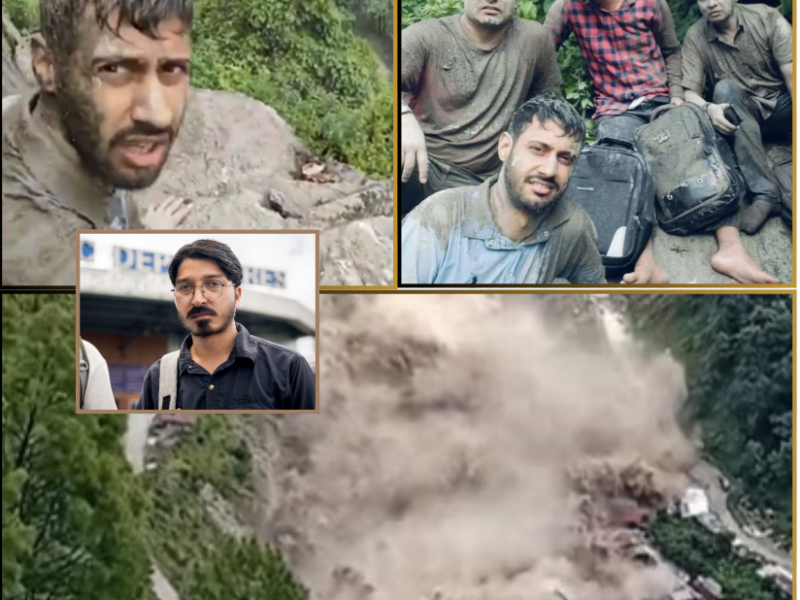
Rabindra Hamal (top left) is among a group who were working by a river during the deadly Nepal-Tibet floods. (Supplied)
The 46-year-old told the ABC that about 8:30am a colleague on the dam side of the river, about 10 kilometres upstream, relayed a message over the radio informing his team that disaster was heading their way.
“He was also running and was just saying, ‘Please run, please run away, please run away, [a] huge flood is coming’,”
he said.
“We immediately informed all our colleagues who were working with us in our office and rushed outside.
“Once we got outside, there was lots of confusion and panic around us.”
A video shared among his colleagues shows the moment a large wave engulfed the dam as workers fled for their lives, closer to the Tibet border.
Has Video .
Watch
Nepali workers watched as disaster unfolded. (Supplied)
Mr Hamal said himself and six others jumped in a vehicle and quickly started driving downstream to get as far away as possible.
He said they had only travelled 700 metres from their camp before they noticed a “large muddy wave” right behind them.
“It just looked like [something from a] Hollywood movie … I cannot even describe [it],” he said.
“We abandoned the vehicle … and started running towards higher ground.
“Fortunately, it was not the main flood wave because that gave [some of ] us enough time to reach … safe ground.
“But unfortunately, we lost our two friends.”
Rabindra Hamal was working on the Upper Trishuli River when the flood hit. (Supplied)
He said the flood wave hit them but because of a small boulder in front of them, they were able to avoid the full impact of the wave and travel just five metres more to escape danger.
The engineer said two from his group of seven, a driver and cook, were not as lucky and were swept away in the flood waters before they could reach higher ground.
A verified video circulating online shows the base camp with red coloured rooftops, where Mr Hamal said his team were stationed, being destroyed by the flash flood just minutes after they escaped.
Ground began ‘shaking violently’ as second wave approached
Has Video .
Watch
Engineers basecamp in Nepal destroyed by floodwaters. (Supplied)
He said his group thought they were safe standing on a large boulder before the ground beneath their feet started “shaking violently” as a second, even larger flood wave approached.
“We were afraid that the rocks around us might fall … fortunately no rock fell and we were able to survive and stay their safely.”
Four hours later, the surviving group of five heard a helicopter in the distance but they could not wave it down.
More on the Nepal-Tibet floods
Nepali photographer documents ‘survival and sorrow’ of flood disaster
Topic:Floods
These guides lead tourists into the Himalayas; now they must carry something heavier
Topic:Floods
Australia deploys drones to Nepal as death toll passes 1,200
Topic:Disaster Relief
The turquoise home that withstood a torrent
Topic:Floods
Mr Hamal said they spent the night covered in mud, on a boulder in the middle of the jungle.
“It was a very difficult and frightening night we experienced,” he said.
“The next day, fortunately, we were rescued by helicopter, finally reached at home safely.
“It’s completely miracle, I didn’t believe that I could be able to survive, It’s completely miracle.”
Hundreds of hydropower workers remain missing
The group were eventually evacuated to a nearby army barracks before being evacuated to Kathmandu.
Rabindra said the flash flood looked like something from a Hollywood movie. (Supplied)
Geologist Harichandra Budhathoki was working at another hydropower site at the time, but by chance left just hours before the flood hit due to an unrelated medical emergency.
“The scale was so huge … no one could have imagined this,” Mr Budhathoki said.
Both grateful to be alive, Mr Hamal and Mr Budhathoki decided to join the search effort and flew out to several work sites to look for survivors on Thursday.
“If we get [to save] one person’s life, it will be very fruitful to my life, that’s why Ineed to go there,” Mr Hamal said while he waited for a helicopter to take him out to the Upper Trishuli 1 site.
Mr Budhathoki says the scale of the rushing water “was so huge”. (ABC: Hamish Harty)
Mr Budhathoki hoped his expertise could help find the dozens of workers who were believed to be trapped in hydro tunnels underground.
“I know every ins and outs of the tunnels, I know the alignment, the size, volume, so for the rescue team I should be able to provide the crucial details,” Mr Budhathoki said.
Early on Friday, two people were rescued alive from a hydropower tunnel at the Upper Trishuli 3A Hydropower Station, nine days after floods hit the area.
Nepali authorities have rescued about 300 people from hydropower projects in the region so far.
If you want to help support the thousands affected by the crisis, the ABC is supporting the Emergency Action Alliance member charities and their local partners. You can find more information here.