The Mafia Kingpin’s Biggest Betrayal Wasn’t What He Thought… A Long-Lost Son Revealed the Sh0cking Truth
PART 1
The letter arrived on a Tuesday. By Wednesday, Theresa Marchetti had stopped pretending she could ignore it.
She stood on the stone terrace of the villa outside Cefalù. The Tyrrhenian Sea spread out below her like hammered silver.
She read the three lines again.
*Your father is dying. He asks for you. Come home before it is too late.*
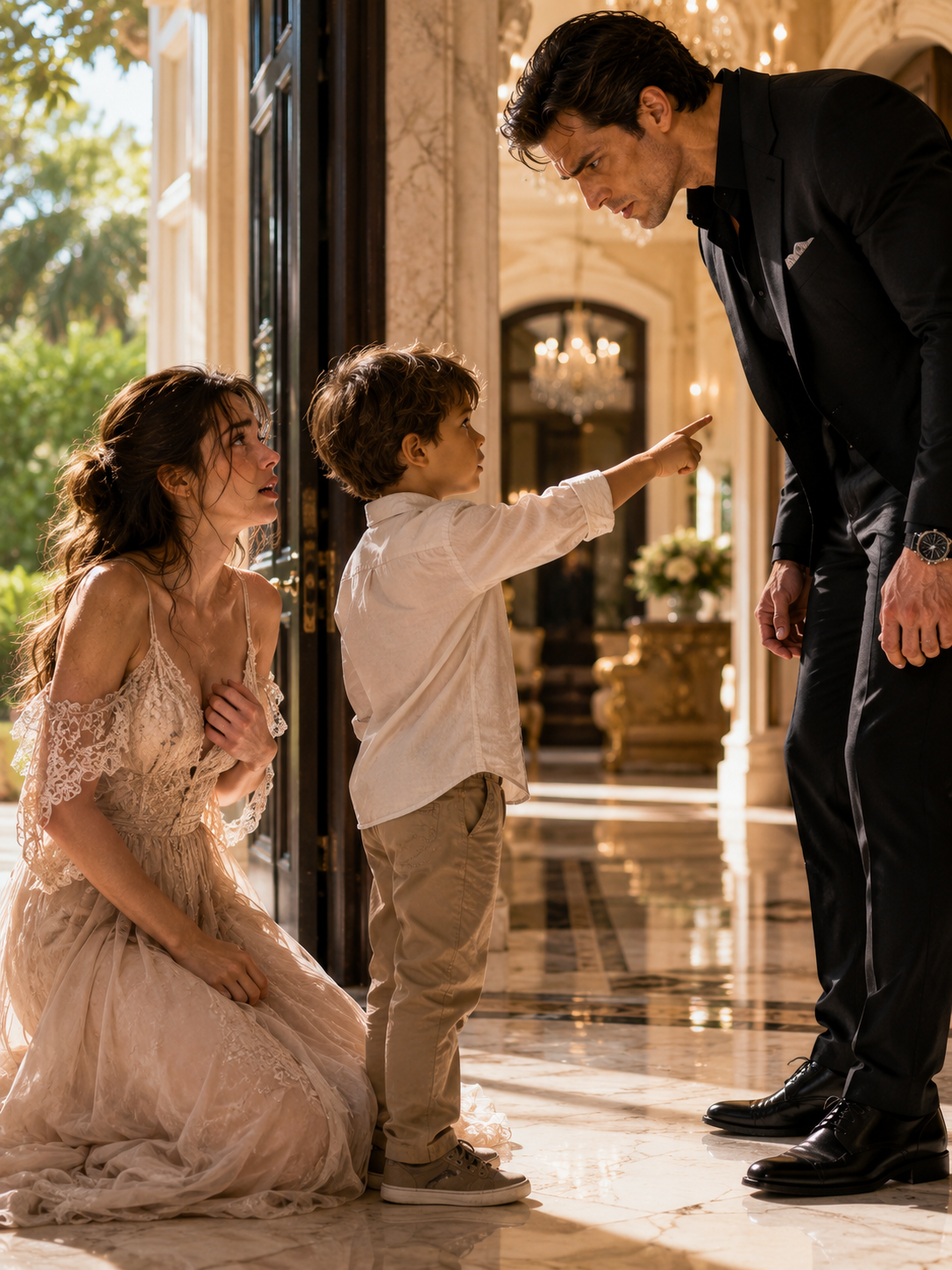
No signature. It didn’t need one. Only one family used that particular cream paper, embossed with a crest that had been paying for silence in New York for sixty years.
“Mama.”
She turned. Mateo stood in the doorway. Nine years old, all elbows and dark eyes that belonged to a man she had spent a decade trying not to dream about.
He had Vincent’s mouth. He had Vincent’s way of watching a room before he entered it.
Some mornings she could barely look at him without her chest folding in on itself.
“Nothing, amore.” She folded the letter fast. “Grandpa’s friends. Grown-up things.”
“You went white.”
“I did not.” She crossed the terrace and pressed her lips to his hair, breathing in salt and sun and the boy-smell of him. “Go finish your lessons. Signora Bruno will scold us both.”
He went slowly, glancing back once with that unsettling adult calm.
When he was gone, she gripped the balustrade until her knuckles ached.
Ten years. Ten years building distance between herself and that world. A fake surname. A small, quiet life where nobody knew that Mateo Marchetti was really Mateo Castellano, heir to the most dangerous name on the Eastern Seaboard.
And now her father — Don Alberto, who had smuggled her out of the country the night everything fell apart, who had never once asked her to explain the tears — was dying in the very center of the storm she had fled.
She could refuse. She could stay here safe and let the old man go into the dark without her hand in his.
She knew she would not.
She packed two suitcases and did not let herself think about the man waiting on the other side of the water. The man who believed she had walked out of his bed and his life without a word.
Vincent Castellano. The Ice King of Manhattan, they called him now. She had known him before the ice. She had known him warm.
They landed at dusk. A black armored car was waiting, driven by a man she half-recognized from the old days.
“Signorina Marchetti,” he said. “The don is at the Long Island house. He’s holding on for you, I think.”
“Thank you, Enzo.” She remembered the name a beat late. “You’ve stayed with him all this time.”
“Somebody had to.” He held the door. “The city changed while you were gone, signorina. Be careful who you smile at.”
Manhattan rose in the distance like a wall of cold light, and the old fear woke up in her belly and stretched.
“Stay close to me here,” she told Mateo, gripping his hand. “Promise me. Whatever happens, whoever talks to you, you stay close.”
“I promise, Mama,” he said, easily, the way children promise things they don’t understand.
She did not know — could not have known — that a man in a penthouse forty floors above the river had already been told a Marchetti car had crossed into the city.
She did not know that Vincent Castellano stood at his window with a glass of something amber and untouched, staring south, his heart doing something it had refused to do for ten years.
She did not know he’d said one word to a room full of men who worked for him.
*Find her.*
The Long Island house was ablaze with light when they arrived. Nurses moved through the halls in soft shoes. Her father’s oldest friends stood in the drawing room in dark suits, murmuring, and went silent when she walked in.
“Theresa.” Her father’s voice was a thread.
She fell to her knees beside the bed and took his cold hand.
“Papa. I’m here.”
His eyes found her, then drifted past her to the doorway, to the boy standing there uncertain. Something crossed the dying man’s face that might have been fear or might have been an apology.
“You brought him,” Alberto whispered. “You brought him here.”
“I had no one to leave him with.”
“Terz.” His fingers tightened with a strength that surprised her. “He knows. Vincent knows you’re back. It took him one hour.” A wet, rattling breath. “You cannot hide the boy. Not here. Not from him.”
“Then I won’t hide,” she said, and was surprised to find she meant it.
He came at midnight.
She was in the kitchen making coffee she wouldn’t drink when she heard the cars — engines low and expensive — and then the front door opening without a knock, because men like Vincent Castellano did not knock at houses that belonged to their allies.
She turned. There he was.
Ten years had done to him what ten years does to a blade that is used every day. Harder. Leaner through the face. Broader through the shoulders. Charcoal suit so dark it drank the light. Black hair cut short, threaded with the first silver at the temples.
It was his eyes that undid her. Pale gray, once soft in the dark. Now flat and cold as a frozen lake.
“Theresa.” He said her name like an accusation.
“Vincent.” She kept it level. “You didn’t waste time.”
“I’ve had ten years of silence. So no, I didn’t waste any more of it.”
They stood three feet apart. His cologne — cedar and something darker — went straight through the decade like it had never happened.
“My father is dying,” she said. “That’s why I’m here.”
“I know why you’re here.” His gaze moved over her, slow, deliberate, possessive. “What I don’t know — what I have never known — is why you left.”
“Vincent, you were in my bed. You told me you loved me. You wore my ring in your pocket because you were afraid to wear it on your hand.”
His voice dropped, and it was worse quiet than loud. “And then one morning you were gone. No note, no word. Your father told me you’d chosen to leave and that if I was a man, I’d respect it. Do you have any idea what that did to me?”
She did. She could see it in every hard line of him. The warmth she had loved had been burned down to fuel something else — something that had made him the most feared man in five boroughs.
“I had reasons,” she said. “Reasons I couldn’t tell you then and can barely tell you now.”
“Try.”
“I can’t. Not yet.”
Footsteps came down the stairs. Small, bare feet on old wood.
Her heart dropped straight through the floor.
“Mama. I couldn’t sleep. The house is making noises.”
Mateo appeared in the doorway in his pajamas, hair mussed, and stopped dead when he saw the tall stranger.
And Vincent turned.
She watched it happen. She watched the great Ice King of Manhattan look at the boy’s face — at his own mouth, his own eyes, his own way of standing — and she watched something crack in that frozen surface. Some vast and silent thing, splitting open.
—
PART 2
Vincent went absolutely still. If he had been holding a glass, it would have fallen.
“Theresa.” His voice had changed completely. Raw. Barely there. “How old is he?”
“Nine,” she whispered. “He’s nine.”
The number landed like a body. Nine years, ten months since she’d left. He did the arithmetic. She watched him do it, and every calculation led to the same place.
His hand came up and gripped the doorframe hard enough to whiten the knuckles.
“Get out.” For a wild second she thought he meant her — but he was speaking to the men waiting in the hall. “All of you. Wait in the cars. Now.”
They went.
Vincent crouched slowly, level with the boy, his voice gentler than she had ever imagined it could still be. “What’s your name?”
“Mateo.”
“Mateo.” He said it like he was tasting something he’d been starved of. “That’s a strong name. Do you know what it means? Gift of God.” His throat worked. “Go back to bed, Mateo. Your mother and I have to talk. Grown-up things.”
When the boy had gone, Vincent straightened to his full height, and the ice came back over his eyes like a door closing.
“He’s mine.” Not a question.
“Yes.”
“You took my son.” Each word a shard. “You hid him across an ocean for nine years and let me believe—” He stopped. Breathed. “Someone is going to answer for this, Theresa. And you’re going to start by telling me the truth. Tonight.”
They talked in her father’s study, a bottle of grappa between them that neither touched.
“Start at the beginning,” Vincent said. “The last night. What happened after I fell asleep?”
“Someone came to me,” Theresa said. “Late. You’d been up three nights with the Genovese trouble. You slept like the dead. Someone with a key to the private elevator.” She looked up. “Only three people had that key, Vincent.”
“You, me, and Salvatore.”
—
PART 3
“He told me things. That you were already promised — that the commission had arranged a marriage. That a girl like me was a liability that would get me killed the moment the deal closed.” Her voice caught. “And then he told me I was pregnant. He knew before I did, Vincent. He’d had a doctor look at my blood work. He sat there in the dark and told me if I stayed, they’d use the baby against you. That the only loving thing was to disappear.”
“And you believed him.”
“I was twenty-two. Terrified. And the man who told me this was someone I trusted almost as much as I trusted you.” She met his eyes. “He gave me proof. Documents. A marriage contract with your name on it. He swore on his mother’s grave that if I ever came back, they’d find the baby and kill it to send you a message.”
“The marriage,” Vincent said slowly. “The commission floated it. I refused it inside a week. That was three days after you left. What you saw was a corpse, Theresa. Someone showed you a corpse and told you it was alive.”
She closed her eyes. Ten years of exile, built on a lie she’d been too frightened to check.
“Say the name,” Vincent whispered, though he already knew.
“Salvatore,” she breathed. “Salvatore Ruggiero. Your consigliere. Your best friend.”
For a long moment Vincent didn’t move. Then he crossed to the window and stood with his shoulders rigid.
“If you’re wrong, I lose the only man I’ve ever fully trusted. If you’re right—” his reflection met her eyes— “he took nine years of my son from me and smiled in my face every single day. I will burn him alive.”
“We have no proof.”
“Then we get it.” He turned, cold gone, replaced by something hotter. “We say nothing. We let him think he’s won. First we take back my son. Are you with me?”
“Yes,” she said. “God help me. Yes.”
Salvatore came to the house the next morning. Handsome, silver-templed, a smile that reached exactly as far as it needed to.
He kissed both her cheeks. It was not the cologne from that night — but the hands were the hands. The heavy gold signet ring was the ring. Her stomach turned over.
Vincent came in and slung an arm around Salvatore’s shoulders, called him *fratello*, laughed at something he said. It was terrifying how good Vincent was at it.
“You’ve met my son, then,” Vincent said lightly, pouring coffee. “Mateo. Nine years old, sharp as a blade. Looks just like his mother, don’t you think?”
Salvatore’s cup paused half an inch from his lips. Just for a second. But Theresa was watching, and she saw it.
Later, on the terrace, Vincent said quietly, “You saw it too. The cup.”
“His ring,” she said. “He wore it that night. A chip out of the left edge of the crest. I’d know it anywhere.”
Vincent nodded once, the last of the doubt burning off. “All right. We give him rope. We protect the boy every hour of every day. And we find who’s really behind him.”
She found the first thread in a woman named Aurora, who ran the family’s crown-jewel nightclub. Elegant as a blade, and beholden to no man.
“You’re chasing Ruggiero,” Aurora said, not a question, sliding a leather notebook across the bar. “Ten years ago, the week you vanished, fifty thousand cash went to a private clinic in New Jersey. Blood work. It wasn’t for anybody in the family that I could ever find.”
“It was my blood work,” Theresa whispered.
“He knew you were carrying before you did.” Aurora’s voice went gentle and terrible. “And he paid a stranger to make you disappear.” She tapped the cover. “One more thing. He comes here every Thursday. Private room, top floor. Once a month there’s a new man — outside the family, tinted windows, gone before dawn. You watch that Thursday room, because a man doesn’t wait ten years to take a throne unless somebody’s paying him to be patient.”
It had never occurred to Theresa, not once in ten years, that Salvatore might not be acting alone.
“It has to be you,” Vincent said, when they worked out the plan. “He knows Theresa Marchetti. He does not know a woman working the floor of Eclipse. Men like Salvatore don’t see the help. They never have.”
“If he recognizes me, he goes for the boy.”
“He won’t get near the boy.” Vincent’s voice dropped to iron. “I would put my own body between that child and a bullet without a single thought. Believe that if you believe nothing else about me.”
“I believe it,” she whispered. “Then do this with me.”
“Yes,” she said. And God help her, she wasn’t only saying yes to the plan.
The private floor of Eclipse was black velvet and gold. Theresa took her place behind the bar, hair pinned severe, plain glasses, eyes down, hands moving.
Salvatore arrived at eleven with four men and never once looked at her face.
At midnight, one of the men glanced at his watch. “He’s early tonight.”
The cards were put away. Two soldiers rose to stand by the door.
The man who entered was old — seventy, maybe more — small and dry and immaculate, walking with a silver-headed cane he clearly didn’t need.
“Don Faro,” Salvatore said, bowing. “You honor us.”
The name went into Theresa like a hook.
“Talk to me about the woman,” the old man said, lowering himself into the velvet.
Theresa kept polishing. She kept her eyes down. She was furniture. She was nobody.
As the old man rose to leave, his cane caught the edge of the bar. He glanced up — just a flick, just for a second — directly at the woman behind it.
Theresa kept her eyes down. She kept her hands moving.
The old man’s gaze held on her a half second too long. Then he moved on, and he was gone.
Salvatore let out a long breath and reached for the amaro with a hand that trembled, very slightly.
Theresa finished polishing the glass. Inside her chest, her heart pounded one word over and over.
*Faro. Faro. Faro.*
She had a name now — the man behind the man. She’d also, she realized, catching her own reflection in the black window, been seen.
“Did he recognize you?” Vincent’s voice was flat and lethal over the phone. “Theresa, answer me.”
“I don’t know. I kept my face down. I was so careful.”
“Where are you now?”
“Service stairs. Aurora said to wait—”
“No. You don’t move on Aurora’s timing. You move on mine.” A crack like a whip. “I have two men coming. They’ll say the word *pond*. If someone comes to that stairwell and doesn’t say pond, you run.”
Two men descended, quiet and fast. “Pond,” the first one said. “Señorina. Vincent sent us.”
She nearly sobbed with relief.
Vincent was waiting in the penthouse garage when the car pulled in. He crossed the concrete in four strides and pulled her into his arms hard enough to knock the breath out of her.
“You’re all right. Tell me you’re all right.”
“I’m all right.” She gripped the front of his shirt with both fists and couldn’t let go. “Vincent, I have the name. Faro. Don Faro. He’s been paying Salvatore for ten years to wait you out. He knows about Mateo.”
Vincent went very still. “Jacomo Faro. He sat on the commission with my father. Everyone thinks he retired to Florida fifteen years ago.” A muscle worked in his jaw. “He’s the one who floated the marriage proposal ten years ago. The one I refused inside a week. It was never about the marriage, Theresa. It was the opening move. When I chose you, Faro didn’t fight me. He went to Salvatore instead. He decided if he couldn’t control my house through a wife, he’d hollow it out from the inside.”
Three days later, an invitation arrived at the penthouse. Heavy cream paper, a familiar crest.
*A celebration of the return of the Marchetti family — and joyful news I understand is worth celebrating. Bring the boy.*
Vincent set it down very gently, which Theresa was learning was more frightening than if he’d thrown it.
“He wants to measure the threat with his own eyes,” Vincent said. “We go, you and I. Regrets about the boy — a fever. And while we’re there, we get inside his house. Faro keeps records. Ten years of paying Salvatore came from somewhere, went somewhere, was written down somewhere.”
He brought in a woman named Luchia — small, forgettable, a former cat burglar who did quiet work for the family. She would arrive with the catering staff, find the study, photograph everything, leave with the dessert trays.
The night of the dinner, Theresa wore deep red. Faro received them in a drawing room the size of a chapel, took her hand in both of his dry, cool ones.
“So this is the woman,” he said. “You have a marvelous face. So calm, so still. I feel I’ve seen it somewhere recently.”
“I don’t go out much,” Theresa said, meeting his gaze without a flicker. “I’ve spent ten years somewhere very quiet.”
He laughed, delighted, and let her hand go. But he had seen. She knew it in her bones.
Over the fish course, apropos of nothing, Faro said, “The boy. Remarkable how fast a child can appear in a man’s life.” He smiled at Vincent. “Imagine the disappointment of men who planned around the assumption you’d die with no one to leave it to.”
It was aimed at Salvatore. Theresa saw the consigliere’s fork pause.
She did the only thing she could do. She made herself interesting, drawing the old man into twenty minutes of stories about Vincent’s father, giving Luchia every second she needed.
When Faro finished, he dabbed his mouth and looked at Theresa with new, cold appraisal.
“You’re very good,” he said quietly. “One might almost think you wanted the room’s attention here, and nowhere else.” He raised a hand. A man near the door slipped out.
The seconds crawled. The man returned, murmured in Faro’s ear. Surprise crossed the old man’s face, then anger, then amusement.
“It seems one of my catering girls has wandered off,” he said. “Gone now, out the kitchen door.” He looked between Vincent and Theresa, smiling. “How enterprising of somebody. Did you bring a thief into my home, Vincenzo?”
“I brought a woman in red and an empty stomach,” Vincent said, without a flicker.
Luchia made it out. She sat at a safe apartment table near two in the morning with a laptop and a cigarette and a face like a woman who’d seen a ghost.
“I got it. Ten years of ledgers. But Don Vincent — you need to see what’s in it, because it’s not what you think.”
Vincent leaned in, and Theresa watched his face go from cold focus to bewilderment, then dawning horror.
“These payments to Salvatore,” he said. “They’re small. Salaries. Retainers.” He looked up. “This isn’t the money you pay a man to steal an empire. This is the money you pay a man to *report*. Salvatore wasn’t Faro’s partner. He was Faro’s informant.”
He scrolled and stopped. Theresa, watching over his shoulder, saw the entry that stopped him and felt the floor tilt.
Dated the very week she’d fled. Fifty thousand dollars. Beside it, in Faro’s crabbed hand: *Per la ragazza. Concordato con V.*
“V,” Theresa whispered. “That’s Vincent. It says as agreed with V. It says *you* paid to send me away.”
“I didn’t.” Vincent’s voice was hoarse. “I swear on our son’s life.”
“I know,” she said, gripping his shoulder. “Someone wanted this written down as insurance. In case it ever came out, it would point at you.”
Luchia scrolled back further, into ledgers from twenty, twenty-five years ago. The same initial, again and again.
Vincent stared. “These arrangements with V go back before I was born. Faro and my father were *partners.* Not rivals.” He scrolled faster, his hand not quite steady, and stopped on one final entry.
Dated three weeks after his father’s death, twelve years ago. The largest amount in the book.
*Vittorio sistemato. Concordato. Il ragazzo non saprà mai.*
“Handled as agreed,” Vincent said, his voice a stranger’s. “The boy will never know. My father didn’t die of a heart attack. Faro had him killed. Which means somebody inside my own house agreed to it. And then stood next to me at the funeral and swore loyalty for twelve years.”
He rose, calm the way a man is calm when he has stopped feeling anything except one single thing.
“Salvatore helped kill my father. He stole nine years of my son. He turned the woman I love into a ghost. I’m going to take everything from him. And then I’m going to do the same to Jacomo Faro.”
Salvatore came to the penthouse looking for Vincent and found him waiting.
“You’ve been busy,” Salvatore said. “The captains won’t take my calls.”
“The truth,” Vincent said. “I’ve developed a taste for it lately. I know about the fifty thousand. I know you sat on my terrace in a mask and told the woman I loved I’d betrayed her. I know about my father, Salvatore. I know what *handled as agreed* means.”
Salvatore didn’t deny it. He walked to the window. “He was going to pass me over for a boy of twenty-six. Faro said, why should blood matter more than loyalty? I told myself a thousand things.”
“You told yourself lies so you could murder the man who raised us both.”
“You’re right about one thing,” Salvatore said finally. “I’m already dead. The moment Faro hears the captains have turned, I’m a loose end.” A grim smile. “So maybe I do one honest thing before the end. I’ll give you Faro. Everything. On one condition.” His voice dropped. “The boy. When this is over, you keep him far from all of it. Whatever else I’ve done, I never actually hurt a child. I want that to still be true when I die.”
“That was never going to be your gift to give,” Vincent said quietly. “But you’ll give me Faro. And then we’ll see what mercy’s left in me.”
They wired Salvatore on a Sunday. Vincent, Theresa, Luchia, and two federal agents sat in a van three blocks from the Faro estate, listening.
Faro’s dry old voice came through, mild as milk, discussing the captains, the girl, Vittorio — hanging himself sentence by sentence.
Then: “The child has to go. You’ll see to it. Handle the boy, Salvatore, the way you should have handled the mother ten years ago.”
“Say it plainly,” Salvatore’s voice pressed. “You want me to kill Vincent’s son. A nine-year-old boy.”
“I want you to kill the child,” Faro said, flat as a man ordering a car. “Mateo Castellano. Tonight if you can manage it.”
In the van, Vincent went rigid. The federal agent breathed, “That’s conspiracy to murder a minor. We’ve got him.”
Then a new voice on the wire — one of Faro’s guns. “Don Faro, forgive me. There’s a van three blocks east.”
The silence on the tape was total.
“Salvatore,” Faro said, all warmth gone. “Stand up. Open your shirt.”
Everything happened at once. A scrape of a chair. Shouting. A crash. Two gunshots, enormous, distorting the recording to static.
“Go!” the agent bellowed. The van lurched forward.
“Listen to me,” Vincent said over the chaos, gripping Theresa’s shoulder. “When we stop, you stay in this van. Mateo’s safe upstate. Enzo has him. Say it.”
“Mateo’s safe,” she repeated, numb.
The estate blazed into a war. Federal vehicles poured through the gates. Muzzle flashes stuttered on the lawn.
Vincent was out of the van before it fully stopped. Theresa did not stay behind. She had spent ten years hiding, and something in her refused to do it one more time.
She found him at a side door. A man down in the doorway. She slipped in behind him.
“You were supposed to stay in the van,” he said without turning.
“I’ve never once done what I was supposed to. Where’s Salvatore?”
“The study.”
They found him on the floor, shot twice through the chest, impossibly still alive. Theresa pressed her hands uselessly to the wounds.
“Where’s Faro?” Vincent demanded.
“Ran,” Salvatore managed. “Back stairs. Panic room. Behind the bookcase.” A wet cough. “The wire. Did it record?”
“Every word. You gave us everything. It’s done, S.”
Something eased in the dying man’s face. His eyes found Theresa. “The girl in red. I knew I’d seen you.” His hand found her bloody wrist, gripping weakly. “Tell him — just that at the end, one thing was true. Never touched the child.”
And then Salvatore Ruggiero, who had murdered one father and nearly destroyed another, was gone.
“The bookcase,” Vincent said. His voice was flint. “Let’s finish it.”
Behind the false spine of an old volume of Dante, a steel door glowed green at the keypad. Behind it, an old spider sat waiting, certain that steel and money and seventy years of survival would see him through this the way they’d seen him through everything.
“He’ll be calling in favors right now,” Vincent said. “By morning he’ll have a story where he’s the victim. Half this city will believe it because half this city owes him.”
His hand was steady on his pistol. Theresa could see the animal in him wanting the door open and the old man’s life in his hands.
“Vincent.” She stepped closer, put her bloodied hand on his forearm. “You told me the coldest thing you could do was make it legal. That Faro would rather you shot him. That’s how you’d know it was right.” Her voice broke. “Give our son a father who won the right way. Don’t give Faro the story where you had to become them to beat them.”
For a long moment Vincent stood before the steel door with a decade of rage in his chest.
Then he lowered the gun.
“Open it,” he said to the federal agent. “It’s your door. I was never here.”
When the steel door finally swung open, Jacomo Faro sat immaculate in a leather chair, his cane across his knees, and smiled.
“Vincenzo. You disappoint me. I expected you to come in shooting. Your father would have.” He rose with great dignity, holding out his wrists for the cuffs. “I will be home before your son’s next birthday.”
“No,” Vincent said, with such absolute quiet certainty that even Faro paused. “The tapes are already copied to six places. The captains have seen the entry about my father. Every man who loved Vittorio Castellano now knows you had him killed and lied to their faces for twelve years.” He stepped close. “You don’t have thirty years of friends anymore, Jacomo. You have thirty years of men who just found out what you did. I didn’t need the bullet. I just needed everyone to know.”
The smile finally, slowly died on the old man’s face.
Don Alberto died eleven days later, his daughter’s hand in his, his grandson asleep in a chair by the window.
“I should have made you tell him,” Alberto whispered in his last lucid hour. “I chose your safety over your happiness. Forgive an old coward.”
“There’s nothing to forgive, Papa.” She kissed his cold hand. “You kept us alive. No more hiding for any of us.”
Faro was arraigned in federal court that same week. The tape didn’t just convict a man — it detonated a structure. Judges resigned. Commission seats emptied overnight. He would die in a cell awaiting a trial that outlasted him, which was the one thing he had spent his whole life avoiding: irrelevance.
They buried Don Alberto on a gray morning, and half the underworld came, because the other thing everyone came to see, though no one said it aloud, was the resurrection of the Castellano family — the Ice King standing not alone and frozen, but with a woman on his arm and a boy at his side.
They went back to Sicily in the autumn. Not to hide this time. Never again to hide.
“This is where he learned to swim,” Theresa said, walking Vincent along the shore while Mateo ran ahead, shrieking, chasing the surf.
That night, after the boy was asleep, they stood at the terrace rail where the story had, in a sense, begun. The Sicilian moon rose enormous and gold over the water.
“Ten years ago,” Vincent said quietly against her hair, “I fell asleep next to you and woke up in a world where you’d vanished. I swore that if I ever got you back, I’d never let there be one inch of distance between us again.”
He reached into his pocket. Theresa’s breath caught, because she knew before she saw it.
The ring. The one she’d carried in her pocket for a week, too afraid to wear, left behind the night she fled.
“You kept it.”
“Ten years in a drawer I couldn’t open and couldn’t throw away.” He went down on one knee on the stone terrace above the sea. “Theresa Marchetti. Mother of my son. The one thing ten years of ice couldn’t kill. Marry me in the light this time, where the whole world can see, so no one ever again gets to decide our story but us.”
“Yes,” she said, laughing and crying at once, as he slid the ring onto her finger where it should have been for a decade. “Yes. In the light. Every day of it.”
He rose and kissed her, slow and unhurried, because for the first time in ten years there was no clock, no threat, no reason on earth to stop.
Above them, the moon poured its gold across the water. Inside the villa, their son slept safe. And on a small stone terrace in Sicily, a woman who had spent ten years hiding and a man who had spent ten years freezing came out into the light together, and stayed there.
THE END