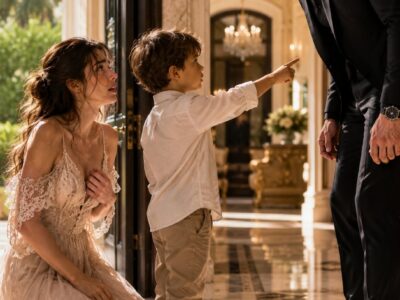
She Ran From the Mafia Prince She Was Forced to Marry… Then Returned to Find Her Hidden Lover in Power
PART 1
The bells of Santa Croce were still ringing when Julia Ferretti realized she was going to be sick.
Not from fear, though fear coiled in her stomach like a snake that had learned her name. Not from the corset pinching her ribs, or the tiara pressing into her scalp like a crown of thorns pretending to be diamonds.
It was the certainty of it. In eleven minutes she would walk down an aisle lined with the most dangerous men in Palermo and give herself, body and name and blood, to a man she had spoken to exactly four times.
Nicolò Baroni. The heir. Her future. They had all decided, without once asking her what she wanted.
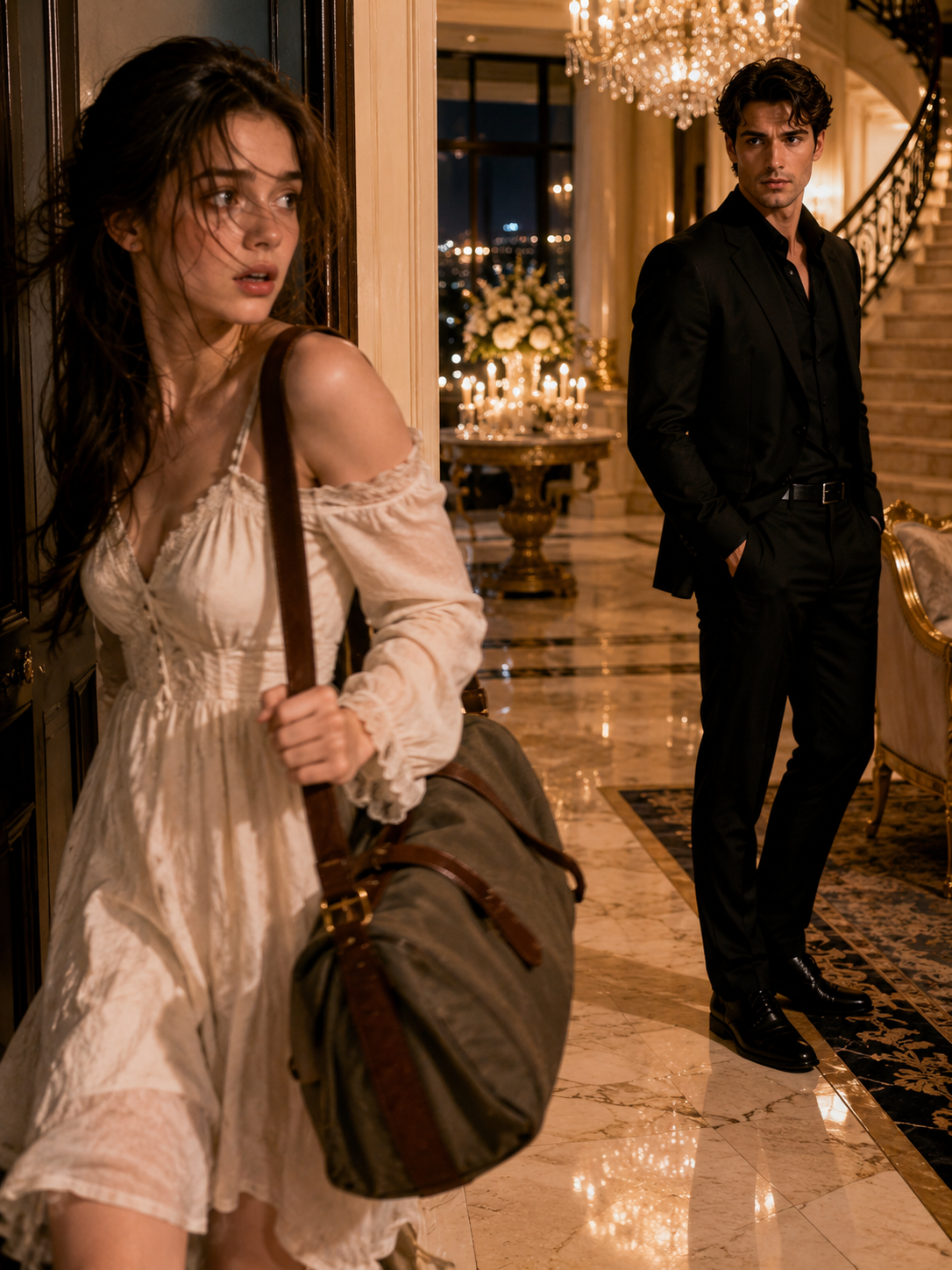
Julia’s mother stood behind her, adjusting the veil with hands that trembled only slightly.
“You look like an angel,” her mother whispered.
“I look like a sacrifice.”
Her mother’s fingers stilled. In the mirror, their eyes met, and Julia saw the truth her mother had spent thirty years burying beneath rosaries and good manners.
“I know,” her mother said. “I have always known. And I could not save you either.”
“To refuse now means what, Mama? Blood in the streets? Papa’s honor?”
“Do not be a coward,” Julia said, and hated herself the instant it left her mouth.
From beyond the door came the murmur of three hundred guests. Somewhere in that crowd stood her father, Don Vittorio Ferretti, pale beneath his silver hair, one hand pressed to a heart that had already begun its slow betrayal.
Julia looked at the window. Three nights ago she had pressed American dollars and a false passport into the hands of Enzo, the groundskeeper’s son, who had loved her hopelessly since he was nineteen.
*If I come to the road, drive. Do not ask where. Do not ask why. Just drive.*
“Mama,” she said, her voice very calm. “I need a moment alone to pray.”
Her mother searched her face, saw the resolve there, and did not name it. She only touched Julia’s cheek and said, “You were always braver than me.” Then she left, and she did not lock the door.
Julia moved fast. The veil came off. She kicked off the satin heels and felt canvas running shoes beneath the gown. The window latch was stiff, then gave, and she was over the sill and into the garden, wedding dress bunched around her thighs, running.
She ran through the roses. She ran past the fountain. She heard a voice call her name and did not stop. Her heart beat one word over and over. *Live. Live. Live.*
Enzo was waiting behind the chapel wall, the old gray Fiat already running.
“Drive, Enzo. For the love of God, drive.”
He drove. The villa fell away behind them. The man in the expensive suit who would wait at the altar and then not wait shrank in the rearview mirror and was gone.
Julia laughed, cracked and half a sob. She did not know then that she was already carrying the secret that would define the next six years of her life. It had begun quietly three months before, in a city of neon and salt air, under a name that was not her own, in the arms of a man she’d believed was no one dangerous at all.
She only knew she was free.
The alarm went off at 5:40, and Julia Rossi — for that was the name she wore now — was already awake. Six years of single motherhood had rewired her body to surface before dawn, listening for the small sounds of the apartment above a Cuban bakery in Little Havana.
Sophia, five years old, going on fifty. Dark curls exactly like her mother’s. Eyes that were not her mother’s at all — a strange, arresting gray-green, the color of the sea before a storm.
“Mama.” A small warm body collided with her legs. “I dreamed about the ocean. The one with the boats. One had a dog on it. A very lucky dog.”
Julia crouched and gathered her daughter up, breathing in the sleep-warm smell of her. *I made you out of a lie. And you are the only true thing I have ever done.*
She had become very good at being no one. No photographs on the walls. No social media. Cash whenever possible. She dropped Sophia at daycare with a kiss and the ritual promise — *I will always come back for you, always* — and told herself, as she told herself every morning, that the past was a country she had immigrated from and would never visit again.
She was wrong. She had two more weeks of not knowing it.
The club was called Velour, and it was there on a Thursday in late June that the past sent its first messenger. A man in a charcoal suit sat alone at the end of the bar, drinking Sicilian amaro from the one bottle she stocked out of a small private homesickness.
“Ferretti,” he said quietly, in Italian. “You are Vittorio’s girl.”
The floor did not open. Julia kept her hand steady on the bottle. “Wrong girl, honey. Name’s Rossi.”
But he had already seen it. He laid a hundred-dollar bill on the bar, far too much, and stood.
“Your father is dying, Julia. He is calling the family home. All of it.” A pause. “You should decide how you want to be found, because you will be found. Better it is by someone who remembers you fondly.”
Then he was gone into the crowd, and Julia stood with the bill in her hand, and the whole careful architecture of her new life groaned under a sudden monstrous weight.
The letter came on a Tuesday, slid under her door. Heavy cream paper. Her real name in a slanted, confident hand.
Inside: a single sheet, a photograph of her father shrunken in a hospital bed, and a first-class plane ticket. One passenger.
*Julia, your father does not know I am sending this… Before he goes, he intends to name his successor… Come home before there is nothing left to come home to.*
Her mother’s hand. Her mother, who had kept the secret for six years and said nothing.
She told the club a family emergency. She left Rosa downstairs an envelope of cash and a list of Sophia’s foods and fears. She packed one small bag and left the coffee-can escape fund exactly where it was, in case she needed to run again.
At the airport, she held Sophia so long the child squirmed.
“I love you more than the whole ocean,” Julia said. “Even the dogboat.”
“Especially the dogboat.”
She boarded the plane as Julia Ferretti for the first time in six years, with no idea she was flying toward the man whose eyes she kissed goodnight every evening on the face of their child.
Sicily received her coldly at first, then all at once, closing over her head. Home. She hated that it still felt like that.
Her father was so small in the great carved bed where he’d been born. She knelt and took his hand, the hand that had signed death warrants, and pressed it to her cheek.
“Julia,” he breathed. “I dreamed you came home. Are you a dream?”
“No, Papa. I’m here.”
“You ran,” he whispered. Not an accusation. A wonder. “I was so angry for years. And then I got old, and I thought — she was the only one of us who was ever free.”
His hand fell from her face, his eyes closed, and for one horrible second she thought he had gone. But he rallied.
“There is much you do not know,” he murmured, fading. “About the arrangements I made. About who I have chosen. Tomorrow, when they are all here, I will tell you. The successor. The one who will protect the family when I am—”
He slept.
The whole family arrived the next day, and the villa filled with the low, dangerous music of power gathering. Julia had asked her mother the night before who her father would name.
“Nicolò is dead,” her mother had said. “Two years now. A war with the Neapolitans.”
“Then who leads the Baroni now?”
Her mother had looked at her strangely. “His cousin. A man who came up from nothing. They call him il Silenzio. The silence, for how quietly he kills. Your father made a pact with him. He is the strongest man in Sicily now. Stronger than your father ever was.”
Now it was afternoon, and the family had gathered in the great frescoed salon — the room where her wedding was to have taken place six years before. Her father sat propped in a wheeled chair, determined to hold court one last time.
The doors opened.
And Julia Ferretti’s entire life came apart in the space of a single heartbeat.
—
PART 2
She knew him before her mind would let her know him. Her body knew first — the heat, then the cold, the breath simply stopping.
Six years older, harder. The gray at his temples was new. He wore black like she did, but on him it was not armor. It was skin.
Mateo. Her Mateo. The man from Nice with no last name. The father of her child, who did not know he was a father.
His eyes swept the room, assessing, cataloging, dismissing — and reached the window where she stood, and stopped. She watched it happen to him. The flat, cold stillness cracked, just for an instant. Just for her.
“Julia,” he said, so quietly only she and perhaps her mother heard it.
Her father’s voice broke the spell. “Ah, Mateo. Good. You are here.” He lifted a trembling hand. “Come, both of you, my daughter and my heir.”
*My heir.* The word landed on Julia like a blow.
Mateo crossed the room toward her, his eyes never leaving her face, and she saw the questions detonating behind them. *You are her. You are Vittorio’s blood. You are the bride who ran.*
He stopped an arm’s length away, close enough to smell cedar and smoke, exactly as she remembered.
“Signorina Ferretti,” he said, ice now, performing for the room, but his eyes were on fire. “We have not been introduced.”
“No,” she managed. “We haven’t.”
Behind them, her father spoke to the assembled family, gathering strength from somewhere. “I name Mateo Baroni my successor. And to bind the families in blood, not merely in words — he will take my daughter to wife, as was always intended.”
The room murmured its approval. Julia stood a foot from the father of her secret child and understood she had run all the way around the world and straight back into the arms she’d been running toward the whole time.
He came for her that night. When the party thinned toward midnight and she slipped into the small study off the library, she was not surprised to hear the door lock behind her.
“Six years,” he said quietly, dangerously, back against the door. “I looked for you for six years. A girl named Julia, dark hair, cheated at cards, disappeared from Nice one morning without a word. I had men in three countries. And the whole time you were Ferretti. Victoria’s daughter. The bride. I heard about the girl who ran from Nicolò’s wedding a hundred times, and never once did I think it was you.”
“You couldn’t have known. I never told you my name, and you never told me yours. That was the whole point.”
“We were no one. That was the game.” His eyes moved over her face like he was checking it against a memory. “And then you were gone, and I told myself it was mercy. And instead you ran straight into a wedding with my own cousin.”
“I didn’t know he was your cousin. I didn’t know anything about you.”
—
PART 3
They stood glaring, the air so thick she could hardly breathe it.
“Why did you run from the wedding, Julia?” Softer now. “Why did you *run*?”
There it was. The question with the answer that would end her. *I ran because I was carrying your child.*
“I ran because I didn’t want to be sold,” she said. It was true. It was not the whole truth. “You told me to run, Mateo. That last morning. *Don’t let them make you into what they need.* So I didn’t.”
Something moved across his face — memory, pain, something that might have been pride. His hand rose, and this time he touched her, one finger tracing her jaw exactly as he had in Nice.
“You listened. God help me. You’re the only person who ever listened to me and did the brave thing.” His voice dropped. “And now your father has given you back to me. As if I ever stopped.”
She should have stepped back. She kissed him instead.
Six years dissolved. When they finally broke apart, both of them shaking, Julia stared over his shoulder and thought one clear, cold thought through the fog of wanting him: *He has a daughter, and I have to keep her from him until I know what he’ll do when he finds out I hid her.*
Her mother found her at dawn.
“You knew him,” Maria said. Not a question. “Before you knew Mateo Baroni. I watched him look at you. A man does not look at a stranger like that.”
Julia told her everything — Nice, the false names, the pregnancy, the wedding she’d run from not just to escape Nicolò but to protect a child who wasn’t his.
“He must not find out,” her mother said, gripping her face in both hands. “Not yet. Not until you know what kind of man he has become. A man who loves you is not the same as a man who will forgive you. Say nothing. Marry him if the family demands it. Buy time. Watch him. Watch what he does when he thinks no one is looking. That is where the truth of a man lives.”
Julia understood. It was cold, and calculating, and the only survivable path.
The days that followed had the texture of a beautiful nightmare — a public courtship, walks in the olive groves, dinners performed for three hundred watching eyes. And each day the ice came off Mateo in pieces when they were alone, and the man from Nice looked out through the killer’s eyes, and it wrecked her every time.
“When you left Nice,” he told her once among the silver trees, “something in me closed. I let them make me into what they needed. The exact thing I told you to run from. You ran. I stayed. And I became the silence.”
The jealousy came on the fourth day, when a cousin named Raphael put his hand on her arm at dinner and Mateo crossed the room without raising his voice and marked her as his in front of the whole family, and Julia was appalled at how much of her wanted it.
On the fifth day, the third door opened, and it opened from the outside.
Julia called Rosa every day on a burner phone from a locked bathroom. On the fifth day, Rosa’s voice was wrong.
“A man came to the bakery asking about you,” Rosa said. “He showed a photograph. Sophia was with me. He looked at her a long time. Then he smiled and said, ‘What a beautiful child. She has unusual eyes.’ And he left.”
Julia’s knuckles went white on the sink. Someone had traced her to Miami. Someone had seen Sophia’s eyes — the Baroni eyes — and said so deliberately, as a message. *We see the child. We know what the child is.*
“Rosa, take Sophia to your sister’s in Orlando tonight. Don’t tell anyone where.”
That night, at dinner, Mateo read the wall around her in an instant. “Something frightened you,” he said in the library afterward. “I need to know, because I cannot protect you from a thing I can’t see.”
Julia stood at the edge of the truth and understood her strategy had just collapsed, because time had run out.
“If I tell you something,” she said, shaking, “something you’re going to hate me for — will you promise me you’ll protect what needs protecting before you punish me?”
His hands went steady around hers. “Whatever it is, I promise you on my life.”
“I have a daughter.” The words fell into the silence and lay there. “She’s five. I had her in Miami alone. She has dark curls like mine.” Julia made herself hold his eyes. “And gray-green eyes. The color of the sea before a storm.”
She watched him do the arithmetic she’d done six years ago in a bathroom in Palermo. She watched the number land. She watched the exact instant Mateo Baroni understood he was a father — and then watched something colder move in behind the shock.
“You’ve known for six years,” he said. “You let me believe—” He rounded on her, and the fury was cold and vast. “You decided she wouldn’t have a father.”
“I did it to keep her alive,” Julia said, crying, furious. “Do you understand what would have happened if I’d stayed?”
“Where is she now?” he said finally, flat, controlled, terrifying — and here it was, the reason she’d broken her silence at all.
“That’s why I had to tell you. Someone found her today. A man came to the bakery, looked at her eyes, and left a message. Someone knows about her, Mateo. Someone who isn’t you.”
Everything changed in him at once. He was already moving, pulling a phone from his pocket, giving orders that would set a machine in motion across an ocean.
At four in the morning came the report. Mateo took it standing at the window, and Julia knew before he spoke that it was bad.
“The two men outside the sister’s house,” he said. “My people took them quietly. They talked.” He turned, and his face was carved from stone. “They were hired to watch the child, confirm she was the one from the bakery photograph, and wait for an order.”
“What order?”
“The order they were waiting for,” Mateo said, “was to take her. Alive.”
—
[WEBSITE — PART 3]
“But she’s safe,” Julia said. “You said she’s safe.”
“She’s safe. My men have her.” He crossed to her and took her by the shoulders. “Listen to me. Someone inside this family tried to steal a child they didn’t even know for certain was mine, which means they’ve now confirmed she is. The stakes just doubled. And the wedding is in two days.”
She saw her father the next morning, in a rare lucid hour. She told him everything — the surveillance, the attempted kidnapping — and watched something ancient and knowing settle over his ruined face.
“I am dying, Piccolina,” he said. “I am not blind. There are men in this family who did not want you to come home. I know who they are. That is why I chose Mateo. I did not choose him for the alliance. I needed a wall around my daughter that no one could climb, and il Silenzio is that wall.” His grip tightened. “The man behind the danger — it is not Raphael. It is my brother’s son. Your cousin. Domenico.”
Julia’s blood turned to ice. Domenico Ferretti. The quiet, watchful consigliere, so unthreatening no one had ever thought to threaten him.
“He has been consigliere so long he began to believe the family was already his,” her father breathed. “When Nicolò died and you were gone, he thought his moment had come. He built alliances quietly, in my own house. I named Mateo instead — a man he cannot control. It was Domenico’s money, Domenico’s men. He wanted you dead before you could return. When that failed, he wanted the child, to control you.” His eyes blazed. “Tell Mateo today. Do not trust his smile.”
Mateo received the name without visible reaction, which frightened her more than fury would have.
“It fits,” he said finally. “God help me, it fits perfectly. He’s been my link to the Ferretti side for two years. Every piece of intelligence filtered through him.” His eyes went cold and distant. “He told me you were probably dead. Two years ago. I stopped looking so hard.” A terrible laugh. “He knew you were alive in Miami. He was watching you himself. And he told me you were dead — to keep me from finding you.”
He crossed to the window. “It’s only now that he needs you dead. Your father recalled you and named me, and the drift he profited from is ending. In two days the succession locks.” He turned back. “Your father is right. The wedding is when he’ll move. So we don’t cancel it. We hold it exactly as planned, and we let him walk into his own trap thinking it’s ours.”
His plan was audacious. At the ceremony, before the vows finished, Mateo would publicly claim Sophia — announce her to the whole family as his daughter and heir, turning her from a secret weakness into a source of Baroni strength no one could exploit.
“You’d stand up and call her your heir,” Julia said. “A child born out of wedlock, to the runaway bride.”
“She is my heir,” Mateo said, no argument in his voice. “I’ve known about her for a day and a half, and I would already stand in front of every gun in Sicily and dare them to say a word against her. The safest thing for Sophia isn’t to be hidden anymore. It’s to be known. Loved and claimed and protected by the most dangerous man in Sicily. Let me be that for her.”
The night before the wedding, Julia could not sleep, and found she did not want to be alone. She went to Mateo’s rooms. On the desk sat a photograph — surveillance, grainy, of Sophia mid-laugh.
“They sent it this afternoon,” he said, “so I could see her. I’ve looked at it maybe four hundred times.” He touched the edge of the photo. “She has your smile. And my everything else, apparently. That weighing look.”
He opened a drawer and handed her a folded, notarized document — dated that afternoon — naming Sophia his sole heir, transferring everything into a trust controlled by Julia if he died. A fortress of paper built in a single afternoon by a man preparing to possibly die for a daughter he’d never met.
“I know you don’t trust me yet,” he said. “But that’s not a gesture, Julia. That’s the truth of where I stand.”
“You’ve known about her for thirty-six hours.”
“And I’ve loved you for six years.” He said it simply, which made it heavier. “Stay tonight. Not for anything. Just stay. Let me not be alone the night before I go to war for a family I’ve never had until now.”
She stayed. Not as a bride bought and sold, but as the girl from Nice who had loved a man with no last name.
The garden had been transformed for the wedding — candles, jasmine, three hundred of the most dangerous people in Sicily gathered once again beneath the cypresses. This time, Julia walked through the door instead of jumping from the window.
Her father was carried down to see it. When the ceremony reached its end, before the priest could finish pronouncing them, Mateo turned to face the assembled family and raised his voice.
“Before we celebrate, I have something to tell my family.” The garden went quiet. “Six years ago, before any arrangement, I fell in love with a woman whose name I did not know. That woman is now my wife. And what none of you know — what I myself did not know until this week — is that our love gave us a daughter. Sophia. Five years old. She is by blood the true heir of both the Baroni and Ferretti lines.”
The garden erupted in a low roar of shock. Julia watched Domenico’s soft smile freeze on his face, because his secret weapon had just been announced to the world as beloved, claimed, and untouchable.
“She is safe in a place none of you will ever find,” Mateo went on, his voice dropping into something quiet and lethal. “Any person who has moved against that child or against my wife will answer to me personally.”
His eyes found Domenico’s and held them.
Cornered, exposed, understanding in a single terrible instant that the wedding was Mateo’s trap and not his own, Domenico Ferretti did the only thing a cornered snake can do. He reached inside his jacket.
Julia saw it as if underwater — the glint of metal, her father helpless in his chair directly in the line of fire, Mateo already shoving her behind him. The garden that had been a wedding became a battlefield.
One of Mateo’s hidden men fired the instant Domenico’s weapon appeared. Domenico spun, hit in the shoulder, his gun discharging wild into the canopy. Screaming. Chairs overturned. Men Julia had never marked as soldiers rising up out of the crowd.
She saw one of Domenico’s men swing a gun toward her father in his chair. She moved before she thought — out from behind the altar, running toward the danger this time instead of away from it — and threw her body over the old man.
She heard Mateo scream her name, a sound she never wanted to hear again.
The shot went into the sky. Mateo’s man reached the gunman half a second before he could fire again. It was over in ninety seconds. When the smoke cleared, Domenico knelt disarmed and bleeding, and Mateo crossed the garden to him without hurrying.
“You sent men across an ocean to steal a child,” Mateo said quietly, crouching to his level. “You told me she was dead. Her mother. So I would stop looking.”
“You’re no better than me, Silenzio.”
“I’m not pretending to be better. I’m telling you why you’re going to die. There’s a difference.”
Vittorio, from his chair, found his old iron for one last moment. “He moved against my daughter and my grandchild in my own house. Do what must be done. But not here. Take her inside first. My daughter should not see this.”
They took Domenico away. Julia did not watch him go, and did not mourn what would happen to him.
Mateo dropped to his knees beside her father’s chair and took her face in both his shaking hands, undone for the first time in the whole impossible week.
“You ran toward it,” he said, cracked on every word. “There was a gun, and you ran toward it.”
“He’s my father. You’d have done the same for Sophia.”
He went still, because it was true, and it was the thing that bound them.
Vittorio Ferretti died four days later, in his own bed, at the gray hour before dawn. He held on long enough to see Domenico’s treachery ended and the capos kneel to the new don. Long enough for one more thing.
“I want to see her,” he said in a lucid hour. “Sophia. My grandchild. Before I go.”
“It’s safe now,” Mateo said quietly. “Domenico is finished. I can have her here in eighteen hours, guarded the entire way.”
Sophia arrived the next afternoon, curls wild, storm-colored eyes enormous, shouting “Mama!” and launching herself across the gravel drive. Julia caught her and held her so hard the child squeaked.
Mateo stood a little apart, and Julia understood what his stillness was. Terror. The most dangerous man in Sicily, frozen with fear at the prospect of meeting a five-year-old.
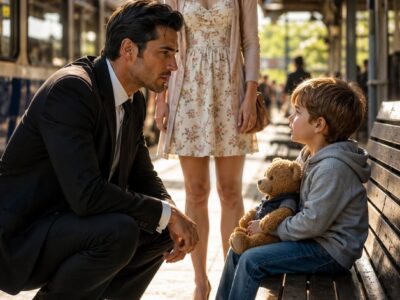
He knelt on the gravel so he was at her height.
“Hello, Sophia. My name is Mateo.”
“You have my eyes,” Sophia announced with blunt five-year-old certainty.
“No,” he said gently. “You have mine. I had them first.”
“Are you mama’s friend?”
“I’m your papa, Sophia. I’ve been away for a long time. I didn’t know where you were, but I looked for you. And I’m never going to be away again.”
“Do you have boats? Boats with dogs on them.”
“I have several boats,” Mateo said, in the gravest voice Julia had ever heard him use. “And if you want a dog on one of them, there will be a dog on one of them by tomorrow. This I promise you.”
He held out his hand. Sophia looked at it, looked at her mother, and put her small hand in his enormous one. “Okay, papa.”
They took her upstairs to meet her grandfather. Vittorio’s trembling hand found her curls.
“There’s the free one,” he breathed. “The one none of them will ever be able to sell. I sold your mother once, to buy peace. It was the great sin of my life. And she ran, and she made you.” His eyes drifted to Julia. “You gave me a gift, Piccolina. You brought the free one home, and she is loved.”
He looked at Mateo. “You will protect them. Both of them.”
“With everything I am,” Mateo said. “Until I die, and after.”
“Good.” Vittorio’s eyes closed, his hand still in Sophia’s curls. “Then I can go. It is enough. It is more than a man like me deserves.”
He died the next morning with his family around him.
They did not go back to Miami. There had been a clause in the document Mateo drew up — *should the mother wish to raise the child elsewhere, she shall have every resource and protection, and the father shall not compel her return.* He had built her a door out and left it unlocked, and it turned out an unlocked door was the only thing that could make her want to stay in the room.
One year later, on their real anniversary, they married again — a small private thing on the terrace with only family, and no one shot at anyone. Sophia was the flower girl, scattering jasmine petals with the fierce concentration of a general deploying troops, and announcing loudly at the end, “I didn’t drop any.”
That night, on the terrace, with their daughter asleep and dreaming of boats with dogs on them, Julia asked him the question she’d carried for a year.
“Do you ever hold it against me? The six years?”
“At the start, yes,” Mateo admitted. “Grief that came out sideways as anger. But if you hadn’t lied, she’d be dead, or worse. You held the line for six years alone so that when I finally became strong enough to protect her, there’d be a her to protect.” He brought her hand to his lips. “I don’t hold it against you. I hold it *for* you. It’s the bravest thing anyone’s ever done.”
Below them, Sophia caught a firefly in her cupped hands in her sleep-fogged memory of the evening, and somewhere in the sleeping villa the family breathed easy for the first time in a generation.
“Say it,” Julia murmured. “The thing you said in Nice. The last morning.”
“If I could burn my whole life down and start again as no one, I would do it tonight for you.” His arms tightened. “But I don’t have to anymore. I burned it down and built it back around you. Everything I am now — it’s a wall around the two of you. Not il Silenzio. Not the don. Just yours. Just Mateo.”
“Just Julia,” she whispered.
“Just Julia,” he agreed. “The woman with one name, who hadn’t decided who to be yet.” He tipped her face up to the moonlight. “Have you decided?”
Julia Baroni smiled — the real smile, the one that reached all the way up, the one it had taken him six years and an ocean to find again.
“Yes,” she said. “I’m going to be the one who stayed.”
And she kissed him under the ancient stars, in the garden she’d once fled, in the world she’d once run from, and there were no more windows to jump out of, and no more names to hide behind, and no more running left to do.
THE END