🚨 BOGIE TRIPLE-MURD3R TRI@L — AN EXPERT HAS NOW LINKED DEREK YOUNG’S HOME TO THE ALLEGED MURD3R SCENE… AND ONE NEW DETAIL IS DRAWING FRESH ATTENTION
A ballistics expert has told a Queensland jury that microscopic marks on spent ammunition could provide a crucial forensic link between the home of accused triple murderer Darryl Valroy Young and the remote gate where three members of one family were shot dead.
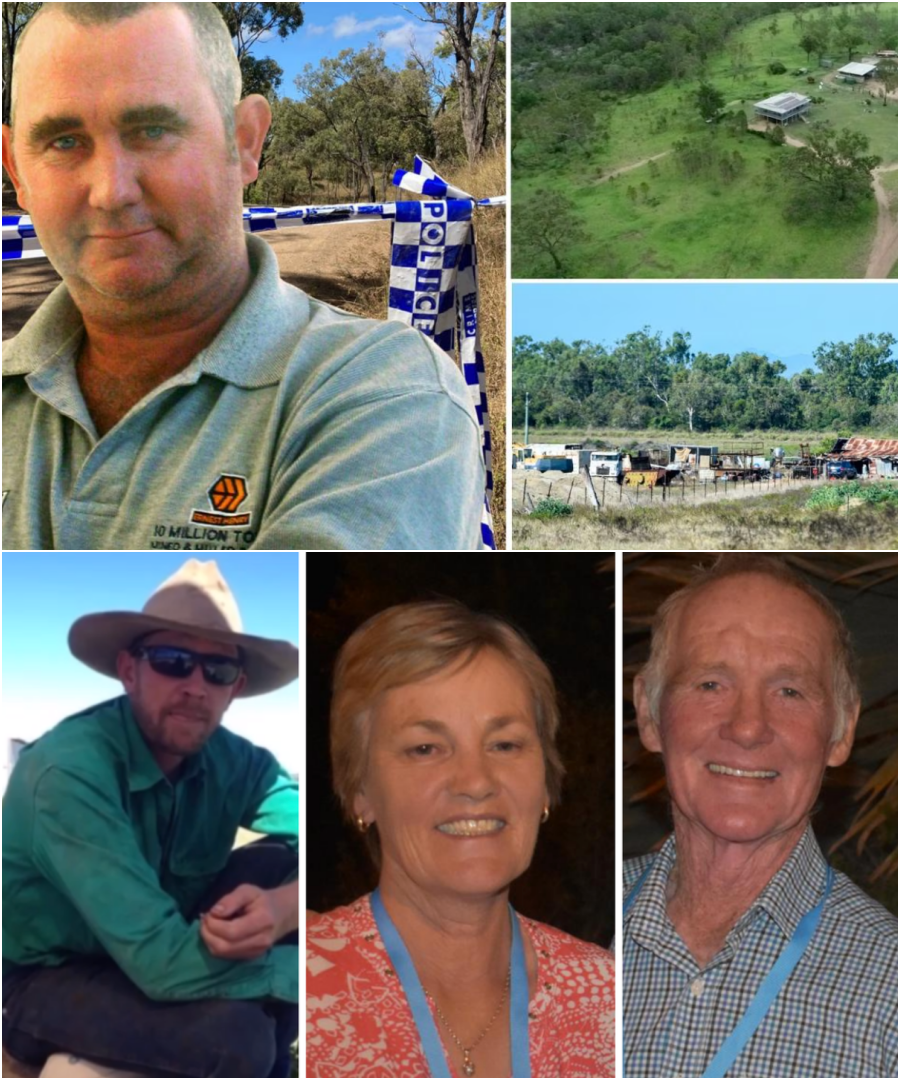
Young, 63, is standing trial in the Supreme Court over the deaths of Mervyn Schwarz, his wife Maree Schwarz and her son Graham Tighe, as well as the attempted murder of Graham’s brother, Ross Tighe.
All four family members had gone to the front gate of Young’s Shannonvale property near Bogie on August 4, 2022, when the shooting allegedly occurred. Young has pleaded not guilty to all three murder charges and the attempted murder charge, with his defence maintaining that he was not at the gate when the shootings took place.
But on Thursday, the jury heard detailed evidence from ballistics expert Sergeant Ian Bruce, who examined ammunition recovered from both the alleged crime scene and Young’s homestead.
The expert told the court that four spent cartridges recovered from the area where the three family members were killed could be compared with another spent cartridge found inside Young’s Shannonvale home. Through microscopic examination, Bruce identified marks left on the casings during the firing process, including impressions associated with the firearm.
His evidence was presented as a significant part of the prosecution case because it potentially connected ammunition at Young’s home with ammunition discharged at the murder scene. Bruce’s findings suggested the casings had been fired from the same firearm, although he also acknowledged the limitations of firearms comparison and did not claim that the analysis could provide absolute certainty.
The jury also heard evidence concerning a projectile fragment recovered from Graham Tighe’s head.
According to Bruce, the fragment was more consistent with Remington 30-30 ammunition, a type of ammunition that had also been found inside Young’s home. However, the expert accepted that the damage to the fragment limited the conclusions that could be drawn from it and prevented him from making a definitive identification of the exact firearm involved.
The alleged murder weapon itself has not been recovered.
That absence has made the cartridge and ammunition evidence particularly important for the prosecution, which is seeking to build a forensic chain between the shootings and items found at Young’s property. Previous evidence has also shown that investigators recovered additional spent casings and ammunition from the Shannonvale property as the police investigation unfolded.
However, Bruce told the court that the evidence did not allow him to completely reconstruct what happened during the fatal encounter.
He explained that a reliable reconstruction of a shooting can depend on factors such as the fixed position of bullet holes, visible damage and the original locations of discharged cartridge cases. In this case, he said, the positions of the spent casings could not necessarily be treated as a precise indication of where the shooter had been standing when each shot was fired.
Bruce also said the available injuries and physical evidence did not allow him to give a firm opinion about the calibre of the firearm responsible for every wound or the precise distance from which the shots had been fired.
The expert’s examination of the victims’ clothing nevertheless produced further evidence for the jury to consider.
The court heard that Graham Tighe appeared to have been shot from behind based on the available physical evidence. But Bruce was unable to reach a similarly clear conclusion about Maree Schwarz after examining her bloodstained and dirt-covered clothing.
The jury had already heard evidence about the devastating injuries suffered during the alleged attack. Maree Schwarz was found in the driver’s seat of a vehicle, while police evidence presented earlier in the trial described shell casings and other ballistic evidence recovered around the gate and the victims.
Later, the court turned its attention to Ross Tighe, the only person from the group to survive.
Dr Marius Jordann, the surgeon who operated on him at Mackay Base Hospital on the day of the shooting, told the jury that Tighe had been flown to hospital with a wound to his stomach and severe internal bleeding.
During emergency surgery, Dr Jordann found about two litres of blood inside Tighe’s abdomen. He also found a projectile lodged in the injured man’s pelvis. The surgeon’s evidence underscored the severity of the injuries, with the court hearing that Tighe would have died without surgical intervention.
Ross Tighe has previously given evidence that Young was present at the front gate when the shooting occurred. During cross-examination earlier in the trial, he angrily rejected the defence suggestion that Young had never been there, insisting that the accused was at the scene.
The prosecution and defence now face a sharply contested question: whether the combination of witness testimony, forensic evidence and the disputed ammunition trail can establish what happened at Shannonvale on that August morning.
For prosecutors, the microscopic similarities between a cartridge found inside Young’s home and four found at the alleged murder scene may represent one of the clearest physical links yet presented to the jury.
For the defence, however, the limits acknowledged by the ballistics expert remain significant. Young has pleaded not guilty, and the prosecution must still prove the allegations beyond reasonable doubt.
As the trial continues, the jury will be asked to weigh the expert evidence alongside testimony from surviving witnesses, police officers, medical specialists and other people connected to the bitter dispute that preceded the deadly confrontation.
The case remains before the Supreme Court.
SOURCE: The Courier Mail