What is so special about Meghan’s latest photo that made her call Harry ‘one and only’?
This past Sunday, when the world saw Prince Harry beaming in the company of his children for Father’s Day, it was more than just a fleeting family moment. Behind the smile of “Papa Sussex” lies a quiet but heavy message, captured in Meghan Markle’s caption: “They’re so lucky to have you. We all are.”
However, beneath the warmth of their Montecito estate lies a far more complex reality. While Harry embraces his role as a father, another journey is silently unfolding: a plan to bring his family back to the United Kingdom this coming July. This is no mere visit; it is a calculated move in a high-stakes game of reconciliation. The price of this gamble is not merely legal disputes over security, but the very survival of a family bond teetering on the brink of collapse.
Why is “Normalcy” Such a Luxury?
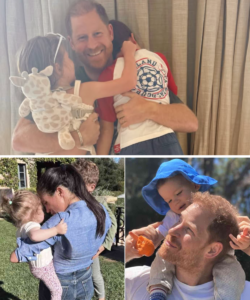
We often look with skepticism at the lives of those who leave the royal fold. But consider Meghan Markle’s candid reflection to PEOPLE magazine in 2025: “Once you know us, I think you want us to have the same normalcy as parents and for our children as they do, despite however unique our situation is.”
This is not a defense; it is a declaration of intent. Their struggle to build a “normal” life in California is, in essence, a resistance against the very royal structure they abandoned. The irony, however, is that the harder they try to escape that spotlight, the more they become the center of public scrutiny. When Harry uses images of his own children to champion his philanthropic work on online safety, he is attempting to redefine himself: no longer as a fallen prince, but as a father building a world for the next generation.
A Game of Fractures
The projected visit in July—timed to coincide with the one-year countdown to the 2027 Invictus Games—is fraught with uncertainty. Harry finds himself in an agonizing dilemma: he wants to go home, yet he feels unsafe on his own native soil without state-funded police protection. The court’s dismissal of his legal appeal for security was more than a legal setback; it was a cold message from the British establishment: “You have left, and you are no longer part of this system.”
The rift between Harry and King Charles is no longer about trivialities; it is defined by a chilling silence. Their meeting in September 2025, after 19 months apart, was but a fragile gesture. Harry—with all the sincerity, and perhaps a touch of desperation, of a son—bared his soul to the BBC this past May: “I would love reconciliation with my family. There’s no point in continuing to fight anymore.”
His next words cut through the apathy of the times: “Life is precious. I don’t know how much longer my father has.” He admitted: “He won’t speak to me because of this security stuff, but it would be nice to reconcile.”
Perspective: Reconciliation is not a destination, but a trade-off
There is a bitter truth Harry seems to have grasped: reconciliation cannot happen in a vacuum of power. On one side stands a Monarch bound by constitutional duties and rigid protocols; on the other, a father determined to protect his family at any cost, even if it means confronting his own heritage.
Harry’s persistent, public desire for reconciliation, even in the face of repeated rejection, reveals a shift in his mindset. He is no longer fighting to reclaim royal privileges; he is fighting for the right to be human—the right of a son to see his father before it is too late. If the July trip proceeds, it will be the ultimate test. If the presence of Archie and Lilibet on British soil cannot soften a grandfather’s heart, then perhaps reconciliation will forever remain a concept consigned to the past.
Harry is playing an all-in hand, where paternal love and self-respect are weighed on the scales. And in this gamble, he accepts the greatest risk of all: the prospect of being turned away once again, on his own home turf.