
A baby macaque monkey named Punch has gone viral for his heart-wrenching pursuit of companionship.
After being abandoned by his mother and rejected by the rest of his troop, his zookeepers at Ichikawa City Zoo in Japan provided Punch with an orangutan plushie as a stand-in mother. Videos of the monkey clinging to the toy have gone viral worldwide.
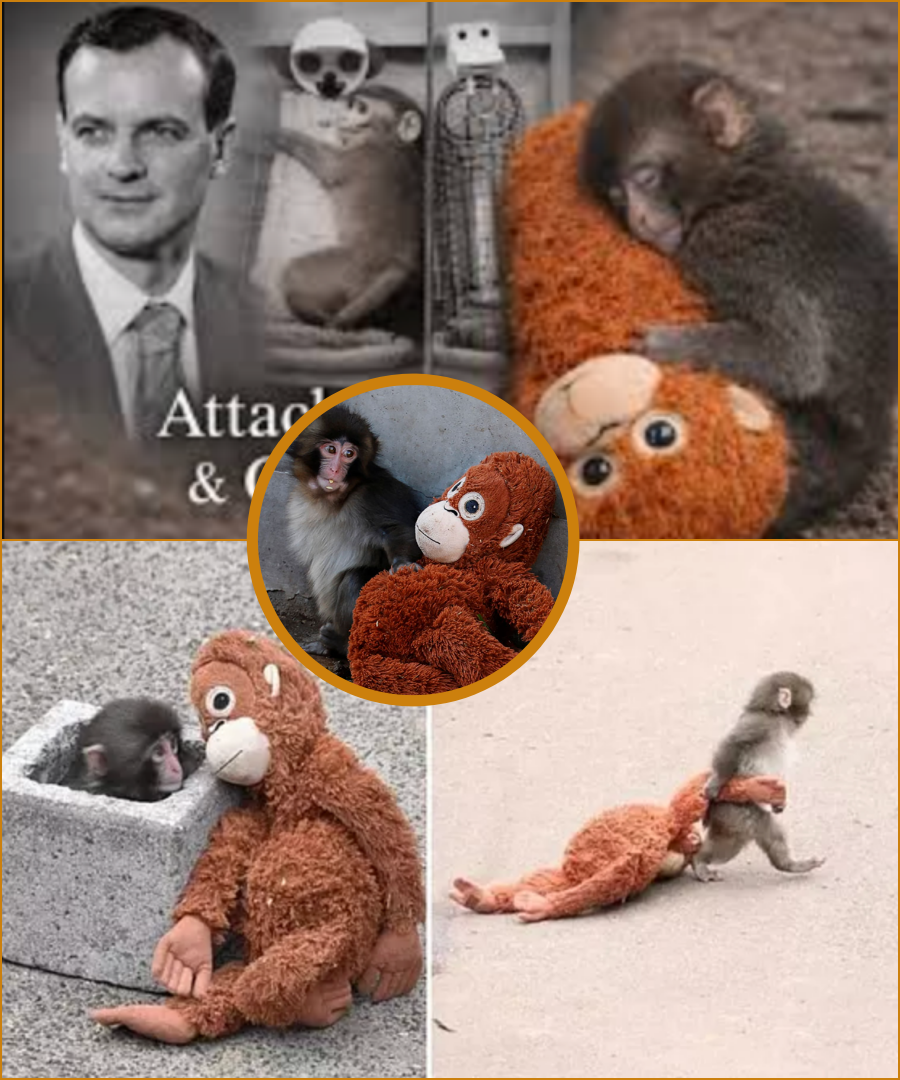
But Punch’s attachment to his inanimate companion is not just the subject of a heartbreaking video. It also harks back to the story of a famous set of psychology experiments conducted in the 1950s by US researcher Harry Harlow.
The findings from his experiments underpin many of the central tenets of attachment theory, which positions the bond between parent and child as crucial in child development.
The other was a monkey-shaped doll wrapped in terry towelling. This doll was soft and comfortable, but it didn’t provide food or drink; it was little more than a furry figure the baby monkey could cling to.
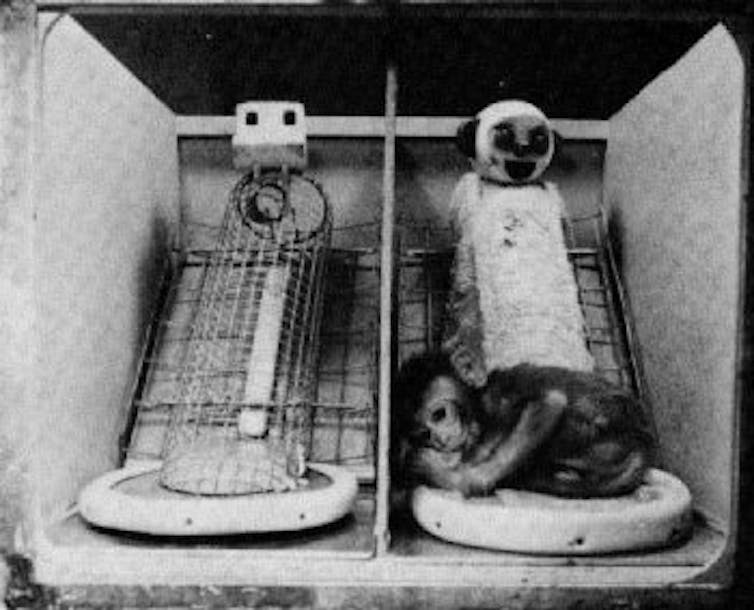
The wire ‘mother’ and the soft ‘mother’ in Harlow’s experiment. Harlow, H. F. (1958). The nature of love. American Psychologist, 13(12), 673–685.
So, we have one option that provides comfort, but no food or drink, and one that’s cold, hard and wiry but which provides dietary sustenance.
These experiments were a response to behaviourism, which was the prevailing theoretical view at the time.
Behaviourists suggested babies form attachments to those who provide them with their biological needs, such as food and shelter.
Harlow challenged this theory by suggesting babies need care, love and kindness to form attachments, rather than just physical nourishment.
A behaviourist would have expected the infant monkeys to spend all their time with the wire “mother” that fed them.
In fact, that’s not what happened. The monkeys spent significantly more time each day clinging to the terry towelling “mother”.
Harlow’s 1950s experiments established the importance of softness, care and kindness as the basis for attachment. Given the opportunity, Harlow showed, babies prefer emotional nourishment over physical nourishment.
How did this influence modern attachment theory?
Harlow’s discovery was significant because it completely reoriented the dominant behaviourist view of the time. This dominant view suggested primates, including humans, function in reward and punishment cycles, and form attachments to whoever fulfils physical needs such as hunger and thirst.
Emotional nourishment was not a part of the behaviourist paradigm. So when Harlow did his experiments, he flipped the prevailing theory on its head.
The monkeys’ preference towards emotional nourishment, in the form of cuddling the furry terry towel-covered surrogate “mother”, formed the foundation for the development of attachment theory.
Attachment theory posits that healthy child development occurs when a child is “securely attached” to its caregiver. This is achieved by the parent or caregiver providing emotional nourishment, care, kindness and attentiveness to the child. Insecure attachment occurs when the parent or caregiver is cold, distant, abusive or neglectful.
Much like the rhesus monkeys, you can feed a human baby all they need, give them all the dietary nourishment they require, but if you don’t provide them with warmth and love, they’re not going to form an attachment to you.
What can we learn from Punch?
The zoo was not conducting an experiment, but Punch’s situation inadvertently reflects the controlled experiment Harlow did. So, the experimental setup was mimicked in a more natural setting, but the outcomes look very similar.
Just as Harlow’s monkeys favoured their terry towelling mother, Punch has formed an attachment to his IKEA plushie companion.
Now, what we don’t have with the zoo situation is the comparison to a harsh, physically nourishing option provided.
But clearly, that’s not what the monkey was looking for. He wanted a comforting and soft safe place, and that’s what the doll provided.
Were Harlow’s experiments ethical?
Most of the world now recognises primates as having rights that are, in some cases, equivalent to human rights.
Today, we would see Harlow’s experiments as a cruel and unkind thing to do. You wouldn’t take a human baby away from its mother and do this experiment, so we shouldn’t do this to primates.
It’s interesting to see people so fascinated by this parallel to an experiment conducted more than 70 years ago.
Punch the monkey is not just the internet’s latest animal celebrity – he’s a reminder of the importance of emotional nourishment.
We all need soft spaces. We all need safe spaces. Love and warmth are far more important for our wellbeing and functioning than physical nourishment alone.
News

SHE WAS A REALLY NICE, LITTLE, GOOD, QUIET GIRL… — GRANDFATHER’S HEARTBREAKING FAREWELL AS Sharon Granites IS FOUND IN TRAG-IC CIRCUMSTANCES
‘Get him to the police station and we’ll look after him.’ Aboriginal and Torres Strait Islander people are warned the…

NEW LIFE TOGETHER… — THE FAMILY’S FINAL PLANS BEFORE THE FIRE LEAVE MANY HEARTBROKEN
Skye Hughes and David Higgins said their family’s lives had changed forever after two of their children were tragically killed…

FOREVER CHANGED… — PARENTS OF CHILDREN KI-LLED IN A HOUSE FIRE SPEAK OUT IN TEARS, LEAVING THE COMMUNITY HEARTBROKEN
The two children killed in a devastating house fire west of Sydney have been identified. Myla Summer-Lea Hughes, 10, and…

HEARTBREAKING L0SS — FAMILY AND COMMUNITY MOURN BELOVED PILOT Rob Hoyle KI-LLED IN H0RRIFIC CRASH AT Parafield Airport
Robert Hoyle — known as ‘Goose’ to his students — had dreamed of flying since childhood. A young pilot who…

💔 ME AND RAMSIAH MISS AND LOVE YOU — A MOTHER’S HEARTBREAKING FAREWELL TO Sharon Granites LEAVES MANY DEVASTATED
Five-year-old Kumanjayi Little Baby had been missing for five days. NT Police Credit: Supplied Source Known A body believed to be that…
MAJOR UPDATE – Zohran Mamdani MEETS King Charles III IN New York City AFTER REVEALING A “PRIVATE MESSAGE” THAT DREW ATTENTION
The mayor shook hands with the King during his visit to New York City on Wednesday, April 29 Zohran Mamdani…
End of content
No more pages to load