For a Decade, She Disguised Her Beauty—Then the Mafia Boss Saw the Real Her
Chapter 1 — Three Seconds
The morning they announced the acquisition, Ariana Vale arrived at work seventeen minutes early, same as every other morning for the past four years. She slipped through the side entrance on Wacker Drive before the lobby filled up and took the stairs to the fourteenth floor because the elevator made her feel trapped. She was good at not being noticed.
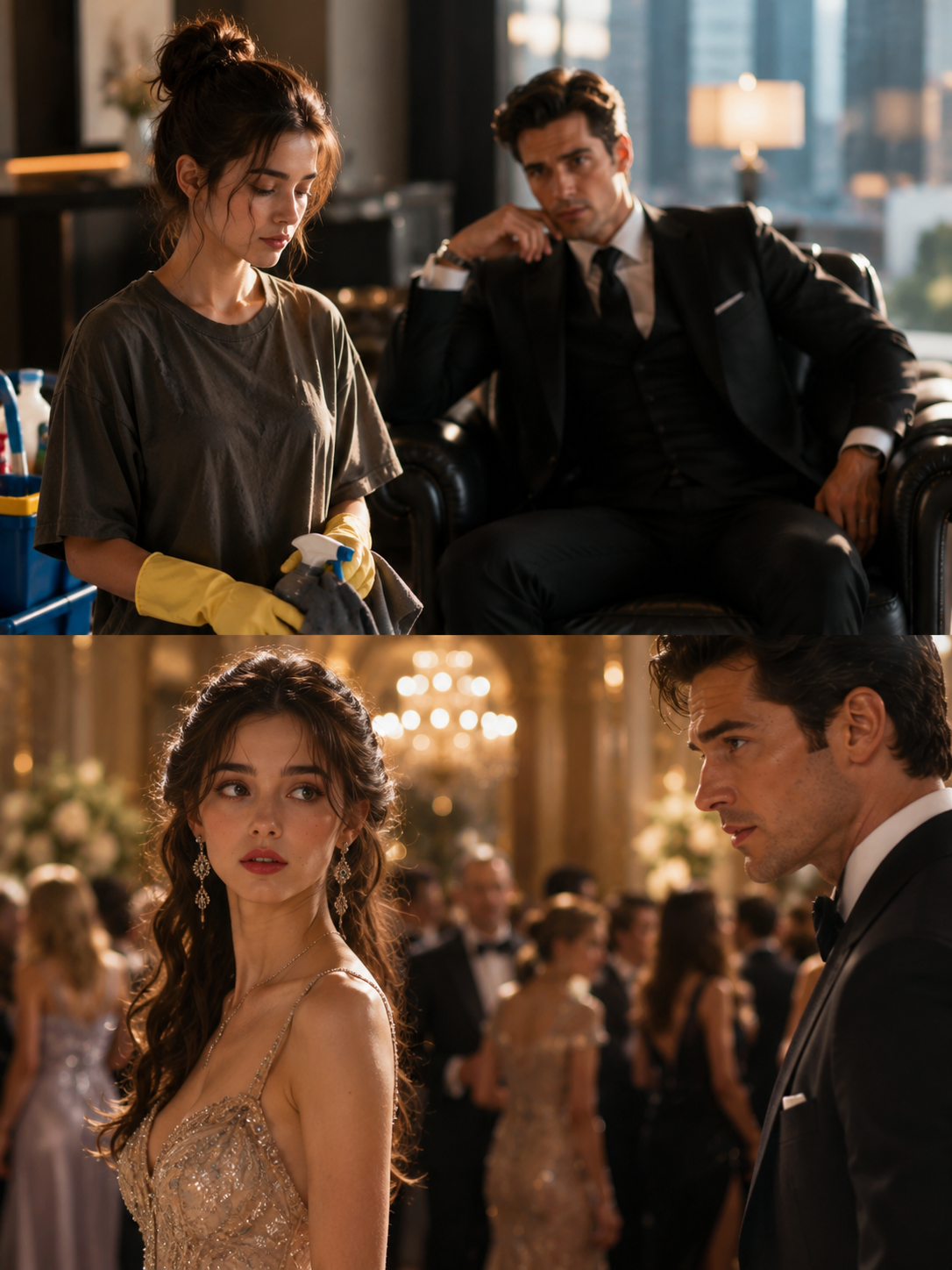
The gray cardigan she wore was two sizes too large. She’d bought it deliberately. The way it hung off her shoulders and swallowed her collarbone was the point. Her hair went into a knot before she left her apartment, and her glasses — plain rectangular frames with clear lenses she didn’t need — sat low on her nose like a prop from a bad costume department. Nothing about her said anything about her. That was the whole architecture of her life.
She sat at her desk in the far corner of the open floor plan at Meridian Capital Group, a midsized investment advisory firm with about two hundred employees, a forgettable logo, and a CFO who still didn’t know her name after four years. She didn’t correct that. She liked it.
At 8:47 a.m., her colleague, Derek Finn, dropped into the chair at the neighboring desk. “You hear? The company got bought. Like — acquired. Quietly. Nobody was supposed to know until this morning.”
Ariana kept her eyes on her screen. “I have a 9 o’clock deadline.”
“The new owner is coming in personally today. They’re calling an all-hands for eleven. Even the analysts.”
At 10:58 a.m., she walked to the large conference room with the rest of the analyst pool and found a spot near the back wall. She was better standing. It left a cleaner exit path.
He walked in at exactly 11:03. Not 11:00, which would have been an obvious power move. Not 11:05 or 11:10, which would have signaled dismissiveness. Exactly 11:03, like he’d calculated the specific minute at which arriving would communicate the most without announcing it.
Lorenzo Duca was taller than she’d expected. He wore a dark suit without a tie, and he had a hard face — not classically handsome, but the kind that had been tested by things most faces never got close to. There was a stillness to how he moved through the room that she recognized, not from anyone in her current life, but from some older and more dangerous part of her memory she kept carefully locked.
He didn’t smile. He looked at everyone slowly, in a way that covered the room completely. When his eyes reached the back wall where Ariana was standing, they stopped. For perhaps three seconds.
She held herself very still, made her face neutral, breathed slowly. His gaze moved on.
“I’ll keep this short,” he said. His voice was low and even. “Meridian Capital Group is now a subsidiary of Duca Holdings. That transition is already complete. Nothing about your day-to-day function changes until I decide it changes. If your work is good, you’ll know it. If it isn’t, you’ll also know it.” He paused. “Questions can go through your department heads. I’m not interested in questions today.”
He left before the applause finished. Derek materialized at her elbow. “That’s him. That’s the guy.”
“I gathered.”
“You know who he is? Like actually who he is?”
She picked up her laptop bag. “I know enough.” She knew more than enough. The name Lorenzo Duca existed in certain financial circles the way a particular kind of weather existed. His legitimate business holdings were substantial and well documented — hotels, a shipping and logistics company, a real estate development arm. What sat beneath that clean surface was the kind of open secret that people in the right rooms understood and in the wrong rooms didn’t ask about.
She had spent four years building a life specifically designed to keep her out of rooms where dangerous men paid attention to her. She went back to her desk. She did not think about the three seconds. She almost convinced herself of that.
The summons came eight days later. An email from someone named C. Reeves, executive office, Duca Holdings. *Ms. Vale, please report to the executive suite, 32nd floor, at 2:15 p.m. this afternoon.*
At 2:12 she took the elevator to 32. The receptionist directed her to a seating area. C. Reeves appeared instead — a woman in her early forties with close-cropped hair. “Mr. Duca will see you now.”
Lorenzo was standing at the window when she entered. He turned, moved to his desk, sat without ceremony. He opened a file folder. “Ariana Vale,” he said, not a question. “Four years at Meridian. Before that, eighteen months at Callaway. Before that, two years at Harrington.” He turned a page. “Before Harrington, nothing. Top of your class from Northwestern, double major in finance and applied mathematics. Then a gap. Then Harrington.”
The silence he left was the kind that expected to be filled. She did not fill it.
Something crossed his face — not quite respect, closer to recalibration.
“Your reports,” he said, “are the best analytical work I’ve seen from this firm by a significant margin.”
“Thank you.”
“That’s not a compliment. That’s an observation.” He closed the folder. “I want to restructure the analytical division. Create a dedicated strategic analysis unit reporting directly to the executive level. I want someone to head it.” He paused. “I want that to be you.”
The thing that moved through her chest was not excitement. It was something adjacent to fear. “I’m not the right person for that role.”
“Why?”
“I work better in support positions.”
“That’s not a reason. That’s a description.” He said it without selling it, which was somehow more unsettling than if he’d tried to persuade her.
“I’m not asking you to be comfortable,” he said. “I’m asking if you can do the job.”
“I’m saying I don’t want the job.” She stood.
“Sit down.” The command was quiet, not sharp, just absolute. She sat. She didn’t understand why. She understood it completely.
He leaned forward slightly. “Something happened to you,” he said. Not curiosity — certainty. “Before Harrington. Whatever that gap is.”
The back of her neck went cold. “My employment history is none of your—”
“It’s not. But I’m going to find out anyway.” He held her eyes. “I’m telling you that directly because I think you’re someone who would rather know what’s coming than be surprised by it.”
She stood again. “The offer remains open,” he said. “Take a week.”
She left without answering. In the elevator, alone, she let herself close her eyes for three seconds. Then she opened them and straightened her cardigan.
The gap in her resume was a grave she’d dug herself, and she’d been tending it for a decade.
—
## Chapter 2 — Before Harrington
Before Northwestern and the perfect GPA and the careful architecture of a professional life built to be useful and invisible, there had been a different Ariana Vale. One who wore fitted clothes and laughed in rooms full of people, who understood with the confidence of someone who’d worked for everything she had exactly what it was worth.
Before that, there had been Damen Ashcroft. She didn’t let herself think the name often. Damen Ashcroft, whose family had been one of the oldest and most entrenched in Chicago’s private wealth architecture, whose mother had looked at Ariana at the first dinner she’d attended with the specific expression of a woman who had already decided.
She’d been twenty-four, completely in love, six weeks from the engagement party, when the photographs appeared. Images of her, intimate in a way that required violation to create, distributed to exactly the people who could do the most damage — her future employer, a partner at the firm where Damen’s father served on the board, three members of Chicago’s financial press.
The images weren’t real. She’d known that immediately. She’d never taken those photographs. But the fabrication had been expert enough that her denials landed as exactly what denials from someone guilty always land as.
Damen had believed her for four days. On the fifth, his mother had called her directly and told her the engagement was over, that the Ashcroft family wished her well, and that any further attempt to contest the situation publicly would result in the distribution of additional materials.
There had been additional materials. She had not contested it publicly. She’d sat in the apartment she’d been two weeks from giving up, and understood that the world she’d been invited into had never actually opened its doors. She’d been standing on a welcome mat that could be pulled at any moment. And when it was pulled, not a single person she’d thought was in her corner had stayed in it.
She’d spent six months barely functional, twelve months rebuilding from scratch, then all the years since constructing a life that couldn’t be taken away because it didn’t have enough surface area to attack. No prominence, no exposure, no letting anyone see her clearly enough to decide they didn’t want what they saw.
She hadn’t realized until Lorenzo Duca said the word *gap* that she had been waiting all this time for someone to find the thing she was hiding.
She didn’t sleep much that night. He was going to look. He’d said so directly. She believed him, not because she thought he was trying to frighten her, but because she thought he was someone who said exactly what he meant.
At 3:20 a.m., she got up, made tea, and worked until the light changed outside the window. Then she showered and dressed and went through the precise routine of becoming someone who could move through the world unnoticed.
The email was already waiting from C. Reeves. *Miss Vale, Mr. Duca has asked me to let you know that the offer discussed yesterday has been extended to two weeks at your request.*
She had not made any such request. She had refused the offer and left the building.
She typed back: *Understood.* That was all. It was enough.
Marcus Chen, her department head, knocked on the side of her cubicle at 10:15. “Heard you had a meeting upstairs. Everything okay?”
“He offered me the strategic analysis head role. I told him I wasn’t interested.”
Marcus blinked. “He offered you directly? Why would he turn it down?”
“I told him I preferred my current position.”
He was quiet for a moment, working through the implication that the work he’d been claiming as team output for four years had apparently been visible enough to the right person to generate a direct offer to the person actually doing it.
“For what it’s worth,” he said, “your work is really good. I know the structure doesn’t always reflect that.” He left.
She stared at the yield model on her screen for a moment before she could see it again.
—
## Chapter 3 — What Kesler Found
The investigator’s name was Ray Kesler, and he’d been working for Lorenzo for eleven years. Lorenzo had given him the name Ariana Vale and three instructions: find the gap, find what’s in it, and don’t touch it until I’ve seen the full picture.
Kesler laid it out on the conference table in Lorenzo’s private office two weeks after the acquisition. He told Lorenzo about the Ashcroft family, about the photographs, about the campaign that had run through the social and financial architecture of a specific stratum of Chicago society with the precision of something planned by people who understood exactly what they were destroying — and had chosen to destroy it anyway.
He showed him the forensic metadata analysis on the original image files — the kind of footprint that a proper investigation could have found in 2014 and hadn’t been asked to look for. He showed him the legal correspondence, the letters from the Ashcroft family’s attorney to the firm that had rescinded her employment offer.
Then he showed him the name of the man who had commissioned the fabrication. It wasn’t Damen Ashcroft.
“The brother,” Kesler said. “Elliot. Best I can reconstruct, Damen was going to go through with the marriage regardless of his mother’s objections. Elliot had a different calculation. Their father was in poor health. Estate planning. A wife from outside the family’s circle of trust complicated certain arrangements. So he manufactured a scandal to end the engagement.” He paused. “She didn’t know any of this. She walked away thinking she’d been destroyed by the weight of her own reputation. She didn’t know it was targeted.”
Lorenzo was quiet for a long moment. “She’s been hiding for ten years,” he said. “From what I can see, yes. Because she thought she deserved to.”
Lorenzo stood and walked to the window. “The brother,” he said finally. “Elliot Ashcroft. Where is he now?”
“Still in Chicago. Runs the family office since the father passed.”
“Find me everything.”
At the door, Kesler paused. “There’s one more thing. The anonymous message you received about her — the one flagging her old scandal — it came from an IP address associated with a private communications firm used by the Ashcroft family office.”
The room was very quiet.
“Someone knows she’s here,” Kesler said. “And someone wanted you to know about her past before you decided whether to keep her.”
He left. Lorenzo stood at the window for a long time. The thing that moved through him wasn’t exactly anger, though it was in that territory. He thought about a woman in an oversized gray cardigan, holding herself still in a way that wasn’t peace — that was practice. He thought about the word *gap* and what it actually contained.
He picked up his phone and called C. Reeves. “The announcement for the strategic analysis division. Prepare the draft. Head of division, Ariana Vale.”
A pause. “She declined the offer.”
“She hasn’t declined the announcement.”
The announcement went out the following Monday, directly from the executive office of Duca Holdings, addressed to every employee at the firm. *Effective immediately, Meridian Capital Group will establish a dedicated strategic analysis division operating under direct executive oversight. This division will be led by Ariana Vale… whose work has demonstrated exceptional insight…*
She read it twice, sat very still, her coffee going cold beside her keyboard. Derek appeared at her cubicle. “Did you see? That’s you. He put your name in a companywide email.”
“I declined the offer.”
“And he announced it anyway?”
She picked up her phone and called C. Reeves’ direct line. “I need five minutes with Mr. Duca today.” She was told he had a full schedule. “Tell him I said the word he used. *Gap.*”
She had her callback in eleven minutes. Ten a.m., thirty-second floor.
—
## Chapter 4 — The Fabrication
He was behind his desk when she walked in. “You announced it without my agreement,” she said.
“I did.”
“That’s not how offers work.”
“No. It’s how decisions work. You can refuse to show up. The title exists either way.” He folded his hands on the desk. “Your work belongs in front of people who can use it. Because you’ve been functioning at a level that should have been recognized four years ago and hasn’t been. And because—” his voice shifted slightly, more precise, “—someone sent me an anonymous message the week of the acquisition about you.”
Her body registered it, though her voice came out level. “What kind of message?”
“The kind designed to make me question whether to keep you employed here.”
“And did it?”
“It made me investigate. I found things that didn’t match the version of events someone wanted me to have.”
“What exactly did you find?”
“Enough to know that what happened to you ten years ago was manufactured. That the photographs were fabricated. That the people responsible made a deliberate calculation to destroy your professional and personal reputation to serve their own interests, and that it worked because you didn’t have anyone in your corner with the resources to fight it.”
She had imagined this moment in the abstract for years. She had never imagined what it would feel like to sit across from the person who found the real version of the story and hear them say it out loud without flinching. It felt like being cut open with something very clean and very sharp.
“I don’t need—”
“I know you don’t need anything from me,” he said. “I’m telling you what I know because you deserve to know that I know it. That’s all.”
She breathed in through her nose, slow and even. “The announcement stands,” he said. “Not as something I’m doing for you. As something I’m doing because it’s what the work warrants. There’s a difference.”
“I understand the difference.”
“Then we don’t need to keep arguing about whether you deserve it.” She looked at him directly. “What do you want from me?”
He held that for a moment. “The work. That’s all.”
“There are people in this building who will make your life difficult over this decision.”
“I’m aware. Some of them have been here longer than I have. I know who they are.”
“I’m not a political asset,” she said. “I don’t know how to function in those dynamics.”
“I’m not putting you in a room to perform,” he said. “I’m putting you in a room because your analysis is better than anything I’ve seen from this firm and I need that at the table when I’m making decisions. Not filtered through three layers of management protecting their own positions.” He paused. “You’ll have full support from this office. And the anonymous message — I’m handling it.”
“That’s not an answer.”
“It’s the answer you’re getting today.”
She stood, the chair scraping back. “One week. I need one week to think about the actual shape of the role.”
“You have it.” She was almost through the door when he said, without inflection, “The person who sent the message. They’re watching this company. They know you’re here.” She stopped. “They wanted me to have a reason to remove you before you became visible. Which means they’re afraid of what happens when you do.”
She didn’t turn around. “I’ll be in touch.” She left.
The fallout started before lunch. Paul Graves, director of strategic planning, wanted a meeting. When Ariana sat across from him in his office, he tried the tone of a man being polite while communicating clearly that he considered the situation a problem needing correction.
“Someone at your level might not have full visibility into,” he said, “structural considerations.”
“Someone at my level,” she repeated.
“I’ve been doing strategic analysis for this firm since I arrived,” she said, her voice taking on the specific quality of a line being drawn. “The reports that have gone to your department, the projections presented to clients under the team’s name — I’ve written the majority of them. That was the structure and I worked inside it. But let’s be accurate about what my level means.”
He was quiet. She left.
Back at her desk, her phone buzzed with an unknown number. She picked up.
“Ms. Vale. My name is Edward Harlo. I represent the Ashcroft family.” The floor dropped out of her stomach. “I’m calling to pass along a message from Damen Ashcroft, who would like an opportunity to speak with you privately.”
“I said no.” She ended the call in thirty-seven seconds. She sat very still. They knew she was here. Which meant they were worried.
She emailed C. Reeves: *Please tell Mr. Duca I’m prepared to discuss the role in more detail at his earliest convenience.*
—
## Chapter 5 — Watching
Lorenzo met Elliot Ashcroft face to face at the Meridian Club — neutral ground on Elliot’s terms.
“I understand you’ve been looking into some old business involving a woman named Ariana Vale,” Elliot said.
“I have.”
“There are complex histories involved. Things that may not look on the surface the way they actually are.”
“You fabricated evidence to end her engagement and destroy her career,” Lorenzo said. “You used a communications firm to produce falsified, intimate images of a woman who had done nothing except threaten your inheritance calculations. You distributed those images to her employer and the press. And then you threatened her with additional materials to prevent her from fighting back.” He paused. “That’s not a complicated history. That’s a list of things you did.”
Elliot’s warmth was entirely gone. “I’m going to need you to be careful about the claims you’re making. A protracted legal situation generates scrutiny. Media attention. The kind of investigative interest that tends to spread beyond its original subject. I would imagine that’s the last thing you want attached to a newly acquired firm.”
Lorenzo picked up his coffee, drank it, set the cup down. “I grew up in Bridgeport,” he said. “It means I learned early that the people who used leverage like that were usually counting on the other person to blink.” He stood. “I don’t blink. And I’ve already had my lawyers review the exposure question. The answer is none.” He buttoned his jacket. “I’ll be in touch through formal channels. Bring a better attorney than Harlo.”
He was two blocks away when he called Kesler. “The documentation. How fast can you get it secured?”
“Already done. Digital and physical copies in three separate locations.”
“Get everything to my legal team. I want the civil filing prepared by end of week.”
The piece came out at 2:17 p.m. the next day. Derek appeared at her cubicle, phone in hand. “Don’t read it.” She held out her hand.
*Duca’s new pick: inside the shadowed past of Meridian’s surprise appointment.* Near the bottom, two paragraphs that landed like the whole point of the piece: sources familiar with Duca Holdings had raised questions about Lorenzo’s judgment, and investigators had allegedly found evidence suggesting the original allegations against Ariana Vale may have been *partially corroborated* by materials not made public at the time.
She called Lorenzo directly. “The partially corroborated line,” she said. “It’s fabricated. We know where it came from.”
“It doesn’t matter where it came from. It’s out there.” Her voice was steady, but something underneath it wasn’t. “Your board is going to see it. Every person in this building who had reservations about this appointment now has a sentence they can quote.”
“Come upstairs,” he said.
Kesler was already there with a file on the table. He walked her through the leak: Elliot had gotten to the principal at the communications firm, fed the reporter a constructed counter-narrative. But the principal also had the original commission documentation — proof of what Elliot had done.
“Can you secure the principal?” she said. “Get his testimony before Elliot neutralizes him.”
“We’re moving on that today,” Lorenzo said.
“There’s something else,” Kesler said. “Damen Ashcroft came to the office this morning before you arrived. Asked to see Mr. Duca. He knows. Elliot told him.” He pushed a folded note across the table. “He left this.”
She picked it up. Damen’s handwriting, still the same slightly leftward slant. *I didn’t know. I need you to know I didn’t know. Whatever you decide, I’ll accept it.*
“I need a minute,” she said. Alone, she pressed both palms flat against the table until the trembling stopped.
She called Harlo. “Tell Damen Ashcroft I’ll meet with him. Once. My choice of location. No attorneys, no family.”
—
## Chapter 6 — Coffee on Michigan Avenue
She met Damen at a coffee shop the next morning. When he walked in, she felt something she hadn’t expected — not rage, just recognition. The specific devastating recognition of a person who had also been taken apart by the same hands.
“I didn’t know,” he said, his voice raw. “I believed my mother, I believed the attorney. I believed them because it was easier.”
“When did you find out the truth?”
“Four days ago. Elliot told me — not because he wanted to, because he thought I could help him manage the Duca situation.” He laughed, short and painful. “He miscalculated.”
“What do you want, Damen?”
“I want to testify. Whatever Duca’s lawyers are building, I’ll testify. I know that burns my family. I know what it costs.”
“It costs less than what it cost you,” he added, meeting her eyes.
“If you testify,” she said carefully, “Elliot will destroy you. He’ll use everything he has.”
“I know what he’ll do. I’ve watched him do it to other people my whole life and told myself it was just how things worked. He did it to you and I let it happen because I didn’t look close enough.” He stopped. “I know that doesn’t fix it.”
“It doesn’t,” she said. Not cruel, just precise. “It doesn’t give me back what I lost. I need you to understand I’m not sitting here because I need your apology. I’m sitting here because the legal case needs your testimony.”
He nodded, his eyes wet. “I’ll contact Duca’s legal team today.”
He stood. “You’re different,” he said.
“Stronger.”
“Not just stronger. Less careful about hiding it.”
She didn’t answer that. He left.
She called Lorenzo. “He’ll testify.”
“That changes things significantly.” A pause. “And Lorenzo — thank you. For finding it. For not—” She stopped, the sentence requiring more vulnerability than she had available on a public sidewalk. “Just thank you.”
The civil filing went in that week — image-based fraud, defamation, tortious interference. Elliot Ashcroft issued a statement through his attorney. It included no denial.
Elliot made his move through the board next, requesting an emergency meeting to review Ariana’s appointment “in light of recently surfaced concerns.”
“It’s a procedural challenge,” Patricia Moore, Lorenzo’s general counsel, said, “dressed up as governance concern.”
“Schedule it,” Lorenzo said. “Tomorrow morning. I want Ariana there.”
“If you put her in that room without preparation—”
“She’s been preparing for this her whole career. She just didn’t know it was this specific meeting.”
—
## Chapter 7 — The Room and the Ballroom
The boardroom held nine people at 8:00 a.m. Hargrove, the senior board member, opened a folder. “We have questions about the process by which Ms. Vale’s appointment was made.”
“I know what the allegations are,” Ariana said, her voice even. “The allegations from eleven years ago were fabricated. Not disputed — fabricated. The scandal was manufactured by a specific person for a specific financial purpose, and that person is currently attempting to use this organization as a vehicle to continue preventing the truth from being established. Legal filings are being prepared and will be public within the week. So the question you’re actually evaluating is whether this organization wants to make a decision based on pressure from a party about to face a civil fraud suit.”
Hargrove looked at her for a long moment, then at Lorenzo. Lorenzo said nothing. He didn’t need to.
“The appointment stands pending review,” Hargrove said finally, and left. Graves resigned that same afternoon.
The gala came three days later. Duca Holdings’ first major public event since the acquisition. Ariana bought her own dress — deep navy, simple, the kind that didn’t ask anything of the body wearing it except that it show up.
She arrived at 7:58 p.m., moved through the room, spoke to people about the work, felt present rather than comfortable. She found Elliot Ashcroft before he found her.
“The filing is public,” she told him, her voice quiet enough that it didn’t carry past the two of them. “I’m not here to threaten you. I’m here because I wanted you to look at me.” She let him see all of it — steady, irreversible. “You took eleven years from me. I need you to know that I’m standing here anyway, in this room, in this dress, with my name on a building four blocks from here. And there’s nothing you can do about that.”
He said nothing. She turned and walked away.
Later, Damen found her at the window. “I did it because it was the only thing I had that was actually worth anything,” he said of the affidavit. “I needed to give you something real.”
“Thank you for the affidavit,” she said. “I believe you didn’t know. That doesn’t mean we go back to anything.” He nodded. “Live better than he did,” she said, meaning Elliot. He left.
Lorenzo found her at 9:30. “Elliot left twenty minutes ago. His attorneys called mine at 9:10. They want to discuss terms.”
“I want full public acknowledgement,” she said. “Not just a sealed settlement.”
“That’ll be in the terms. Non-negotiable.”
She turned to him. “Why did you look at me in that room? The all-hands. You stopped at me for three seconds.”
“Because you were the only person in that room who wasn’t trying to be seen,” he said. “Everyone else was performing something. You were just there, doing the work of not being noticed, and being so good at it that it looked like effort. I recognized it. I’ve made that effort myself. For different reasons.”
“What was yours?” she asked.
“Bridgeport. Nineteen years old. My father died owing debts to people who collected in the specific way people without legal recourse collect.” He paused. “I stopped being afraid by building something that made the fear irrelevant. You survived by going quiet. I survived by going loud. We both paid for it.”
“What did you pay?”
“Ten years of not trusting anything that didn’t have a price I could calculate in advance,” he said. “Until a back-corner analyst refused a direct offer, and I looked at why, and found something I recognized.”
“That’s a terrible reason to upend someone’s life,” she said.
“Probably. Are you complaining?”
“No,” she said.
—
## Chapter 8 — Where the Real Story Started
Six months later, the settlement was public. The formal acknowledgement, drafted by Moore and reviewed line by line, stated clearly that the materials distributed in 2014 were fabricated, that the campaign against Ariana Vale had been deliberately orchestrated, and that no basis existed for any allegation against her.
She read it at her new desk, on the twenty-eighth floor, a corner office with a view she’d initially thought was too much and had come to accept as simply what the work warranted. Her team of six worked in the adjoining office.
She forwarded the notice to her mother. *It’s done. I’ll come this weekend.* Her mother responded in four minutes: *Your father will cook. Just come.*
The oversized cardigans were in a bag at the back of her closet — not thrown away, not sentimentalized either. They had been armor when she needed armor. The needing had changed. The glasses had gone in the trash on a Wednesday without ceremony, before she’d even fully registered doing it.
The past was not gone. It didn’t work that way, and she had stopped expecting it to. What was different was its gravity — the way it had once bent everything toward it, warped the shape of every room she entered, and now sat at a distance that was real, but no longer pulling. You didn’t heal from something like what had happened to her the way a wound healed, clean and closed. You integrated it, carried it as part of the material of who you were rather than the weight that defined the ceiling of what you could become.
Lorenzo was at her door at 6:15, as he was most evenings now. “Ready?”
“What’s the reservation?”
“7:30. The Italian place on Huron. The one where the owner argues with his chef every Saturday.”
She pulled on her coat, turned off her desk lamp, stood a moment in the low light of the empty office, looking at the desk and the view and the particular life that had assembled itself in the past six months from the pieces of the one that had been taken from her. Not the same life. Something better and harder and more real.
They took the elevator down together, walked out into the cold, the city running its lights in every direction — north along the lake, west through the grid, south toward Bridgeport, where a nineteen-year-old had once learned what it cost to survive and had built an empire around making sure the cost was never that high again. East, the lake sat in the dark, enormous and unconcerned with any of it.
She had walked into this city’s financial world at twenty-four with the clean faith of someone who hadn’t yet learned what rooms could do. She had walked back into it at thirty-four with something better than faith — with evidence. The evidence of her own survival. The evidence of work that held up under scrutiny. The evidence of a person who had been taken apart and had, piece by piece, chosen to put herself back together as herself, rather than as the smaller, safer version fear would have preferred.
Not perfect. Not unbroken. Still standing.
Lorenzo’s hand found hers in the cold, easy and unhurried, the way a thing happens when it has been waiting long enough to simply be true. She held it. They walked north into the January dark, into everything that was still ahead of them — the work, the cases, the calls home on weekends, the team she was building, the slow, patient business of becoming familiar to herself again.
She had spent ten years disappearing. It had taken three weeks to be found. It had taken six months to understand that being found wasn’t the end of anything.
It was just where the real story finally started.
THE END