They Called Her ‘Forgettable’ — Until She Became the One Holding Everything Together
Part 1
I grew up in a small town in the Midwest where everybody knew the make and model of your father’s truck, your mother’s casserole dish, and your last embarrassing moment before you did. The houses were set back from the road with deep yards and flagpoles, and every church parking lot was basically a second courthouse for public opinion. If somebody sneezed in the grocery store on Tuesday, the cashier at the gas station would ask if they were feeling better by Thursday.
My father loved that kind of place because he understood the rules of it. Franklin Donovan had retired from the Army with a spine as straight as a fence post and a voice that could make even a dog look guilty. He ran our house like it was a barracks that happened to have floral curtains. Shoes lined up. Beds tight. No whining. No excuses. He believed toughness was the same thing as worth, and worth was something you performed where people could see it.
My mother, Joanne, softened the edges of that house the way a lamp softens a dark room. She had flour on her wrists half the time, peppermint gum in her purse, and the kind of patience that made people confess things they hadn’t meant to say out loud. She taught third grade for years, which meant she could spot insecurity at twenty paces and usually knew exactly what not to say. It also meant she saw me more clearly than anyone else in that house ever did.
Then there was Valerie.
My older sister had the kind of face people remembered and the kind of laugh that made a room turn toward her whether they liked her or not. She was tall, athletic, loud, and born with an appetite for attention that nobody ever tried to starve. If she won a race, Dad put the trophy in the living room. If she made the local paper, he folded the article and carried it in his wallet like a holy relic. If I got straight A’s, he’d glance at the report card and say, “That’s what school is for.”
At dinner, he’d say Valerie had leadership. He’d say she had presence. He’d say she had fire.
About me, he’d say I was responsible.
In his mouth, responsible never meant dependable. It meant harmless. Useful. Forgettable. Like masking tape.
Valerie understood the family economy early, and she learned how to spend it. She’d grin across the mashed potatoes and say, “Maybe Rey can alphabetize the salt shakers.” Dad would snort into his iced tea. Mom would shoot him a look, but then she’d turn to me later at the sink, shoulder brushing mine, and murmur, “Steady matters more than loud. Loud just gets noticed first.”
That line stayed with me because it was the only currency I got from home that actually increased in value over time.
When Valerie joined the Army National Guard, the whole town behaved like she’d marched into history. Dad threw her a send-off barbecue with a giant banner in the yard that read OUR HERO in block letters so big they bent in the wind. People brought potato salad and lawn chairs. Somebody cried. Somebody sang part of the national anthem before forgetting the words. Dad shook hands all afternoon like he personally had produced patriotism in our bloodline.
I was seventeen and refilling the cooler with sodas while strangers patted Valerie on the shoulder and said things like, “You’re what this country needs.”
Nobody asked what I needed.
When she came back from a short overseas deployment, it got worse. People stood when she entered the diner. Men who still wore Vietnam caps on Saturdays slapped the counter and bought her pie. Dad introduced us with the same line every time. “This is Valerie, my soldier, and this is Rey. She reads a lot.”
He always laughed after he said it, like he’d delivered something devastatingly clever.
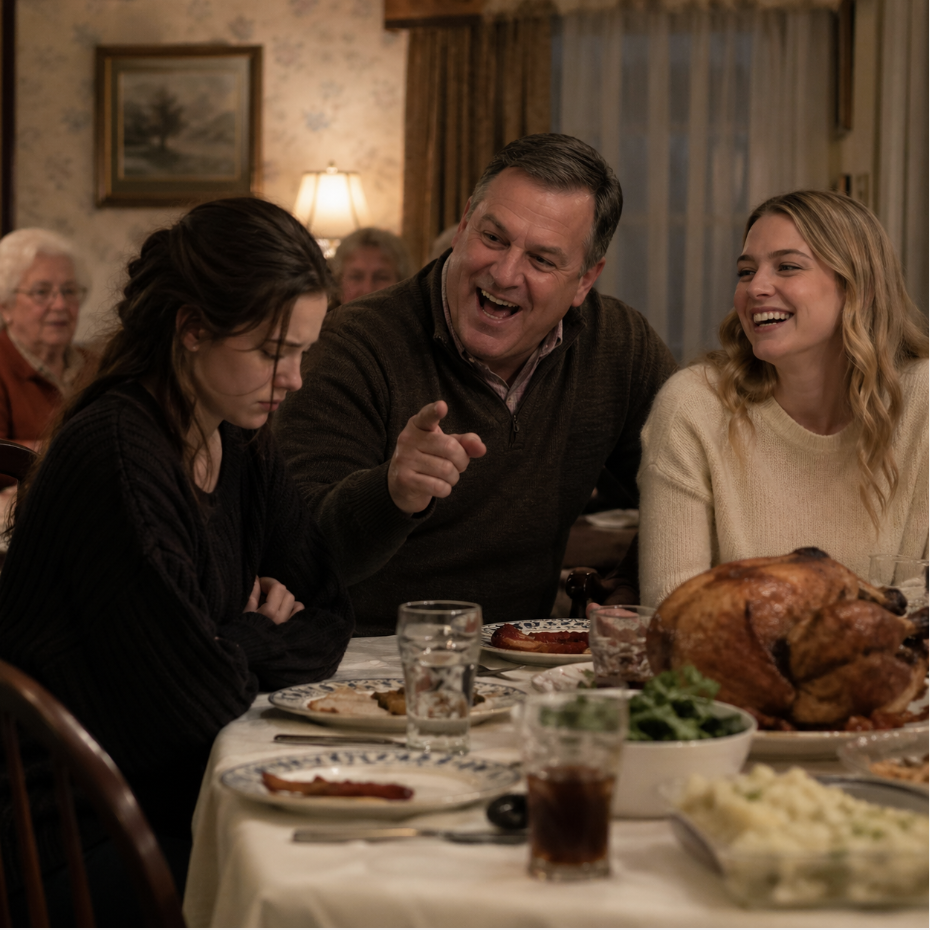
One Thanksgiving, with a house full of relatives and the smell of turkey grease hanging in the warm air, he raised his glass and toasted Valerie. He talked about service, sacrifice, duty. Then he looked at me with a smile that never reached his eyes and said, “And here’s to Rey. Maybe one day she’ll figure out what she’s good at.”
Everybody chuckled because people will laugh at cruelty if it’s wearing a familiar face.
I kept my smile pinned in place and squeezed my fork hard enough that the metal cut into the base of my thumb. Under the table, my knees were locked so tight they hurt. Valerie leaned toward me, perfume and smugness drifting across the table.
“Don’t take it personal,” she whispered. “Some of us are just built for more.”
That was the night I stopped hoping the story would fix itself.
Mom found me later rinsing plates that were already clean. She dried her hands slowly, watching me the way she did when she knew I was holding something sharp inside.
“You don’t have to become loud to matter,” she said.
I laughed once, short and ugly. “Good, because I’m fresh out of loud.”
“No,” she said, and her hand settled on my shoulder. “You’re not made that way. That’s not a flaw.”
Part 2
I left that town six months later with two duffel bags, a partial scholarship, and a plan that didn’t sound impressive when said out loud.
I was going to study logistics.
Not medicine. Not law. Not anything that came with applause built in. Logistics—the invisible skeleton that holds everything upright while louder people take credit for standing.
Dad called it “moving boxes with a degree.”
Valerie laughed when she heard. “Perfect,” she said. “You can organize my medals when I run out of wall space.”
Mom hugged me at the bus station like she was trying to memorize my shape. She slipped a folded note into my jacket pocket. I didn’t read it until hours later, somewhere between towns that looked exactly like the one I’d just left.
Steady builds things loud people get to stand on.
I kept that note.
College was the first place nobody knew Valerie’s name.
It was also the first place nobody knew mine.
At first, that felt like erasure. Then it started to feel like freedom.
I learned systems. Supply chains. Failure points. How a missed shipment in one state could ripple into empty shelves three states away. How timing wasn’t just precision—it was survival. I worked nights in a warehouse to pay for what scholarships didn’t cover. I learned how to fix a broken loading schedule faster than most people could explain one.
I didn’t stand out.
But things around me stopped breaking.
After graduation, I didn’t go home. I took a contract job with a civilian support company that worked alongside the military. It was the closest I’d get to Dad’s world without needing his approval to enter it.
My first deployment wasn’t glamorous. Desert heat, long hours, spreadsheets that dictated whether people ate on time or not at all. No medals. No headlines.
But when a convoy got rerouted last minute and still arrived with everything intact, people noticed.
Quietly.
That became my pattern.
Fix what nobody else saw.
Hold together what louder people assumed would just… work.
Years passed. Promotions came without ceremony. I learned to lead teams who didn’t need speeches, just clarity. I became the person people called when something went wrong and time was already gone.
Back home, Valerie’s reputation kept growing.
Decorations. Interviews. A photo in uniform framed in the diner where people still stood when she walked in.
Dad sent me clippings sometimes. Never letters. Just proof that one daughter was still doing it right.
Then came the call.
It was Mom. Her voice was too calm, which meant things weren’t.
“Your father had a stroke,” she said.
I was on a plane that night.
The town hadn’t changed. It never did.
Same diner. Same courthouse parking lot gossip. Same flagpoles.
But the house felt smaller.
Dad was in a hospital bed in the living room, stubborn even in weakness. Half his face slack, his voice reduced to something that struggled to carry command.
Valerie was there too, pacing, phone in hand, issuing sharp, frustrated instructions to someone who wasn’t doing things fast enough.
She looked at me like I was a piece of furniture that had been moved without permission.
“Finally,” she said. “We need to figure out long-term care, insurance, transport—”
“I’ve already started,” I said.
She blinked.
“What?”
“I reviewed his policies on the flight,” I said, setting my bag down. “We need to refile one claim—they denied it on a technicality. I’ve got a contact who can push it through. Physical therapy starts in three days. I’ve arranged in-home support for the first month.”
Valerie stared at me.
Dad’s eyes moved between us, sharp despite everything else.
“You… what?” she said again, slower this time.
“I handled it,” I said.
No flourish. No explanation.
Just the truth.
For the first time in my life, Valerie didn’t have a line ready.
Part 3
Recovery is not loud.
There are no speeches in the middle of the night when someone can’t sleep because their body won’t listen. No applause for the thousandth small repetition of a movement that used to be automatic.
It’s slow.
Steady.
Invisible, unless you’re the one doing it—or the one holding it together.
I stayed.
Not out of obligation. Not out of some sudden need to prove something.
I stayed because I knew how.
Schedules. Medications. Insurance calls that required patience sharp enough to cut through bureaucracy without raising your voice. Coordinating therapists. Adjusting routines. Catching problems before they became crises.
Valerie tried, at first.
But her world ran on intensity. On visible wins. On moments that could be pointed at and named.
This wasn’t that.
“This is ridiculous,” she snapped one afternoon after arguing with a billing department for twenty minutes and getting nowhere. “They’re incompetent.”
“They’re overworked and following a script,” I said, taking the phone gently from her hand. “Watch.”
I didn’t raise my voice. I didn’t argue.
I listened. I asked the right questions. I waited through the pauses that made other people impatient.
Ten minutes later, the issue was resolved.
Valerie looked at me like she was seeing a different language being spoken.
“How do you do that?” she asked.
“I pay attention,” I said.
Dad watched everything.
He couldn’t say much, but his eyes followed me when I moved through the house. When I adjusted his pillows before he had to ask. When I anticipated the things he needed before they became frustration.
One evening, weeks into recovery, I was helping him sit up when his hand caught my wrist.
His grip was weaker than it used to be.
But it was still him.
He struggled with the words, his voice thick, uneven.
“Rey,” he said.
I waited.
His eyes held mine, and for once, there was no performance in them. No audience.
Just… effort.
“Good,” he managed. Then, after a long pause, “at… this.”
It wasn’t much.
For anyone else, it would have sounded like nothing.
For him, it was a confession.
I nodded once.
“I know,” I said.
Valerie stood in the doorway, silent.
Later that night, she found me in the kitchen.
“No one ever… clapped for this,” she said, gesturing vaguely toward the living room where Dad slept.
“They’re not supposed to,” I said.
She leaned against the counter, the edge gone from her posture.
“I thought being the one people noticed meant I was the one who mattered most.”
I didn’t answer right away.
Mom’s note was still in my wallet, edges worn soft from years of being folded and unfolded.
“Loud gets noticed first,” I said finally. “It doesn’t mean it lasts.”
Valerie let out a quiet breath.
For the first time in our lives, there was no competition in the room.
Just understanding—fragile, unfinished, but real.
Months later, when Dad could walk again—slowly, stubbornly—the town showed up.
They always did.
There was talk of resilience. Of strength. Of the Donovan grit.
People shook his hand. They praised Valerie for her service, as they always had.
And then, something new happened.
Mrs. Hanley from down the road touched my arm and said, “We heard you kept everything running.”
Just that.
No banner. No speech.
But her eyes were steady.
I smiled.
Because for the first time, I didn’t need the room to turn toward me to know I mattered.
I had built something that held.
And that was enough.