CHAPTER 1 — The Grip
The music was too loud for a fight.
Bass thundered through the floor of the bar, rattling glasses, shaking laughter loose from drunken throats. Neon lights smeared color across sweating faces. To everyone else, it was just another Friday night—cheap beer, bad decisions, forgettable conversations.
To her, it was a mistake she shouldn’t have made.
She stood near the edge of the crowd, back almost brushing the exposed brick wall, a short glass of whiskey untouched in her hand. She wore jeans and a dark jacket, hair loose, posture relaxed in a way that made her look smaller than she was.
No uniform.
No insignia.
No warning.
A woman alone.
That’s what he saw.
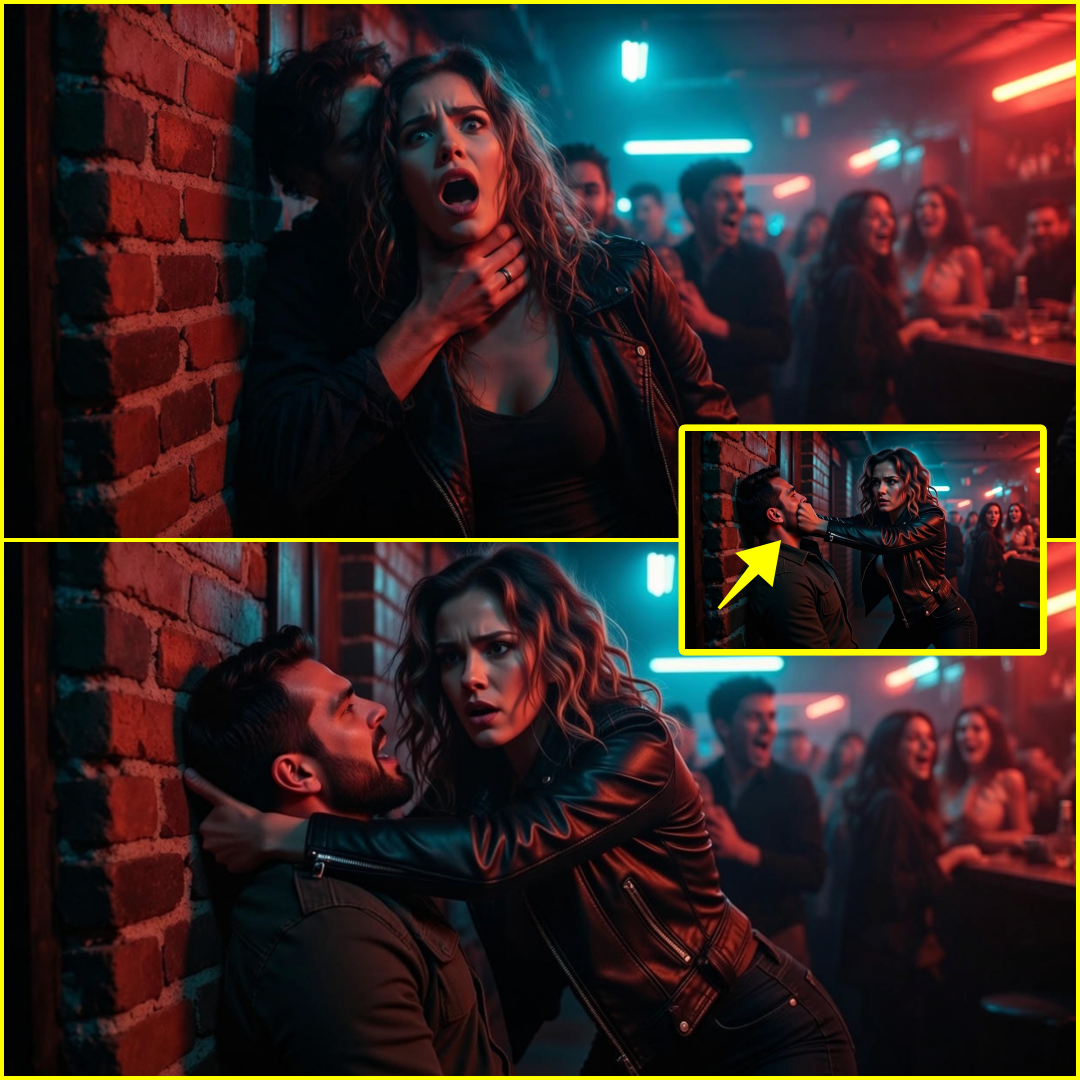
“Hey,” the man said, stepping too close, breath sour with alcohol. He was big. Thick arms. The kind of confidence that came from never being told no. “You’ve been staring at me all night.”
She hadn’t looked at him once.
“I’m not interested,” she replied calmly, eyes already scanning the room—exits, reflections, spacing. Habit.
He laughed. “Relax. Just talking.”
“Then step back.”
That was the moment the tone changed.
His smile flattened. “You don’t talk to me like that.”
Around them, the bar kept moving. Someone shouted for another round. A woman screamed with laughter near the dance floor. Nobody noticed the shift—the narrowing of his eyes, the way his shoulders squared.
He reached out.
She twisted away instinctively, but the crowd pressed tight. Someone bumped her elbow. Her back hit the wall harder than she expected.
“Hey!” she snapped.
Too late.
His hand shot forward, fingers slamming into her throat, thumb crushing under her jaw.
The world shrank.
Air vanished.
Her glass shattered on the floor.
Gasps tore uselessly at her chest as he leaned in, pinning her with his weight, forearm locking her neck against brick. His face hovered inches from hers, distorted with rage and thrill.
“Don’t make me look stupid,” he hissed.
Her vision flickered at the edges—not panic, not fear.
Calculation.
She forced herself to go still.
That made him grin.
“Yeah,” he muttered. “That’s better.”
Across the bar, a few heads turned. A man frowned. Someone hesitated.
But no one moved.
Because she didn’t look like a threat.
Her hands trembled—on purpose.
Her knees bent slightly, just enough to sell it.
He squeezed harder.
“Thought you were tough?” he said. “You’re all the same.”
She counted.
One.
She felt the pressure points in her neck, mapped the angle of his wrist, measured the slack in his stance.
Two.
Her pulse slowed, controlled. She let her body go heavy, sagging just a fraction.
His grip adjusted.
That was the opening.
Three.
Her eyes met his.
Not pleading.
Focused.
Cold.
“What—” he started.
She moved.
In one fluid motion, her left hand snapped up, locking his thumb, rotating his wrist inward while her right forearm drove up under his elbow. His grip broke with a startled grunt as pain lanced through his arm.
Before he could react, she stepped inside his reach.
Hard.
Her knee rose, not wild, not angry—precise. It struck his thigh at the nerve cluster, stealing his balance. He stumbled forward, swearing.
“B—!”
She hooked his arm, twisted, and slammed him chest-first into the wall beside her. The impact knocked the air from his lungs.
The music stuttered.
Someone screamed.
“Get off her!” a voice shouted too late.
He tried to swing back at her, but she was already gone from where he expected—slipping behind him, controlling his arm, forcing it up his back.
“On the ground,” she said quietly in his ear.
He laughed, breathless and furious. “You’re dead.”
She tightened the lock just enough to make her point.
His laughter choked off.
She leaned closer. “You should’ve let go.”
With a sharp twist and a calculated shove, she sent him crashing to his knees. He hit the floor hard, gasping, eyes wide with disbelief.
The bar went silent.
Music still played—but softer now, like it knew it shouldn’t be there.
People stared.
Phones lifted.
“What the hell just happened?” someone whispered.
She stood over him, breathing steady, eyes alert, already watching the doors.
The man clutched his arm, face red, rage turning to fear. “You think you’re tough?” he spat. “You’re nothing. You hear me? Nothing.”
She crouched slightly so only he could hear.
“I warned you,” she said.
He looked up at her—and something in her gaze made his mouth snap shut.
Not anger.
Not triumph.
Training.
The bouncer finally pushed through the crowd. “Hey! Hey! Break it up!”
She stepped back immediately, hands open, compliant.
“He attacked me,” she said evenly.
The man tried to stand and failed. “She—she attacked me! She’s crazy!”
The bouncer looked between them, uncertain.
Then he noticed the way she stood.
Balanced.
Ready.
Not shaken.
Not drunk.
Not scared.
“Ma’am,” he said slowly, “are you okay?”
She nodded once. “I will be.”
Sirens wailed faintly in the distance—someone had called it in.
She turned toward the exit.
Behind her, the man shouted, “You don’t know who you messed with!”
She paused at the door.
Looked back.
Her voice carried across the stunned room, low but unmistakable.
“You put your hands on the wrong woman.”
And then she was gone—into the night, into the shadows, leaving behind a bar full of people who would never forget the moment they watched a woman almost lose her breath…
…and a predator lose everything else.
CHAPTER 2 — The Wrong Silence
The alley behind the bar smelled like spilled beer and rain that never quite washed anything clean.
She leaned against the cold brick, one knee bent, head tilted back just long enough to take a full breath. Her throat still burned where his fingers had dug in. She rolled her neck slowly, testing range of motion.
No damage.
Just anger.
She hated bars. Always had. Crowded, loud, unpredictable. A place where bad instincts felt brave because they were drowned in music and alcohol. She had broken her own rule tonight—don’t linger, don’t relax, don’t assume.
She pushed away from the wall and started walking.
Halfway down the alley, her phone vibrated.
Unknown number.
She answered without slowing. “Yeah.”
“You moved fast,” a man’s voice said. Calm. Too calm. “Thought you might want to know—cops are inside. EMT too.”
Her jaw tightened. “I didn’t ask for a report.”
A pause. Then a low chuckle. “Same woman as always.”
“Why are you calling, Marcus?”
“Because you don’t usually draw attention,” he replied. “And tonight? You did.”
She stepped out onto the street. Neon faded behind her. The city breathed differently here—quieter, sharper. “He put his hands on me.”
“I figured.” Marcus exhaled. “But that guy? Not just some drunk.”
She stopped walking.
“Explain.”
“Name’s Ryan Holt,” Marcus said. “Ex–private security. Works freelance. Likes to throw weight around. And—this is the important part—he’s got friends who don’t like being embarrassed.”
Her grip tightened on the phone. “He attacked me in public.”
“Doesn’t matter to his kind,” Marcus replied. “What matters is you made him look small.”
She closed her eyes briefly. Of course.
“You’re telling me this now?” she asked.
“Because,” Marcus said carefully, “he didn’t stay down.”
Inside the bar, Ryan Holt sat on a metal stool, jaw clenched, arm wrapped in ice. A police officer stood nearby, bored, notebook half-open.
“I told you,” Ryan snapped. “She attacked me.”
The officer sighed. “Multiple witnesses say you grabbed her throat.”
“They’re lying.”
The EMT finished checking his arm. “Nothing broken. You’re lucky.”
Ryan glared. “Lucky?”
The bouncer crossed his arms. “You put hands on her, man.”
Ryan’s eyes flicked around the room—faces, phones, judgment. Humiliation burned hotter than the pain.
“She ran,” he muttered.
The officer looked up. “What?”
“She ran,” Ryan repeated. “If she was so innocent, why’d she leave?”
The officer shrugged. “People leave.”
Ryan smiled slowly.
“She didn’t leave,” he said. “She disappeared.”
She took a longer route back to her apartment, instincts buzzing now, old wiring coming back online. Streetlights. Reflections in windows. Footsteps. None matched her pace.
Still, the quiet felt wrong.
Her phone buzzed again.
“Talk to me,” Marcus said. “You still in the open?”
“For now.”
“You want a ride?”
“No.”
A beat. “You always say that.”
“And I’m always fine.”
She ended the call and slipped the phone into her pocket.
Her building rose ahead—six floors, cracked concrete, a flickering entrance light she’d reported three times. Home, at least in theory.
She reached the door.
It was already open.
Just a crack.
Her body reacted before thought—she shifted sideways, weight light, hand sliding into her jacket, fingers brushing cold metal.
The hallway was dark.
Too dark.
She listened.
Breathing.
Movement.
Someone trying not to be heard.
She stepped inside.
The door closed behind her.
The lights snapped on.
Two men stood at the far end of the hall. One leaned casually against the wall. The other held something black and heavy in his hand.
Not a gun.
A baton.
“Evening,” the first man said. “You’re hard to find.”
She didn’t move. “Get out of my way.”
The man laughed. “See, that’s the thing. You embarrassed our friend.”
“So he sent you?” she asked calmly.
The second man stepped forward. “He wants to talk.”
“I’m not interested.”
He raised the baton.
She sighed.
“Wrong answer,” he said.
He rushed her.
She pivoted, letting his momentum carry him past, her elbow snapping back into his ribs. He grunted, stumbled, but didn’t fall.
The first man lunged.
She ducked, grabbed his wrist, twisted—felt bone grind—and slammed his hand into the wall. He screamed.
The baton swung blindly.
She caught it mid-air, ripped it free, and drove it into the attacker’s knee.
He went down hard.
The hallway echoed with curses and pain.
She stood over them, chest rising, eyes cold.
“You don’t know who you’re dealing with,” the first man gasped.
She crouched, baton resting lightly against his throat.
“You’re right,” she said. “And neither did your friend.”
Sirens wailed in the distance again—someone else, somewhere else.
She backed away, already planning the next move.
Because this wasn’t over.
Not anymore.
Across town, Ryan Holt sat in a dark apartment, arm wrapped, jaw tight, staring at his phone.
“Find her?” he asked.
A voice on the other end answered quietly. “Yeah.”
Ryan smiled.
“Good,” he said. “Because next time… I don’t want witnesses.”
CHAPTER 3 — The Hunt
She didn’t go home.
That instinct—sharp, old, unarguable—kept her moving long after the sirens faded behind her. Home was a pattern. A place to predict. And tonight, someone was predicting her.
She ducked into a twenty-four-hour laundromat three blocks away, the kind that smelled like detergent and exhaustion. Fluorescent lights hummed overhead. Two men slept in plastic chairs, coats pulled over their heads.
She chose a seat near the back, facing the door and the reflection in the glass. Her breathing slowed. Her pulse settled.
Only then did she allow herself to think.
Ryan Holt wasn’t stupid. Not smart, but not reckless either. He hadn’t come alone at the bar. He hadn’t come alone at her building. That meant he believed he had leverage—numbers, surprise, intimidation.
It also meant he’d underestimated her.
She pulled her phone out and powered it on.
Three missed calls.
Marcus.
She called him back.
“You still breathing?” he asked immediately.
“Barely worked up,” she replied.
A pause. Then: “They came to your place.”
“Yes.”
“Two of them?”
“Yes.”
“They alive?”
She almost smiled. “Unfortunately.”
Marcus exhaled slowly. “Then it’s escalating.”
“It already has.”
“You want me to make some calls?”
“No.”
“That wasn’t a question,” Marcus said. “This guy is pushing buttons he shouldn’t.”
“So am I,” she said quietly.
Another pause. Marcus lowered his voice. “He knows something, doesn’t he?”
She didn’t answer right away.
Outside, a car idled too long at the curb.
“Not yet,” she said. “But he’s close.”
Ryan Holt paced his living room like a caged animal.
The men he’d sent were late. That bothered him more than the pain in his arm, more than the memory of her eyes when she’d looked back at him in the bar.
Not fear.
Assessment.
“Call them again,” he snapped.
His associate hesitated. “Already did. No answer.”
Ryan stopped pacing. “Then something went wrong.”
“You want to pull back?” the associate asked carefully.
Ryan turned on him, eyes bright with anger. “Pull back? She humiliated me. In front of everyone.”
“She’s trained,” the associate said. “You saw how she moved.”
Ryan leaned forward. “Everyone’s trained at something.”
He picked up his phone.
“I want everything on her,” he said. “Name. Work. Past. I don’t care how deep you dig.”
The associate hesitated. “That could get messy.”
Ryan smiled thinly. “So did tonight.”
She left the laundromat fifteen minutes later, blending into foot traffic, doubling back twice, crossing the street without signaling. The idling car was gone.
Good.
She reached a quiet park and sat on a bench beneath a broken lamp. Shadows pooled thickly between trees.
Her phone buzzed again.
This time, she didn’t need to look.
“They ran your plate,” Marcus said.
She stiffened. “How do you know?”
“Because I know who’s asking questions,” he replied. “And because someone pinged an old database they shouldn’t have access to.”
Silence stretched between them.
“They know,” she said.
“Not everything,” Marcus corrected. “But enough to be dangerous.”
She closed her eyes.
Years ago, she had learned how to disappear. New name. New city. No trail. No history that led anywhere useful. But some things couldn’t be erased completely—not if someone knew where to look.
“You should leave town,” Marcus said.
“No,” she replied.
“Don’t be stubborn.”
“This isn’t stubborn,” she said. “It’s containment.”
Marcus cursed softly. “You’re thinking like it’s a mission.”
“It is.”
She stood, scanning the tree line. “He’s not going to stop. If I run, he’ll keep pushing until he hurts someone else.”
“And if you stay?”
She opened her jacket slightly, fingers brushing the familiar weight concealed there. “Then he runs out of moves.”
They came for her just after midnight.
Not at her apartment. Not in the open.
Smart.
She felt it before she saw it—the shift in the air, the subtle echo of footsteps that didn’t belong. She turned into a narrow service corridor between buildings, walls close, light poor.
A van rolled in silently from the far end.
Doors slid open.
Three men jumped out.
One with a gun.
Time compressed.
She ran toward them.
The gun came up.
She dropped, sliding on wet concrete as the shot cracked overhead. Her foot kicked out, catching one man’s ankle. He fell hard. She rolled, came up inside the shooter’s reach, slammed the heel of her hand into his wrist.
The gun clattered away.
The third man rushed her from behind.
She spun, caught his collar, and drove him headfirst into the van’s side panel. Metal dented. Bone cracked.
The shooter lunged.
She intercepted him, elbow snapping into his jaw. He staggered back, dazed.
She didn’t let up.
Three strikes. Efficient. Final.
Within seconds, all three men were on the ground—moaning, broken, alive.
She stood in the center of the corridor, breathing steady.
A voice echoed from the shadows.
“Jesus Christ.”
Ryan Holt stepped forward, slow-clapping, eyes wide—not with fear, but awe.
“So it’s true,” he said. “You’re not just some girl.”
She turned to face him fully.
“No,” she agreed. “I’m not.”
“SEAL,” he said. “That’s what my guy found. Navy SEAL.”
Her jaw tightened.
“Didn’t think women could do that job,” Ryan continued. “Guess I was wrong.”
“You’ve been wrong all night,” she said.
He lifted his hands slightly, mock-surrender. “Look, this got out of hand.”
“You sent men to my home.”
“You humiliated me.”
She took a step closer. “You attacked me.”
Silence stretched.
Ryan swallowed. “So what now?”
She looked at the men on the ground. At the van. At him.
“Now,” she said calmly, “you disappear.”
He laughed nervously. “You think you scare me?”
She leaned in close enough for him to smell the steel in her voice.
“I don’t need to.”
She stepped back, already turning away.
Behind her, Ryan shouted, “This isn’t over!”
She paused.
Looked back one last time.
“It is,” she said. “You just don’t know it yet.”
CHAPTER 4 — The Last Breath
Dawn came without warmth.
Gray light leaked into the city, washing the streets in colorless truth. She sat in a parked car two blocks from the harbor, hands resting lightly on the steering wheel, eyes fixed on the water beyond the warehouses.
She hadn’t slept.
She hadn’t needed to.
Ryan Holt would not disappear. Men like him never did—not until they were forced to. Pride, humiliation, fear… those things fermented into something ugly and reckless. He would strike again, harder, dirtier.
So she had set the trap.
Her phone buzzed once.
Marcus: You’re sure about this?
She typed back: He’s already chosen.
A pause.
Then finish it, Marcus replied. Clean.
She shut the phone off.
Ryan Holt believed in leverage.
That was his fatal flaw.
The message had come through an hour earlier—anonymous, short, impossible to ignore.
You want answers. Come alone. Pier 17. Sunrise.
He stood now at the edge of the dock, coat pulled tight, gun heavy in his pocket. The water below slapped quietly against pylons, indifferent to human drama.
He checked his watch.
“She won’t show,” he muttered.
A voice answered from behind him.
“You’re late.”
He spun, gun halfway out before he stopped himself.
She stood ten feet away, silhouetted by the rising light. Calm. Unarmed. Alone.
Just like the bar.
A chill crawled up his spine.
“You’re brave,” Ryan said, forcing a smile. “Or stupid.”
“Neither,” she replied. “I’m done.”
He laughed. “You think you can scare me into backing off?”
“No,” she said. “I think you already crossed a line you can’t uncross.”
Ryan’s eyes narrowed. “You threatened me.”
“I warned you.”
He stepped closer. “You ruined me. My people are gone. My name’s trash.”
“You did that yourself.”
Ryan’s hand closed around the grip of his gun.
“Don’t,” she said softly.
He pulled it anyway.
The shot never came.
In one smooth motion, she closed the distance, deflected the weapon, and drove him backward. The gun skidded across the dock and splashed into the water.
Ryan stumbled, eyes wide. “How—”
She struck him once. Twice. Hard.
He crashed to his knees, gasping, memories of the bar flooding back.
She grabbed his jacket, hauled him upright, and slammed him against a steel post.
“This ends now,” she said.
Ryan laughed weakly. “You won’t kill me.”
“No,” she agreed. “I won’t.”
She leaned in, voice low and final.
“But everyone will know what you are.”
Sirens wailed in the distance—closer this time. Boats. Cars. Backup he hadn’t expected.
His face drained of color. “What did you do?”
“I documented everything,” she replied. “The bar. The men you sent. Tonight.”
Footsteps pounded on the dock.
“Hands where I can see them!” a voice shouted.
Ryan sagged, defeated.
As officers swarmed him, cuffing his wrists, he looked up at her one last time.
“You could’ve walked away,” he whispered.
She met his gaze, unblinking.
“So could you.”
Hours later, she stood at the edge of the harbor alone again.
The city was waking. Life moving on.
Marcus joined her, coffee in hand. “It’s done.”
She nodded. “It always ends the same.”
He studied her. “You ever think about going back?”
She shook her head. “I never left.”
A faint smile touched his lips. “What now?”
She looked out at the water, where the sun finally broke free of the clouds.
“Now,” she said, “I breathe.”
She took a full breath.
Deep.
Free.
Unrestricted.
For the first time since the bar, since the hand on her throat, since the silence that followed…
She breathed without looking over her shoulder.
And the city let her disappear—
not as a victim,
not as a legend,
but as exactly what she was:
A woman who refused to be broken.
THE END
News

Harry Left Out During Easter? Selfie Sparks Online Uproar While Royal Family Stays Silent — Could He Be Feeling Abandoned?
The freestyle ski champion shared the photo on Instagram on Thursday, April 2 Prince Harry, Eileen Gu and Justin Trudeau.Credit…
💔 GABRIELLE UNION HEARTBROKEN — Shares Tearful Tribute to Her Father After His Sudden P@ssing, Revealing the Depth of Her Grief and the Unforgettable Impact He Had on Her Life…
NEW YORK, NEW YORK – APRIL 29: Gabrielle Union attends the Prime Video’s “The Idea Of You” New York premiere…
RALO BREAKS HIS SILENCE — Teases Hidden Details About Pooh Shiesty’s Alleged Showdown, Leaving Fans Sh0cked and Questioning What Really Happened Behind the Scenes
NEW YORK, NEW YORK – FEBRUARY 18: Ralo attends Ralo’s “Chosen” Book Release Gathering Hosted By Angela Yee And Torae…

Memphis Rapper ROBBED His CEO in Front of 2 Officers & an Informant!?
A controversial incident involving Memphis rap star Pooh Shiesty, his father, and none other than Gucci Mane has resurfaced online,…
👑 THE TWO WORDS THAT MELTED THE INTERNET — Prince Louis’ Sweet Comment to King Charles Sparks Heartwarming Buzz…
Prince Louis melted hearts with a sweet ‘Happy Easter’ greeting to his grandfather King Charles at the Windsor service, as…
CAUGHT ON CAMERA: Princess Catherine’s Outfit Detail Has the Internet in a Frenzy at Easter!
The Wales family’s return to the traditional Easter Matins service at Windsor Castle has dominated headlines — and one fashion…
End of content
No more pages to load