The latest updates on the mysterious metallic objects discovered on the Australian coast
The discovery of six mysterious metallic spheres washing up on Forrest Beach, Queensland, over the past three days is more than just a curiosity; it is a grave reminder of the mounting challenges concerning aerospace security and orbital environmental management. While authorities, including the Australian Space Agency and fire services, have swiftly cordoned off a 50-meter exclusion zone to ensure public safety, this event provides tangible evidence of the unpredictable risks posed by uncontrolled space debris.
The Fragile Barrier Between Orbit and Earth
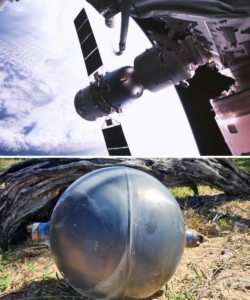
While space debris originating from satellites or launch vehicles is no longer a novel phenomenon, the concentrated appearance of these objects in the same location over a short period is deeply thought-provoking. Typically, space debris is engineered to incinerate through atmospheric friction before reaching the surface. The fact that robust structures—specifically these “metallic spheres”—remained intact upon impact suggests that the heat resistance and structural integrity of modern orbital hardware are exceeding standard projections.
Objectively, these are no longer isolated incidents. Similar spheres were documented in Queensland in 2023 and Namibia in 2011, revealing a troubling trend: Earth is increasingly becoming an unintended “dumping ground” for unchecked orbital activity. As humanity accelerates the deployment of satellites and telecommunications hardware, the proliferation of space debris is an inevitable consequence. The crux of the issue lies in the glaring loopholes within the “end-of-life” management protocols for these assets.
The Challenges of Accountability and Ethics
Describing these objects as “mysterious” is merely a field observation; in essence, they are tangible proof of a failure in equipment recovery accountability. Any nation or corporation launching assets into space has a legal and moral obligation to ensure those objects do not become “time bombs” threatening communities below. Leaving debris to fall at random, trusting it will either burn up or land in desolate areas, is a high-risk gamble.
Furthermore, these spheres may harbor hazardous materials. Unintentional contact by civilians could lead to health complications that are not immediately quantifiable. While the Queensland authorities’ directive to maintain distance and contact officials is a necessary precautionary measure, it remains a reactive solution rather than a systemic one.
A Future for Our Atmosphere
The incident at Forrest Beach is a stern reminder that a more stringent international legal framework for space operations is long overdue. “Littering” in orbit cannot remain an accepted byproduct of technological advancement. The world requires rigorous standards for satellite design, mandating that complete atmospheric disintegration must be an absolute certainty. Failing this, any coastline—from Australia to Namibia or beyond—remains a potential landing zone for these “uninvited guests” from space.
While this specific event has yet to cause physical injury, it has successfully rung an alarm bell for an era in which the space above us is becoming increasingly congested and hazardous.
SOURCE: 7NEWS
https://7news.com.au/news/space-mystery-deepens-with-two-more-metal-orbs-found-on-forrest-beach-in-north-queensland-c-22533935