
The city never sleeps, but it is always coughing through the smog and the wail of sirens. Inside Fire Station 14, a man known as the “Soul of the Squad” sits in silence, polishing his axe. At forty, he has everything a firefighter could covet: a wall covered in medals, the absolute respect of his peers, and a record of lives saved that few could match.
But behind that rugged uniform lies a void that nothing can fill. Three years ago, a hit-and-run accident stole his only son right on the pedestrian path to the park. The perpetrator vanished into the night, leaving behind a shattered forest-green headlight fragment and a simmering rage in the father’s heart. He had used every connection and every forensic skill he possessed to track that car. He didn’t want the justice of a courtroom; he wanted a life for a life.
That night, the alarm bell tore through the stillness of the station.
The Tenement Fire
The blaze broke out in a dilapidated apartment complex on the South Side—a place for those living on the fringes of society. By the time the trucks arrived, the fire had already swallowed the third floor, columns of thick black smoke rising like a beast trying to gulp down the starry American sky.
“Someone’s trapped on the fourth floor! A child!” – The screams of the crowd below heightened the chaos.
Without a second thought, he donned his gear, strapped on his oxygen mask, and plunged into the sea of fire. To him, every child in a fire bore the shadow of the son he lost. He moved through crumbling hallways, the sound of collapsing timber and the roar of the flames echoing like a demon’s laughter. The peeling wallpaper melted like black tears.
In the back room of a fourth-floor apartment, he found the child. A boy, about six or seven years old, huddled under a bed, his breathing shallow from smoke inhalation. He scooped the boy up, wrapping him in a wet blanket. But as he turned to leave, a section of the ceiling collapsed, blocking the only exit.
He was forced to kick through the wall into the adjoining unit to find an alternate fire escape. In that moment of frantic movement, the flashlight on his helmet swept across a corner of the living room being consumed by flames.
He froze. His heart felt as though it had stopped, despite the thousand-degree heat surrounding him.
A Cruel Encounter
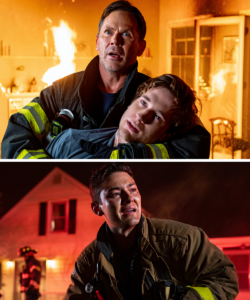
Under the flickering orange light, in a room filled with the smell of gunpowder and cheap whiskey, he saw it. An old tarp had burned away at the corner to reveal a vintage forest-green sedan. The headlight had been replaced, but the surrounding paint still showed the crude marks of a patch-up job. On a wooden shelf nearby sat a worn leather wallet. With his soot-covered gloves, he flipped it open.
A family photo appeared: A man with a long scar across his eyebrow was grinning broadly beside that very car. It was him. The man he had sworn to kill with his own two hands.
And the child in his arms was that man’s son.
Around him, the fire seemed to mock him. Destiny had a cruel way of torturing a man. He was holding the life of the most precious thing belonging to the person who destroyed his world. All he had to do was take a step back. All he had to do was “accidentally” let the toxic smoke prevail for a few more minutes, or simply leave the boy here. His vengeance would be washed clean in the same way his son’s life was: a solitary death.
The tongues of fire licked at his boots. The boy in his arms groaned softly, his small hand gripping the stiff fabric of the firefighter’s jacket as a final tether to life.
In that moment, his oxygen mask began to beep. A steady, rhythmic warning—the countdown of his conscience. He looked into the boy’s tightly closed eyes, then back at the photo of the man. Hatred surged, urging him to let go. “Justice for my son,” a voice whispered in his head.
But then, another memory surfaced. The image of his own son, once just as small, clutching his sleeve every time he left for work. This child was innocent. He didn’t choose a killer for a father. If he let the boy die, he would no longer be the firefighter who protected this city; he would become the very thing he hated: a killer hiding in the dark.
The Only Way Out
He let out a pained roar through his mask. He had made his choice.
He didn’t take the safer fire escape further down. Instead, he charged toward a window engulfed in flames, using his axe to shatter the glass. Below, his teammates’ air cushion was ready. He hugged the boy tight, using his own body as a shield against the glass shards and the lethal heat, then threw himself into the void.
The moment he hit the cushion, he lost consciousness.
The Aftermath
The next day, he woke up in a hospital bed with second-degree burns across his arms and back. His fellow firefighters surrounded him as if he were the greatest hero they had ever known. The boy was safe. His father—the hit-and-run driver—had been arrested at the hospital when he came to see his son, after the firefighter had quietly provided the evidence of the car to the investigators before slipping into unconsciousness.
People praised him for his boundless courage: saving the son of the man who murdered his own child. But only he knew that on that fiery night, he didn’t just save a child.
He had saved his own soul from being incinerated by the flames of hatred.
As he looked out the hospital window toward the city skyline, he watched the white smoke from industrial chimneys drift upward. He realized that the most painful punishment for the killer was not the death of his son, but having to live in prison, owing his child’s life to the very man he had caused the greatest pain.
The city remained bustling, but inside the firefighter, the blaze that had lasted three years was finally extinguished.
News

Meghan speaks out for the first time about the shocking images of her appearance as a special guest on MasterChef Australia
Meghan Markle has broken her silence (Image: Getty) Meghan Markle has given a new interview following her and Prince Harry’s recent tour…
SHOCKING REUNION: CARDI B AND STEFON DIGGS SPOTTED ‘ALL SMILES’ BACKSTAGE—IS A RECONCILIATION ON THE HORIZON AFTER THEIR BITTER SPLIT?
After a public romance and new parenthood, Cardi B and Stefon Diggs called it quits earlier this year. Cardi first sparked breakup…

Meghan makes an unbelievable move after King Charles feeds a flock of chickens during his New York visit
Meghan Markle has shown the world her chickens in a bizarre new video featuring Princess Lilibet, just hours after King Charles was…
A platoon, tense after holding a position for many days, hesitates when the enemy appears—because they recognize the leader as their former interpreter
Lieutenant Daniel Harper’s platoon had been holding outpost Echo-17 for twelve straight days, a strip of red dust pressed against…

Meghan accidentally lets slip a heart-melting detail about her children in a new, candid video from the family’s chicken coop
Meghan Markle in an April 30 Instagram Story (left); Meghan Markle with her two children (right).Credit : Meghan, Duchess of Sussex/Instagram…
A soldier saves his comrade amidst b0.mbs and bu.ll3:ts, only to later realize that the man he saved was the one who had betrayed him
The nights in Afghanistan were bone-chilling, the cold seeping through layers of body armor straight into the marrow. Staff Sergeant…
End of content
No more pages to load