The entire neighborhood thought the old man was a solitary miser—until his will was read, and everyone hung their heads in shame
For nearly thirty years, the old man had been the least popular person in the neighborhood. Children crossed the street when they saw him walking toward them, not because they were afraid, but because they knew he would probably remind them not to ride bicycles across freshly planted grass or leave empty soda cans beside the sidewalk. Adults greeted him politely out of courtesy, yet their conversations usually ended after only a few words because the old man never enjoyed small talk. He rarely smiled, never attended neighborhood parties, declined every invitation to holiday gatherings, and refused to decorate his modest house even during festive seasons. The front yard remained perfectly trimmed but painfully plain, the porch held only an old wooden rocking chair, and the mailbox looked as though it had survived several decades without replacement. People often whispered that he could easily afford to improve the property because he had worked continuously for most of his life, yet nothing around the house ever seemed to change. Curtains remained faded, paint slowly peeled from the wooden fence, and the old pickup truck parked outside looked older than many of the people living nearby. Over time, a simple conclusion quietly spread from family to family until almost everyone accepted it as undeniable truth: the old man was unbelievably stingy.
Stories about his supposed selfishness multiplied with every passing year. Someone claimed he refused to contribute money for new playground equipment. Another insisted he had declined to sponsor a neighborhood celebration even though several local businesses had gladly donated. A young couple once knocked on his door asking whether he would support a fundraising event for children recovering from serious illnesses. He listened politely before explaining that he could not participate. The couple left disappointed, later telling neighbors that the old man clearly cared more about protecting his savings than helping sick children. Nobody questioned whether there might have been another reason. Human beings often complete unfinished stories with assumptions that fit what they already believe. Soon enough, the old man’s reputation became so firmly established that almost every unfamiliar action he took was interpreted through the same lens. If he repaired something instead of replacing it, he was cheap. If he purchased discounted groceries, he was miserly. If he wore the same winter coat for years, he must be obsessed with saving every possible dollar. Few people considered that perhaps he simply valued things differently.
Despite living alone, the old man maintained a remarkably disciplined routine. Before sunrise each morning, he walked slowly through the neighborhood carrying a reusable shopping bag, quietly collecting litter left behind after busy weekends. He never mentioned doing so, never asked for recognition, and never expected gratitude. Once the sidewalks looked clean again, he returned home, watered the flowers growing beside his porch, brewed a simple cup of coffee, and spent several hours reading old books whose pages had become soft with age. In the afternoons he often disappeared for several hours before returning shortly before sunset. Curious neighbors occasionally wondered where he went every day, but nobody cared enough to ask directly. Most simply assumed he spent his afternoons searching for cheaper stores or finding ways to avoid spending money. The truth followed him every afternoon, hidden inside the worn leather satchel he always carried but never opened in public.
Only one person in the neighborhood seemed genuinely comfortable speaking with him. The elderly mail carrier had delivered letters along the same route for decades and understood that silence did not always mean coldness. Sometimes, after finishing deliveries, the mail carrier accepted an invitation to sit on the old man’s porch for a few minutes. Their conversations remained quiet, interrupted frequently by long comfortable pauses during which neither felt pressured to fill the silence with unnecessary words. The mail carrier once noticed several children’s drawings carefully displayed inside the old man’s hallway despite knowing that no family members ever visited the house. Before curiosity could become a question, the old man gently closed the door and changed the subject. Respectfully, the mail carrier never asked again. Some stories reveal themselves only when their owners decide the time is right.
One summer afternoon, several neighborhood children accidentally kicked a soccer ball through the old man’s front window. Glass scattered across the living room floor with a crash loud enough to bring nearby residents onto their porches. Expecting another angry confrontation, the children stood frozen with frightened expressions while parents hurried across the street prepared to apologize. Instead of shouting, the old man quietly examined the broken window before picking up the frightened little boy’s trembling soccer ball. For several long seconds he said nothing at all. Then he handed the ball back and calmly suggested that the children move their game to a nearby open field where they would have much more space. The parents immediately offered to pay for repairs, but he politely declined. “It was an accident,” he said simply. “Windows can be replaced easier than childhood.” Everyone thanked him for his unexpected understanding. Yet as soon as he closed the door, someone quietly remarked that refusing compensation probably meant he planned to repair the window himself rather than hire professionals. Once again, generosity disappeared beneath the heavy weight of assumptions.
Years continued passing. New families moved into the neighborhood while older residents relocated or passed away. The old man remained exactly where he had always been, quietly living inside the same modest house that seemed almost untouched by time. Younger neighbors who knew nothing about his past accepted the stories already circulating as undeniable facts. They called him the lonely miser without ever speaking to him for more than a few moments. Some children invented harmless jokes about the old pickup truck that looked ready to collapse. Teenagers laughed about how the old man still repaired worn shoes instead of buying new ones. Adults shook their heads whenever his name appeared during community meetings because everyone assumed he would reject any proposal involving donations or shared expenses. Ironically, almost nobody noticed that whenever a struggling family suddenly found anonymous grocery vouchers in their mailbox or an overdue utility bill mysteriously disappeared, the timing often coincided with one of the old man’s quiet afternoon outings.
As age slowly weakened his body, neighbors observed him walking more carefully, relying increasingly upon a polished wooden cane that had become as familiar as the old truck itself. Even then, he refused assistance whenever someone offered to carry groceries or shovel snow after heavy storms. Pride, people whispered. Stubbornness, others insisted. Few realized he simply believed that independence was one of the last gifts old age should surrender. His health gradually declined, though he rarely complained. On warm evenings he still sat alone upon his porch watching children ride bicycles and families laugh together across freshly cut lawns. Sometimes a faint smile appeared without anyone noticing. Other times he remained perfectly still, as though listening to memories drifting softly through the evening air.
One cold morning, the neighborhood awoke to unfamiliar silence. The old pickup remained parked exactly where it always had. Newspapers rested untouched beside the front steps. Curtains stayed closed long after sunrise. When the mail carrier noticed several days’ worth of letters filling the mailbox, concern replaced routine. Authorities entered the modest house later that afternoon and discovered the old man peacefully seated in his favorite rocking chair, a closed book resting gently across his lap. There had been no struggle, no fear, only the quiet ending of a life that had unfolded almost entirely without witnesses. News spread quickly. Conversations filled sidewalks, grocery stores, and front porches. Many residents expressed polite sadness, yet most admitted they had barely known him. Several quietly wondered what would happen to the money he had supposedly spent decades refusing to share.
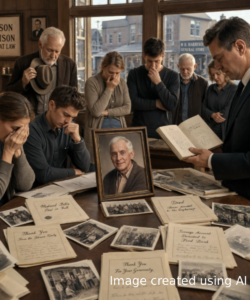
A week later, notices arrived inviting nearby residents to attend the reading of the old man’s will if they believed they might have any connection to his estate. Curiosity spread faster than grief. Some expected distant relatives to appear. Others imagined hidden fortunes accumulated through a lifetime of careful saving. The neighborhood gathered inside a modest meeting room, exchanging whispered theories while waiting for the attorney to begin.
None of them knew that before the afternoon ended, every comfortable assumption they had carried about the old man for decades would collapse beneath a truth so overwhelming that many would struggle to meet one another’s eyes.
This article uses AI