
PART 1
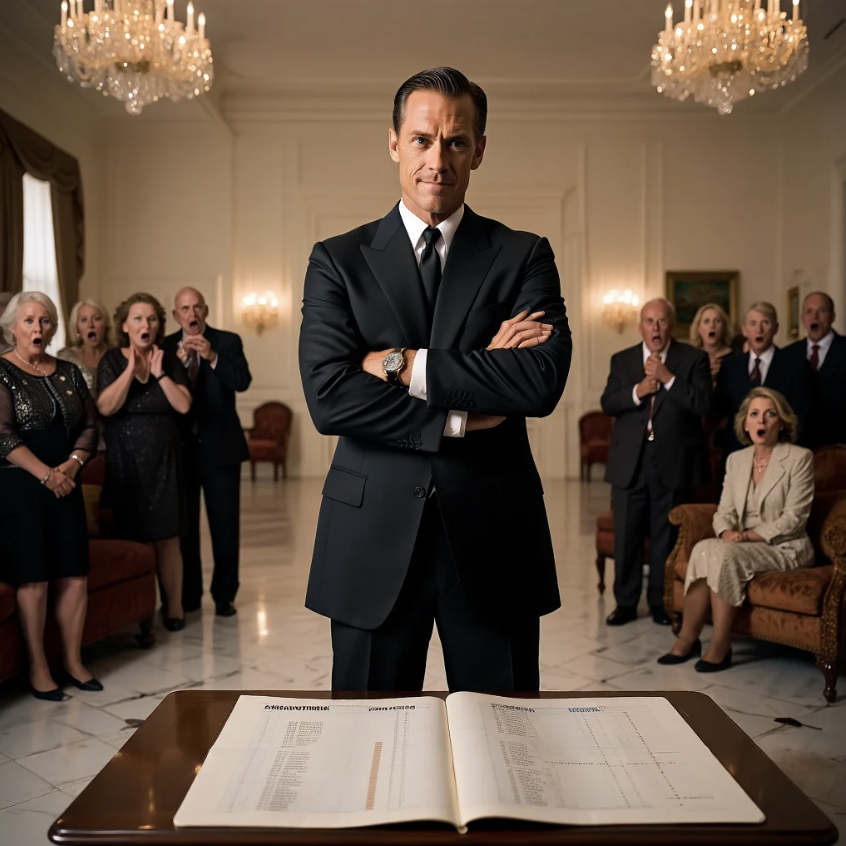
MY PARENTS GAVE MY ENTIRE INHERITANCE TO MY GOLDEN-CHILD BROTHER BECAUSE HE’D “ACTUALLY SUCCEEDED,” THEN TOLD ME I WAS STILL DRIFTING, STILL FIGURING MY LIFE OUT, AND LUCKY TO GET A TINY TRUST AT ALL—SO I TOOK MY TAX RETURNS TO THE ACCOUNTANT WHO’D HANDLED OUR FAMILY’S MONEY FOR 23 YEARS, WATCHED HIS FACE GO WHITE AS HE READ THE NUMBERS, AND THEN HE LOOKED UP AT ME AND SAID, “WAIT… THEY REALLY DON’T KNOW WHO YOU ARE, DO THEY?”
The first sign that something was wrong was the way Gerald Whitmore stopped breathing.
Not literally, maybe. But close enough that I noticed.
He was sitting across from me in a polished little coffee shop in Greenwich, the kind of place with reclaimed wood tables and minimalist pendant lights and baristas who looked like they all had trust funds hidden behind their septum rings. Outside, men in quarter-zips and women in cream wool coats moved past the windows with the efficient calm of people who had never once worried about making rent. Inside, an espresso grinder whined, milk hissed, and somewhere near the door a woman laughed too brightly into her phone.
Gerald had been flipping through the documents I’d handed him with the measured focus of a man who had spent three decades reducing chaos to numbers. He was in his early sixties, neat gray hair, clean cuffs, a navy tie even on a Friday, the kind of accountant who made you believe taxes were a moral practice and not just an annual panic. My parents had trusted him for twenty-three years. He’d handled their returns, their trusts, the sale of my grandmother’s house, the financial wreckage after my grandfather’s stroke. In our family, Gerald wasn’t exactly family, but he had always existed in that adjacent orbit reserved for people who knew too much and never abused the privilege.
He turned one page, then another.
Then he went still.
His eyes lifted to me, dropped back to the paper, then lifted again as if I had somehow changed faces while he was reading.
“Nathan,” he said slowly, removing his glasses. “Does your family know what you do for a living?”
I leaned back in my chair and looked at him over the rim of my coffee. “They know I work in tech.”
He let out a short, disbelieving breath. His hand—Gerald Whitmore’s perfectly steady accountant hand—actually trembled as he tapped the number at the bottom of the first tax return.
“Your mother told me,” he said, “that you were still figuring things out. That you’d never really found your path.”
I didn’t answer.
He tapped the page again.
“This says you earned two point three million dollars last year before equity compensation.”
For a second, everything around us turned muffled and remote, as if someone had lowered a glass bowl over our table. I could still see the coffee shop, the movement, the light glancing off laptops and rings and espresso spoons, but it had all become decorative, irrelevant. Gerald was staring at me as if I had just unzipped my skin and revealed a second person underneath.
I gave him a smile that felt sharp around the edges.
“Yeah,” I said. “That sounds about right.”
He sat back very slowly.
“Do they not know who you are?”
The question landed harder than the number had.
It was not a complicated sentence. No one gasped. No dramatic music swelled in the background. But something in me shifted when he said it, because underneath the surprise in his voice was something far more dangerous.
Recognition.
He wasn’t just shocked by the money. He was shocked by the scale of the lie my family had built around me and how easily they had mistaken it for truth.
I looked down at my coffee and watched the thin skin cooling across the top.
“No,” I said after a moment. “They don’t.”
Three weeks earlier, I’d been in my apartment in San Francisco, shoulder-deep in a machine learning model that refused to converge.
It was a Sunday night. Fog pressed against the windows in pale smears, turning the city into a watercolor of light and shadow. My living room looked like it always did when I was close to a breakthrough: three monitors glowing on the desk, a legal pad dense with equations, two empty coffee mugs, one half-finished bowl of takeout ramen, and Alan Touring stretched across the back of my couch like a small orange tyrant who believed my furniture existed solely for his comfort.
Alan lifted his head when my phone buzzed across the desk.
I glanced at the screen and felt my stomach tighten.
Mom.
I almost let it ring out…
PART 2
…but I didn’t.
I answered on the fourth ring.
“Nathan,” she said immediately, her voice already tight with something rehearsed. “We need to talk.”
No hello. No how are you. Just that tone—the one that meant a decision had already been made somewhere without me.
I swiveled my chair slowly, looking out at the fog swallowing the city.
“Okay.”
There was a pause, then my father’s voice came on, clipped and formal like he was stepping into a boardroom instead of calling his son.
“We finalized the estate restructuring,” he said. “It’s done.”
I let the words sit.
“And?” I asked.
Another pause. Longer this time.
“We’ve allocated the majority to your brother,” my mother said, softer now, like cushioning a blow she believed was justified. “You know… because he has a family. Responsibilities. Stability.”
Stability.
I stared at the half-finished model on my screen, lines of code still blinking, waiting.
“And me?” I asked.
“You’ll have a small trust,” she said quickly. “Something to help while you… figure things out.”
There it was again.
Figure things out.
I almost laughed.
“Right,” I said. “Because I’m still drifting.”
My father exhaled sharply. “Nathan, let’s not make this emotional. You’ve never been… consistent. Your brother built something real.”
Something real.
I thought about the company I’d co-founded. The one they’d never bothered to Google. The one that had quietly become infrastructure for half the systems they used every day without realizing it.
But I didn’t say any of that.
“Got it,” I said instead.
There was relief on the other end of the line. Audible, immediate.
They thought I understood.
That was the part that stung.
“Good,” my mother said. “We just wanted to be fair.”
Fair.
I ended the call, set the phone down, and sat there in the quiet hum of my apartment while Alan jumped onto my keyboard and stared at me like I’d just failed an exam.
Three days later, I booked a flight.
Not home.
To Gerald.
He was still looking at me in that coffee shop like I’d handed him a paradox.
“They told me,” he said slowly, “that your brother was the primary driver of the family’s financial future.”
I let out a breath through my nose.
“Yeah,” I said. “That sounds like something they’d believe.”
Gerald hesitated, then flipped to another page.
“There’s more,” he said.
I raised an eyebrow.
He turned the document toward me and tapped a section I hadn’t paid much attention to before.
Equity distributions.
Valuations.
Dates.
His finger rested on a number that made the two-point-three million look like pocket change.
“They consolidated assets last quarter,” he said carefully. “Moved a significant portion into vehicles tied to your brother.”
I leaned forward slightly.
“And?”
Gerald looked up at me.
“They did it under the assumption,” he said, choosing each word, “that you would never contest it.”
The air between us shifted.
Not emotional anymore.
Strategic.
I sat back.
“And if I did?”
He held my gaze.
“Then this stops being a family decision,” he said quietly. “And starts becoming a legal one.”
For the first time since the call, I felt something settle into place.
Not anger.
Clarity.
I picked up my coffee again, now cold.
“Set up a meeting,” I said.
“With them?”
I shook my head.
“With everyone.”
PART 3
Two weeks later, we were all in the same room.
My parents. My brother. His wife. Gerald. And me.
They chose the setting—my parents’ house, long dining table, polished wood, the same place where every major “family decision” had ever been announced like a verdict.
My brother sat at the head, casual confidence, arm draped over the back of his chair like he already owned the room.
He smiled when he saw me.
“Nate,” he said. “Didn’t think you’d fly out for this.”
“I didn’t think I needed to,” I replied, taking my seat. “Until I realized I’d been written out of my own life.”
My mother stiffened. “That’s not what this is—”
I raised a hand gently.
“Let’s just… go through it.”
Gerald cleared his throat and opened his folder.
He started with their version.
The restructuring. The logic. The “fairness.”
My father nodded along like a man presenting a clean, rational argument.
Then Gerald stopped.
Closed the folder.
And opened another.
“Before we finalize anything,” he said, “there are some… clarifications that need to be made.”
My brother frowned slightly.
“What clarifications?”
Gerald turned a document toward him.
“Income statements,” he said. “Comparative.”
My brother glanced down.
At first, nothing happened.
Then his expression shifted.
Confusion.
Then disbelief.
“That’s not right,” he said. “There’s no way—”
“It is right,” Gerald said calmly. “Those are verified filings.”
My mother leaned in.
My father stood.
“What am I looking at?” he demanded.
Gerald didn’t answer.
He just looked at me.
So I did.
“It’s what I make,” I said simply.
Silence.
Heavy. Total.
My brother laughed once, sharp and hollow. “Since when?”
“Years,” I said.
My mother’s voice came out small. “But… you said you were just… working in tech.”
“I am,” I said. “I just didn’t realize you needed a scoreboard.”
My father’s face had gone pale.
“You expect us to believe,” he said slowly, “that you’ve been making this kind of money and never said anything?”
I held his gaze.
“You never asked.”
That hit harder than anything else.
Gerald slid one more document forward.
Valuations.
Ownership stakes.
Exit projections.
My brother pushed his chair back slightly.
“This is a joke,” he said. “It has to be.”
“It’s not,” Gerald replied.
The room tilted.
Not physically—but in the way power does when it realizes it’s been standing on the wrong foundation.
My mother looked at me like she was seeing me for the first time.
“Why wouldn’t you tell us?” she whispered.
I thought about that.
About every dinner where I’d been dismissed.
Every call cut short.
Every assumption.
“Because you already decided who I was,” I said. “And it was easier for you if I stayed that way.”
No one spoke.
Finally, my father straightened.
“This doesn’t change the structure,” he said, forcing authority back into his voice. “Decisions have been made.”
I nodded slowly.
“Okay,” I said.
Then I reached into my bag and slid my own folder onto the table.
“Then this is mine.”
Gerald didn’t touch it.
He didn’t need to.
My father opened it.
Read the first page.
And stopped.
“What is this?” he asked.
“A notice,” I said calmly. “To contest the transfer of assets based on incomplete disclosure and material misrepresentation.”
My brother went still.
My mother’s hand flew to her mouth.
“You’re… suing us?” she said.
I shook my head.
“No,” I said. “I’m correcting you.”
Silence fell again.
But this time, it was different.
Not confusion.
Not disbelief.
Something closer to realization.
They hadn’t just underestimated me.
They had built an entire version of reality around that mistake.
And now it was collapsing—quietly, completely—right there at the table.
I stood.
Pushed my chair in.
And for the first time in years, I felt… steady.
“Next time,” I said, looking at all of them, “if you want to decide who deserves what…”
I let the words hang just long enough.
“…you might want to know who you’re talking about first.”
Then I walked out.
And this time—
I didn’t feel like I was drifting at all.
News

ROYAL RECAP — Prince Harry and Meghan Markle hit with a brutal putdown from a former PM — but one remark is now getting all the attention…
The former prime minister had some less complimentary remarks about some members of the Royal Family. A former Prime Minister…
ALL EYES ON SANDRINGHAM — A brief moment between Princess Beatrice and Edoardo Mapelli Mozzi at Christmas is now being closely examined — and one subtle detail is raising questions…
Princess Beatrice and Edoardo Mapelli Mozzi shared a ‘strained’ moment at Sandringham ahead of revelations surrounding their ‘troubled marriage’, a body language expert…
BREAKING TODAY: Princess Beatrice and Edoardo Mapelli Mozzi consider a major move to the US — but one reason behind it is quietly drawing attention…
There can be little doubt that the lives of Andrew Mountbatten-Windsor’s children have been profoundly impacted by the Jeffrey Epstein scandal. Following…
NO BUILD-UP — A new book by Hugo Vickers is pulling back the curtain on what really happened behind palace doors — and the claims about Meghan Markle, Prince Harry, and Queen Elizabeth II are raising eyebrows…
At 2.40pm on the afternoon of May 6, 2019, Prince Harry came into the Royal Mews at Windsor to give the media…

NO WARNING — A quiet decision by Prince William and Catherine, Princess of Wales about Princess Charlotte’s next school is now sparking questions — but it’s one overlooked detail that’s making people look twice…
Princess Charlotte is quietly getting on with her studies at Lambrook School in Berkshire – but her parents are already thinking…

EXPL0SIVE DETAILS REVEALED: Why Lil Mikey was sh0t & k!lled in Jaro City — and the “k!ll or be k!lled” claim is now raising ch!lling new questions…
A serious shooting incident in Jaro City is drawing widespread public attention after the victim was identified as Lil Mikey…
End of content
No more pages to load