My Husband Forced Me Into the Second Row at His Daughter’s Wedding, Until She Stopped Everything to Reclaim Me…
Part 1: The Invisible Line
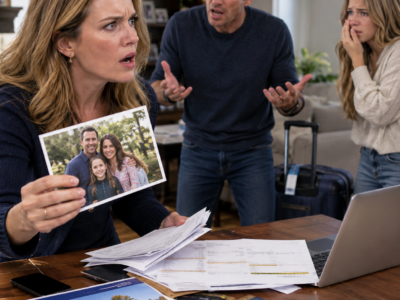
The copper steam rose between us in a thin, rhythmic hiss, smelling faintly of heated linen and distilled water. Four days before my stepdaughter’s wedding, I stood at our granite kitchen island, carefully running the steamer over the cascading silk folds of Hannah’s pale blue rehearsal dinner dress. On the counter beside me sat a small, battered black velvet box. Inside lay six antique pearl hairpins—the ones her mother, Audrey, had worn when she married Greg twenty-six years ago.
I had guarded that box for eight years. When Audrey passed away, Hannah was ten, left with a heart like a locked room. When I married Greg four years later, I learned quickly that grief doesn’t leave a house just because a new woman moves in. Audrey’s presence was built into the very architecture of our home: her handwriting in the family recipe tin, her dried bridal bouquet framed in the hallway, her quiet memory lingering in the silent spaces between father and daughter. I had never tried to paint over those walls. I simply learned how to live beside them, packing Hannah’s school lunches, sitting through frozen track meets, and keeping her small secrets safe.
“Do you think,” I asked, setting the steamer into its cradle, “Hannah would want Audrey’s pearls woven into the back of her braid for the ceremony?”
Greg dropped his truck keys onto the counter with a metallic clatter. He didn’t look up immediately. He rubbed the bridge of his nose, exhaling a long, weary breath that seemed to pull all the warmth out of the room.
“Jenna,” he said softly, his voice heavy with an edge he usually reserved for difficult contract negotiations. “You’re not her mother. Stop acting like it.”
The silence that followed was dense, almost physical. The little red standby light on the steamer pulsed steadily between us.
“What?” I managed, the word barely more than a whisper.
“I appreciate everything you’ve done,” he said, looking at me finally. “You’ve helped around here. You’ve helped Hannah. Nobody is denying that.”
Helped around here. The words settled in my chest like lead. Eight years of holding a motherless teenager through her first heartbreaks, driving three hours to her college dorm at midnight when she thought her world was ending, and teaching her to navigate the slow, painful process of growing up—reduced to helping around here.
“I have never tried to replace Audrey, Greg,” I said, my voice trembling despite my effort to hold it steady. “I’ve never asked her to call me Mom. I kept her photos up. I was the one who insisted we keep her portrait in the hallway after the remodel.”
“You’re missing the point,” Greg sighed, turning toward the doorway. “This is Hannah’s wedding. Her mother isn’t here to see it. And sometimes… sometimes it feels like you forget that. I just want boundaries.”
“Boundaries,” I repeated. I looked down at the velvet box holding another woman’s pearls. “Then you’ll have them.”
He looked relieved, and that relief hurt far worse than his blunt words.
I turned off the steamer. The tiny red light died. I folded the garment bag over the silk dress, placed it gently across a dining chair, and picked up the velvet box. That night, I slept in the guest room, watching the shadow of the ceiling fan turn slowly across the white plaster, realizing that no matter how much love you pour into a home, you can still remain a guest in it.
Part 2: The Art of Disappearing
Over the next seventy-two hours, I practiced the quiet, agonizing art of retreating.
When Hannah came rushing through the front door the next afternoon, arms overflowing with garment bags, seating charts, and stray rolls of satin ribbon, I didn’t step forward to lighten her load as I normally would. I stayed behind the kitchen island, hands folded neatly inside my cardigan pockets.
“Hey!” she gasped, dropping the armload onto the sofa. “Jenna, I need the steamer and the emergency double-sided tape.”
“Tape is in the second drawer on the left,” I said, offering a small, measured smile. “The steamer is in the laundry closet.”
Hannah paused, her hand hovering over a bundle of lace. She narrowed her hazel eyes at me—eyes so like her father’s—and tilted her head. “You okay? You look… weird.”
“Just letting you manage your big week,” I replied softly. “Everything is where you need it.”
She hesitated for a second longer, waiting for me to step in, to take the clipboard, to double-check the flower arrangements as we had done every night for six months. But I stayed still. I was respecting the boundary Greg had drawn in thick, unyielding ink.
At the rehearsal dinner the following evening, I chose a seat at the far end of the long wooden table, far from the elevated head bench where Greg sat looking proud and stoic. When the photographer shouted for immediate family to step together for a group portrait by the hearth, I took two smooth steps backward, merging quietly into the shadowy edge of the bar. Greg caught my eye across the crowded room. He didn’t call me over. He simply gave a tiny, approving nod—a contractor inspecting a job completed according to spec.
That small nod hollowed out whatever was left inside me.
The morning of the wedding arrived under a cool October sky that smelled of damp earth and woodsmoke. The stone chapel was bathed in the jewel-toned light of tall stained-glass windows. Organ music echoed softly through the nave as guests filed in.
I walked down the central aisle alone, wearing a simple navy lace dress I had purchased off the rack—a choice made specifically so I wouldn’t draw attention or look like I was trying to play Mother of the Bride.
In my hands, I held the white floral corsage that Hannah had ordered for me weeks ago. Before taking my seat, I walked to the quiet alcove near the sanctuary doors where the memorial table stood. Beside a silver-framed photograph of Audrey, lit by the warm glow of a votive candle, sat the velvet box with the antique pearl hairpins. I gently placed my corsage onto the linen runner beside Audrey’s portrait. It belonged to her memory, not to my wrist.
I walked back down the aisle and took a seat in the second row.
The front pew, reserved for the primary family, had plenty of space. Greg sat at the edge, looking straight ahead in his charcoal tuxedo. Next to him was a wide, empty cushion—a vacant space saved for a ghost, or perhaps just meant to be kept clear of me. I folded my hands tightly in my lap until my knuckles turned white, staring at that empty blue cushion, realizing Greg had gotten precisely what he wanted. I had successfully disappeared.
Part 3: The Unspoken Place
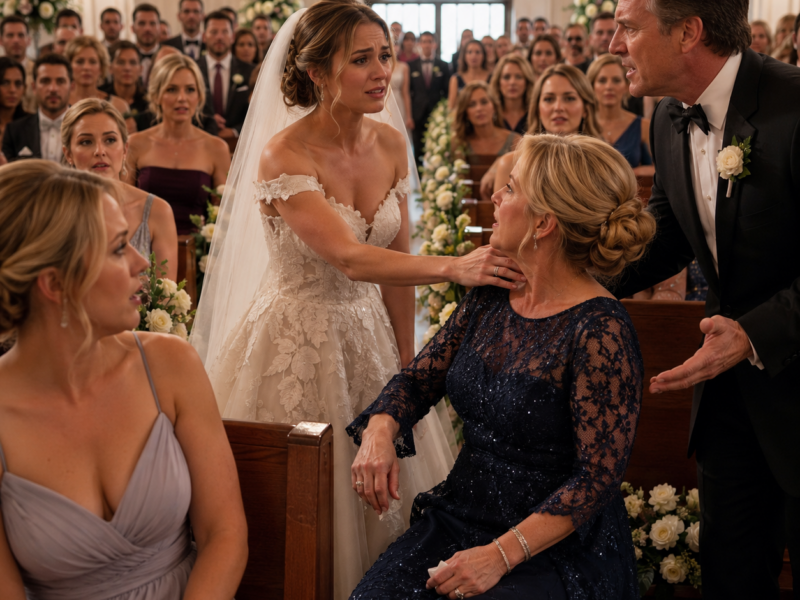
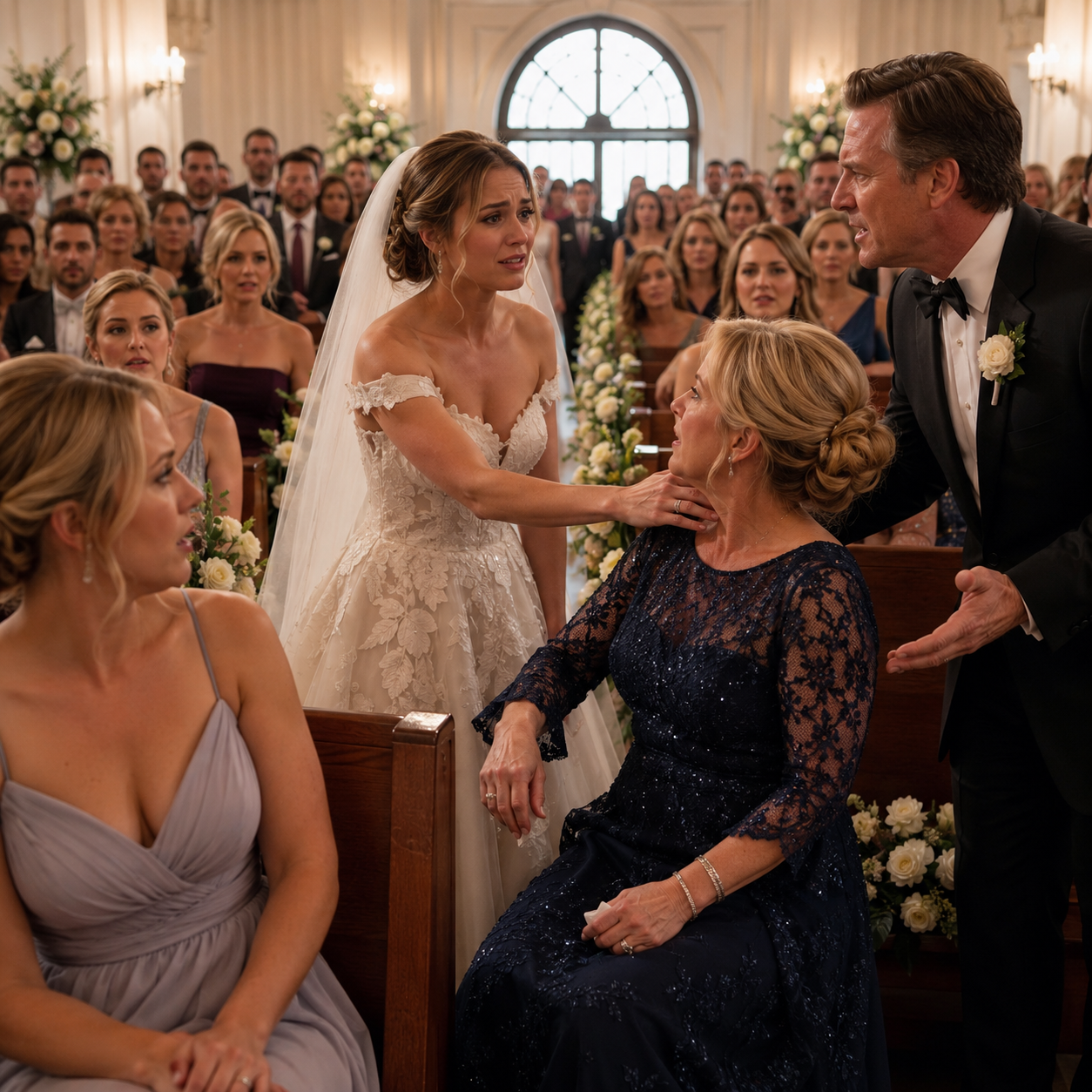
The organ shifted into the rich, resounding chords of the bridal march. The heavy oak doors at the back of the chapel swung open, and the congregation stood in unison.
Hannah appeared on her father’s arm.
My breath caught in my throat. She was radiant. The ivory dress fell around her in flawless silk folds, but it was her hair that made my heart hammer against my ribs. Her dark hair was styled into an intricate, tumbling braid—and woven carefully throughout the locks were the six antique pearl hairpins, shimmering like tiny starlight points under the chapel light. She had found them on the memorial table and worn them down the aisle.
Greg walked her forward, his chest puffed out with pride, his steps measured and heavy. When they reached the altar, he kissed her cheek, lifted her veil briefly, and then stepped back to take his place in the front pew, sitting right beside that empty space he had guarded so carefully.
Hannah turned to face Ethan, but before the minister could speak the opening prayer, her eyes swept across the gathered pews.
She scanned the front row. She saw her father sitting alone beside the wide, empty cushion. Then her eyes drifted back, finding me in the second row, sitting quietly behind a distant aunt.
Her brow furrowed. Her hazel eyes darted down to my bare wrist, noticing the absence of the corsage, and then back to the empty seat beside her father. A subtle, sharp look of understanding crossed her face, replaced instantly by a cool, unyielding resolve.
The ceremony proceeded, but I barely heard the vows. My mind was trapped in the quiet agony of my self-imposed displacement. I had done what was asked of me. I had stepped out of the way.
An hour later, the reception at the renovated brick mill was in full swing. Warm bistro lights strung across the rustic rafters cast a golden glow over fifty tables. Laughter, the clinking of champagne flutes, and low jazz filled the air.
I sat at Table 9, near the back exit, sipping ice water and conversing quietly with Greg’s second cousins. Greg was at the main family table near the dance floor, holding court with business associates, looking every bit the proud patriarch.
Suddenly, the music faded. The wedding coordinator tapped a microphone near the head table, handing it over as a chair scraped against the hardwood floor.
Hannah stood up.
A collective hush fell over the room as guests turned their attention toward the bride. Greg sat up straighter, a proud, expectant smile forming on his lips, assuming his daughter was about to deliver the traditional thank-you toast to her father and new father-in-law.
“Thank you, everyone, for coming tonight,” Hannah’s voice resonated clearly through the speakers. She held the microphone firmly, but she didn’t look at Ethan, nor did she look at Greg.
She stepped away from the head table.
The room went dead silent as the bride began walking across the wide floor, her long ivory train trailing behind her. She walked right past her father’s table. She didn’t pause. She didn’t look down at him.
Greg’s smile faltered, his posture freezing mid-frame.
Hannah walked straight down the central aisle of the reception hall, past twenty rows of tables, until she stopped right in front of Table 9. Right in front of me.
The entire room turned to follow her path. My heart hammered against my ribs like a trapped bird.
“Jenna,” Hannah said, her voice echoing through the silent hall, rich with an emotion that made my eyes instantly burn. She reached down, took my hand, and gently pulled me up from my chair.
She reached into her purse on the nearby chair, pulled out the white corsage I had left beside her mother’s portrait, and carefully pinned it to the navy lace over my heart.
“Four days ago,” Hannah spoke into the microphone, her eyes locked onto mine, glistening with unshed tears, “someone told me that I only have one mother. And that’s true. Audrey gave me my life, and I carry her in my heart every single second.”
She turned slightly, her voice steadying as she looked back toward the head table where Greg sat, completely motionless.
“But Audrey died when I was ten,” Hannah continued, her words cutting through the air with terrifying clarity. “And for eight years, Jenna was the person who stayed. She was the one who packed my lunches when I was too sad to eat. She was the one who sat in the freezing rain at my track meets. She was the one who kept my secrets, held my head when I cried, and taught me how to be a woman without ever once demanding that I give her a title to prove she cared.”
Hannah gripped my hands tightly, her knuckles white.
“You don’t get to choose who gives birth to you,” Hannah said, her voice ringing across the silent room. “But you do get to choose who earns the right to be called family. Jenna, you didn’t replace my mother. You saved me after I lost her.”
She looked across the room directly at her father. Greg’s face had drained of all color. Slowly, under the weight of two hundred staring guests and his daughter’s unwavering gaze, my husband lowered his head, staring down at his hands on the white tablecloth, unable to meet anyone’s eyes.
Hannah turned back to me, smiling through a spill of tears.
“You belong in the front row, Jenna. You always have.”
She took my arm, turned her back on the quiet room, and walked me up to the main table, placing me in the seat right beside her, where I belonged.