In the days following the tragic death of 19-year-old Canadian backpacker Piper James on K’gari (Fraser Island), a series of witness statements has emerged that directly contradict the initial police narrative and raise deeply troubling questions about the circumstances of her final moments.
Multiple local residents and campers who were on or near the beach close to Eli Creek on the morning of January 17, 2026, have come forward to describe the conditions as “unusual” and “not normal.” Several people interviewed by Queensland Police and local media outlets stated they saw only one or two stray dingoes in the area that morning — a common sight on the island, but nothing alarming or aggressive. “It was quiet,” one camper told the Courier Mail. “We saw a single dingo walking along the dunes, nothing more. No pack, no threatening behaviour. It felt like any other day.”
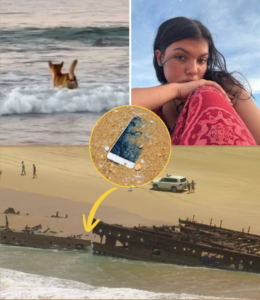
Yet what was recovered from Piper’s own phone tells a completely different story.
The device, found near her body, contained a short 18-second video she began recording shortly before she disappeared. The footage — partially released to investigators and described in detail by police sources — shows Piper walking alone along the beach. She turns the camera toward the dunes and whispers, “Look at them… they’re following me.” The video then captures at least 12–15 dingoes emerging from the scrub, moving in a loose, coordinated group. They do not scatter or wander aimlessly; they appear to be stalking, fanning out in a semi-circle, heads low, eyes fixed on her. Piper’s breathing quickens. She backs away slowly, panning the camera again. The last clear frame shows the pack closing in before the footage cuts out abruptly.
The discrepancy is stark: witnesses saw only one or two dingoes; Piper’s video shows a large, organised pack. Police have confirmed the animals in the footage are consistent with a known group of habituated dingoes that frequent the Eli Creek area — animals that have lost their natural fear of humans due to years of feeding, close photography, and discarded food scraps left by tourists.
Investigators are now urgently examining whether the pack’s behaviour was influenced by human interaction in the days or weeks prior to the attack. Queensland Parks and Wildlife Service has acknowledged that habituation is a growing problem on K’gari, where dingoes — one of the purest remaining populations in Australia — are protected but increasingly bold around people.
Piper had been working at a local hostel for six weeks and was known to interact frequently with dingoes — taking photos, leaving small amounts of food, and sitting near them on the beach. Friends say she viewed the animals as “beautiful and misunderstood” and believed they were safe when treated with respect. Her last text to her father on New Year’s Eve read: “Love you Dad. This place is magic. The dingoes are so calm tonight. See you soon.”
The 19-year-old’s body was found at 6:35 a.m. on January 17, surrounded by the pack. Autopsy results confirmed death from exsanguination due to multiple deep lacerations and puncture wounds, with clear defensive injuries showing she fought back desperately.
The video has intensified calls for stricter dingo management on K’gari. Authorities have ramped up patrols, issued new warnings about habituated animals, and temporarily closed sections of beach. A full investigation continues into whether human behaviour contributed to the pack’s aggression.
Piper’s family in Canada is devastated. Her father told media: “She loved animals. She loved this place. She thought the dingoes were her friends. Now we’re left with questions no parent should ever have to ask.”
A GoFundMe for repatriation, funeral costs, and a safety-awareness fund in Piper’s name has raised over CAD $650,000. Tributes continue to flood her social media, where she shared her travels with an infectious smile and love for adventure.
K’gari — a place of stunning beauty — now carries a dark shadow. A single 18-second video has turned a peaceful beach walk into a chilling warning: paradise can turn deadly when wild animals lose their fear of humans — and when humans forget to respect the wild.
News

NFL STAR STEFON DIGGS SPARKS FIRESTORM AFTER ALLEGEDLY EXP0SING CARDI B — FANS SAY THIS COULD BACKFIRE IN A BIG WAY
A wave of online reactions is building after Stefon Diggs found himself at the center of controversy involving Cardi B—and…

SIX DAYS AFTER TURNING HIS LIFE AROUND — A FATHER IS GU-NNED DOWN IN FRONT OF HIS SON IN Chicago
What should have been the beginning of a new chapter ended in unimaginable tragedy. In Chicago, Keenan Terrell Campbell had…

STREETS, LOSS, AND LOYALTY: RUMORS SWIRL AROUND RAPPER K SHORDY AS PAST CONFLICTS AND A TRAGIC DE-ATH RESURFACE
In the world of street rap, perception can be just as powerful—and dangerous—as reality. And right now, few names are…

FROM CEO TO TARGET: BULLETS END A BLO0DY CHAPTER AS BATON ROUGE LABEL BOSS IS EXECUTED AFTER YEARS OF WAR, BETRAYAL, AND FEDERAL HEAT
The rise was as dramatic as the fall. In the streets of Baton Rouge, his name carried weight—equal parts respect,…

BEHIND THE SPOTLIGHT, A DARK TRUTH: AFL STAR’S HEARTBREAKING ADMISSION OF SUIC-IDAL THOUGHTS SH0CKS FANS
Fremantle star Nathan O’Driscoll took to social media to open up about his mental health struggles. In the heartbreaking post,…

FROM DESPERATE SEARCH TO CHILLING BREAKTHROUGH: MISSING GIRL CASE TAKES A DEVASTATING TURN AS SUSPECT IS FINALLY CAUGHT
Northern Territory Police have arrested Jefferson Lewis, the man investigators believe abducted and killed five-year-old Sharon Granites. NT Police on Thursday…
End of content
No more pages to load