
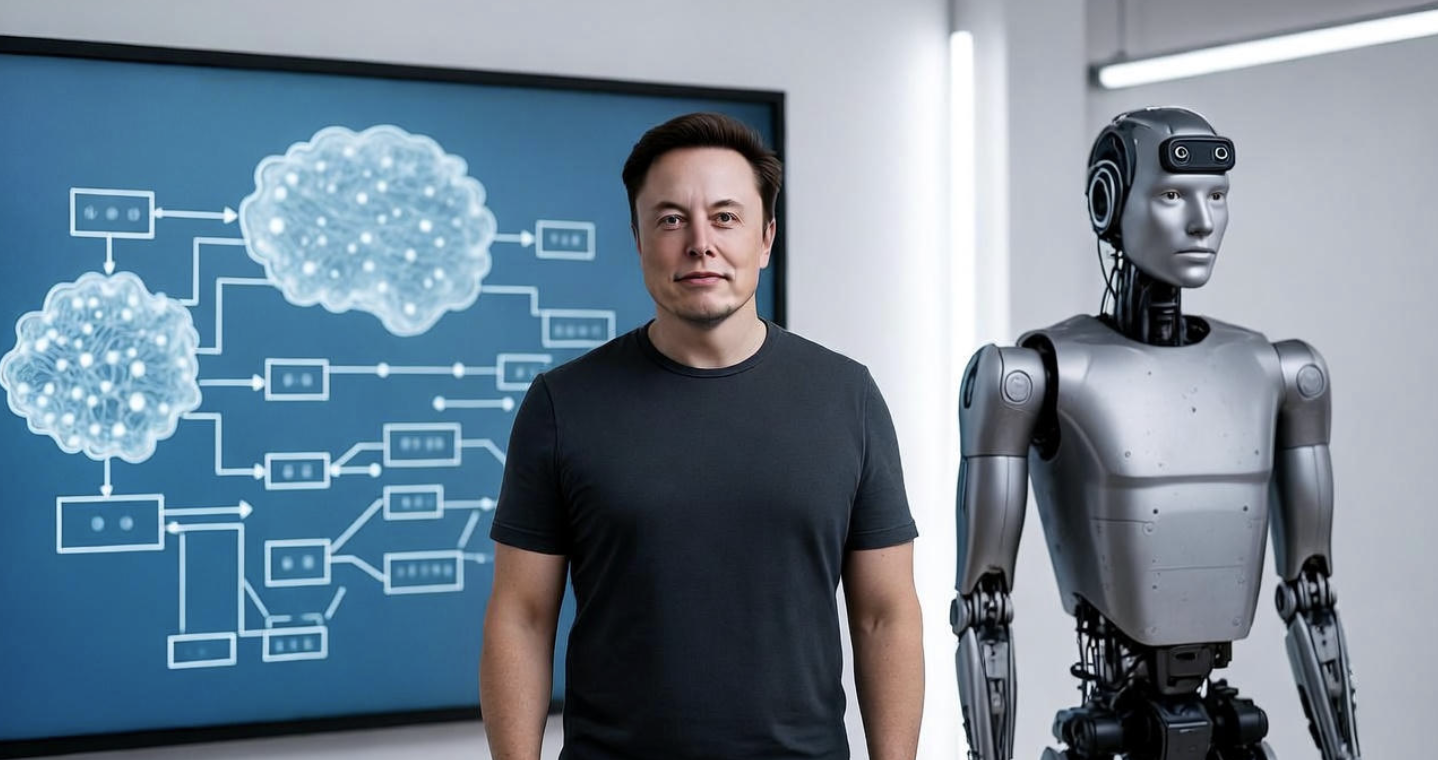
Billionaire entrepreneur Elon Musk has claimed that the only realistic solution to the United States’ ballooning national debt—now exceeding $38 trillion—is the large-scale deployment of artificial intelligence and robotics to dramatically boost productivity and economic output.
Speaking on the podcast “Another Conversation with Nikhil Kamath,” aired on November 30, Musk argued that the current level of U.S. debt has reached what he described as an “absurd” threshold, making traditional fiscal solutions increasingly ineffective.
“Just the interest payments on the debt now exceed the entire U.S. military budget, and that number is going to rise in the near term,” Musk said. “I really believe that only AI and robots can solve the debt problem.”
Productivity as the Key to Debt Reduction
According to Musk, the massive adoption of AI-driven automation and humanoid robots—such as those being developed by Tesla—could unlock unprecedented gains in productivity and output, enabling the economy to grow fast enough to offset mounting debt obligations.
He emphasized that technological advancement, rather than higher taxes or spending cuts, is the only scalable path forward. “AI and robotics are almost the only things that can increase productivity to the level required,” he said.
Deflationary Pressures Ahead
However, Musk warned that such productivity gains would likely bring deflationary effects, as the supply of goods and services expands faster than the money supply.
“When you have AI and robots, the output of goods and services increases dramatically, which can lead to deflation,” Musk explained. “You can’t increase the money supply at the same pace as production.”
Addressing why inflation remains above the Federal Reserve’s 2% target, Musk argued that AI has not yet had a strong enough impact on productivity to counteract aggressive monetary expansion.
“AI hasn’t yet accelerated production faster than the money supply,” he said. “The U.S. is increasing the money supply significantly, with deficits of around $2 trillion. Output needs to grow faster than that to avoid inflation.”
A Turning Point Within Three Years
Musk predicted that this balance could shift soon. “Within about three years or less, the growth rate of goods and services will exceed the growth rate of the money supply,” he said, suggesting that AI-driven productivity could soon become a dominant macroeconomic force.
Looking further ahead, Musk argued that widespread AI and robotics adoption could fundamentally reshape the global economy—and even challenge the relevance of traditional monetary systems.
“At a certain point, when AI and robots are manufacturing chips, building solar panels, extracting resources, and producing more robots,” he said, “you effectively decouple from the monetary system.”
Beyond Nations and Money
When asked whether this future could resolve national debt entirely, Musk went even further, suggesting that the concept of nation-states themselves may become outdated.
“In the future I’m describing, the idea of countries becomes obsolete,” he said. “This is just my view of what I think will happen based on what I’m seeing. I’m not trying to make it happen—it will happen regardless of whether I want it to.”
Musk concluded by stating that as long as human civilization continues to progress, the large-scale deployment of AI and robots is inevitable.
“As long as civilization advances, we will have AI and robots at massive scale,” he said.
News

💥 THREE WORDS THAT MELTED HEARTS — Princess Charlotte Turns to the Camera at Easter and Quietly Says It…
Prince William got in on the coordinated look as well From left: Princess Charlotte, Kate Middleton, Prince George, Prince Louis…

THE FATEFUL DIAMOND CHAIN — Kevin “Tugg” Watson Sh0t D3ad on Facebook Live in South Austin, Ch!lling Argument Footage Leaves Viewers Shaken
What began as a routine livestream quickly spiraled into a moment that would leave viewers stunned and searching for answers….

WATCH VIDEO: Tugg Watson’s Family Drops Bombshell on K!llers – Chicago PD Ignored Key Evidence!
The case surrounding the death of Tugg Watson has taken a dramatic and unsettling turn, as his family steps forward…

CHAOS ERUPTS — Chief Keef Reacts After Cousin Is Taken in Sh0cking Chicago Incident
Tensions in Chicago have once again erupted into chaos, and this time the situation has hit close to home for…

“SHE CALLED ME A DISGRACE IN FRONT OF THE ENTIRE BOARD…” — But When the Keynote Speaker Walked Past Everyone and Stopped at My Table, the Whole Room FROZE as He Said: “I KNOW… I WAS THE ONE WHO SIGNED IT!
Part 1 My aunt told the alumni board I had been fired for misconduct. She put it in writing on…

💥 “THE DOOR WAS KICKED IN… I WAS ARRESTED RIGHT IN FRONT OF THE ENTIRE COMPANY” — The CEO Stood Behind the Glass, Smiling, Thinking His Perfect Setup Had Worked… But a 2:47 AM Post Destroyed Everything! 😱🔥
PART 1 They Kicked Down My Office Door And Arrested Me In Front Of Everyone I’d Worked With For Eleven…
End of content
No more pages to load