

The very aspects that make “Iron Lung” from director Mark Fischbach (better known to his legion of YouTube followers as Markiplier) succeed are the very same elements that cause it to unravel. A grungy, blood-soaked DIY chamber piece based on David Szymanski’s 2022 video game of the same name, it’s admirably restrained, being far more interested in creating a haunting ambience than raising your blood pressure.
That pacing can be punishing, though, as one gets the sense it’s trying to be a touch too reverent to its source material. Fischbach’s good intentions may not translate to competent filmmaking, but he clearly understands not just the appeal of this story but of video games as a whole. For every moment that drags–like the film’s opening sequence, which feels like it takes an entire solar cycle–he finds new ways to make cramped spaces more terrifying. Overall, “Iron Lung” is a mighty endeavor, a project that speaks to the capacity for humanity’s creativity amid limitations. Anyone can learn the technical skills of filmmaking, but passion can’t be faked, and Fischbach has the latter in grisly, cosmic spades.
Admittedly, it takes time to adjust to Fischbach’s wavelength. His script doesn’t so much dole out information as assault you with exposition, which might leave even the most attuned viewer confused (he jokingly insinuated in an interview that he made the world-building clunky so people would watch it again to better understand).
A gravelly voiceover notes that an event called “The Quiet Rapture” caused star systems and planets to vanish without explanation, severely reducing the human population. Simon (Fischbach) is an unlucky soul forced to scavenge for natural resources on a literal ocean of blood on a submarine called the Iron Lung. When Simon captures a picture of the skeleton of a giant creature on the ocean floor, he’s tasked by his overlords to retrieve a sample by any means by yesterday. He, like other cinematic expendables who are tasked with putting their bodies on the line to boost a corporation’s bottom line, begins to suspect that maybe those in power don’t have his best interests at heart.
In addition to starring and directing the film, Fischbach also wrote the script and self-financed it. That level of involvement might justify the fact that his presence is inescapable for nearly every frame of this film. It can still be a big ask to spend over two hours with his tortured character, whose only registers of emotion seem to be stressed and more stressed. When Simon’s not yelling at his superiors, whose voice is heard through a blinking intercom, he’s staring at the monitor and reacting to what’s moving or not moving outside.
It’s never cringe, but it’s never quite at the register of compelling either, with many of Fischbach’s deliveries feeling like he’s saying the dialogue as if he’s rehearsing it for the first time. It’s not a good sign when, during a heated exchange he has with a crew commander, Ava (Caroline Rose Kaplan), it feels like the faceless, stationary speaker emanating Ava’s voice is giving a more compelling emotional performance than he is. He works far better when he delivers snark (“Things are somehow faster when I don’t know what I’m doing”) instead of terror, and we get ample amounts of both registers from him as his expedition progresses.
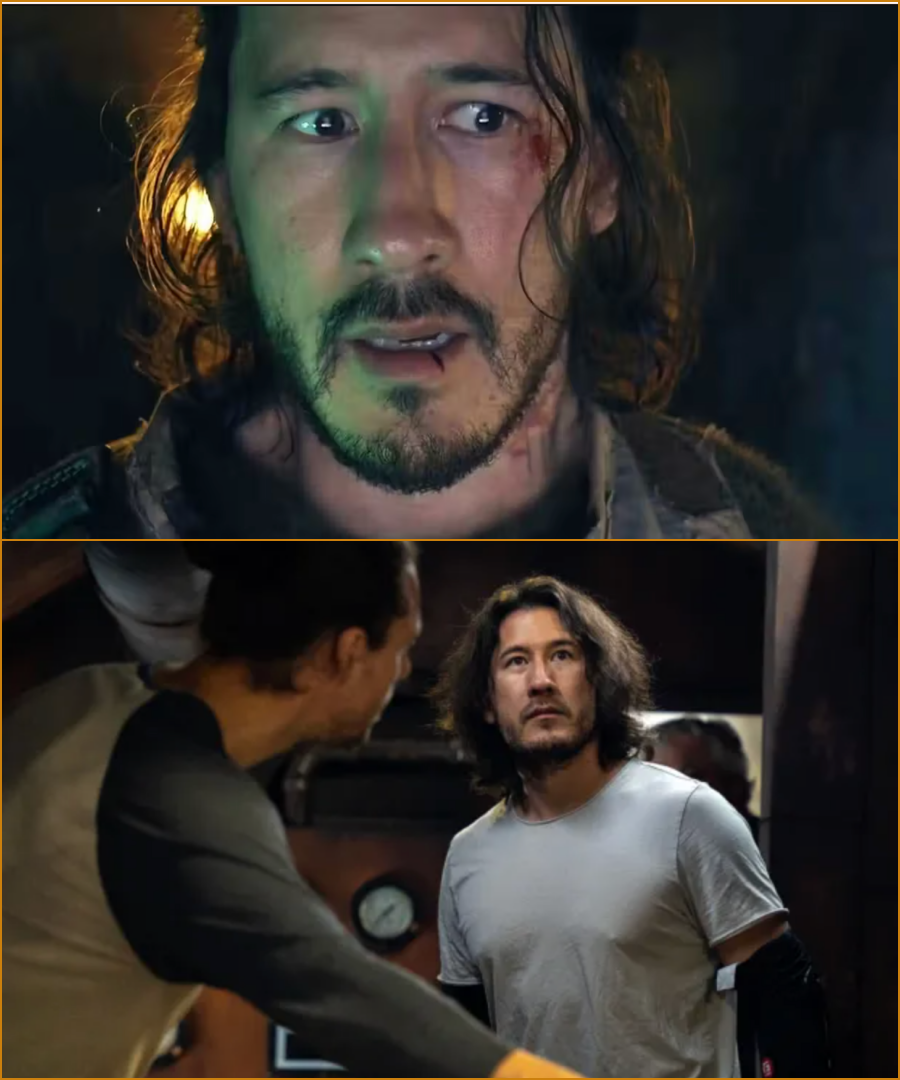
Yet the film boasts better blocking and is more interestingly shot than most films crafted on the same scale and budget. Its visual language is consistently interesting, even if it may reuse one too many set-ups. While there are brief flashbacks, monologues, and intercom voices to break up the static rhythm, for the most part, we never leave the enclosed space Simon finds himself in. To emphasize how enclosed the submarine is, cinematographer Philip Roy frequently shoots with low angles, often from the perspective of whatever item Simon is grabbing at the time to steady himself.
Take a moment where he is attempting to cross the wires of a control panel; the camera is situated in such a way that we see Simon’s hands struggling to connect the wires, but the rest of his body is obscured. It’s then edited with a wider, fish-eye lens to briefly establish a sense of place before returning to the more constrictive perspective. It’s this constant oscillation, an almost quivering between claustrophobia and width, that gives the film a feeling of unease. From the leaky pipes to flickering lights, it’s evident that not all is well in the Iron Lung, but the camerawork makes it feel as though we’re already in the belly of the beast, even if on-screen, we know Simon is just outside of the skeleton’s craw.
At times, the film struggles to decide whether to commit to its campy premise or pursue something more subversive. It’s riddled with cheesy lines like “This is not an expedition. It’s an execution,” but thematically it also explores how violence is seen as the only option for characters who wish to assert a sense of agency. Simon is trapped, and as his diatribes grow increasingly violent once he realizes he’s been left behind by an organization that espouses values of human dignity and care, and yet they’re all too ready to use him as a sacrifice. “There is too much at stake not to take a calculated risk,” a superior tells him to sympathize. That sounds a lot better when you’re not the aforementioned risk.
It’s hard to discuss the film without also mentioning the broader underdog narrative surrounding its success. During its opening weekend, the film earned a global tally of $21.7 million, some $9 million shy of Sam Raimi’s larger budgeted and more heavily marketed “Send Help,” which opened the same weekend. That’s a major accomplishment for an independent film that wasn’t backed by a major studio, nor did it have a traditional marketing rollout.
The powers that be in Hollywood often obscure the metrics of success and make it difficult for indie films with uncompromising visions to breathe and live their own lives. In many ways, they act as the forces outside of the Iron Lung, forcing creatives to stay within a constrained set of norms lest they dare to be devoured by stepping outside. The runaway success of “Iron Lung” represents a hopeful new era of moviemaking, one where those with passion and a platform can create art that’s just as worthy of being seen and celebrated. Quality of the film aside, there’s no denying that “Iron Lung” is a celebration of those artists who aren’t afraid to carve their own path outside the studio model.
News

PRINCE HARRY DROPS WARNING — Rumors About Kids Visiting King in UK Spark Questions Across Palace
Friends close to Prince Harry have claimed he wants the King to invite him to bring his family to Sandringham…

ROYAL MOVE UNDER SCRUTINY — Prince Harry’s Actions Spark Speculation During King Charles’ US State Visit… and It’s Not What We Thought
A source close to the Duke of Sussex has confirmed that he will not travel to the country’s capital to…

Princess Beatrice Takes Major Step to Permanently Bar Prince Andrew From Visiting — Palace Sources Reveal Rising Tensions and Questions About Family Dynamics…
Princess Beatrice is said to be under “intense personal pressure” and is considering a move to the US to escape…

SH0CKING OCEAN MYSTERY — FBI Drops Urgent Update on Amy Bradley, Missing 28 Years After Vanishing From Royal Caribbean Cruise
THE FBI is looking for new leads in the shocking disappearance of Amy Lynn Bradley, who vanished 28 years ago…

BREAKING TODAY: Major Update on King Charles’s US State Visit — But One Detail Sparks Questions…
King Charles and Queen Camilla’s state visit to the US was confirmed today. King Charles is visiting the US next…

🔥 EXPL0SIVE — Drakeo’s K!llers Finally Exposed: Backstage Scuffle at LA Festival Bl@med for Fat@l St@b D3ath!
The hip-hop community is still reeling from the shocking death of Drakeo the Ruler, the rising Los Angeles rapper whose…
End of content
No more pages to load