The rain had not stopped for days.
On the southern end of Okinawa, the earth had turned into a thick, sucking mud that clung to boots, tires, and wounded men alike. The hills were torn open by artillery, the trees were nothing but splintered trunks, and the air smelled of smoke, cordite, and decay.
It was June 1945, and the battle for the island had become one of the bloodiest fights the United States had ever faced.
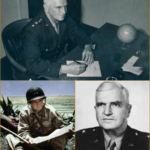
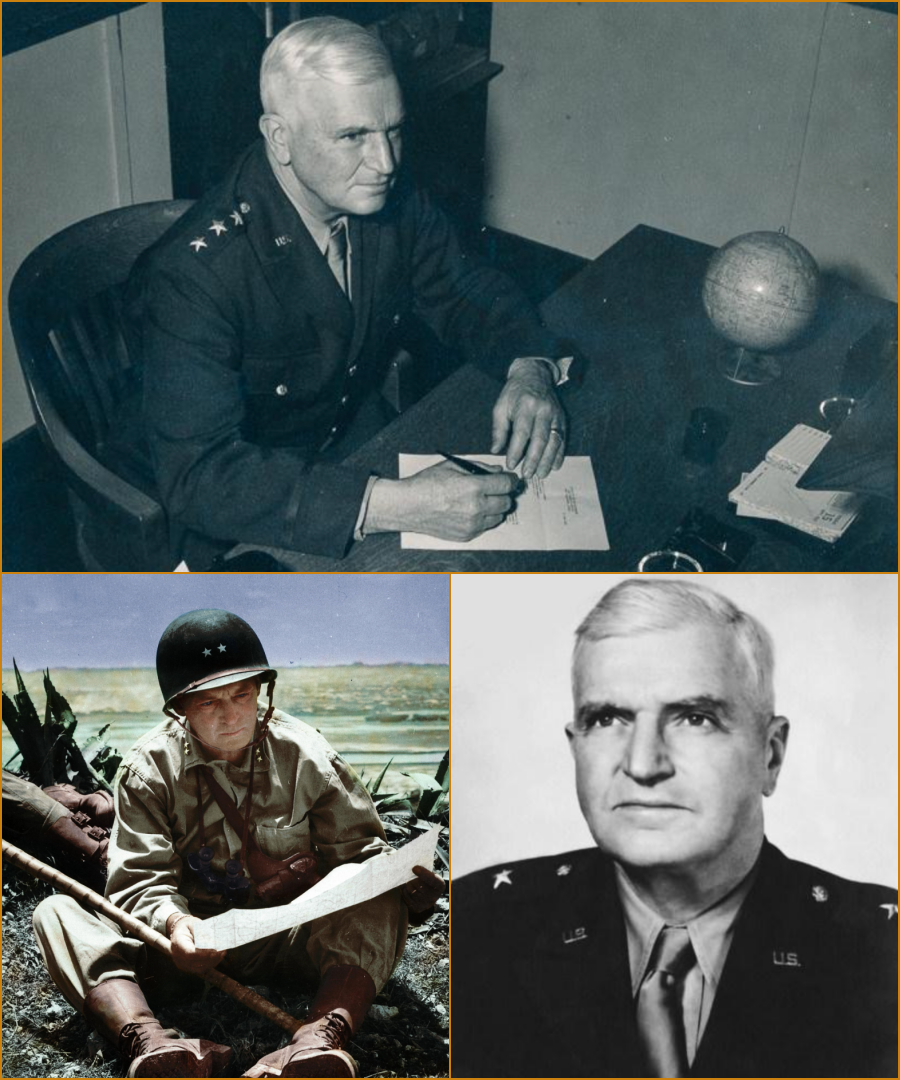
Lieutenant General Simon Bolivar Buckner Jr., commander of the U.S. Tenth Army, stood on a narrow ridge overlooking the shattered terrain. Through his binoculars, he studied the Japanese defensive lines that clung stubbornly to the southern hills.
To many men in the army, he didn’t look like the kind of officer who would command such a massive force. He was tall, broad-shouldered, with a face that carried both firmness and fatigue. The weeks of battle had etched deeper lines into his features.
But he was known for one thing above all else.
He stayed close to the front.
A Commander Raised for War
Buckner had grown up in the shadow of the army. His father, a Confederate general during the American Civil War, had named him after the South American liberator Simón Bolívar. The name was a heavy one, filled with history, expectations, and legacy.
Buckner followed the only path he had ever truly known.
He attended West Point, graduated into the U.S. Army, and spent decades serving in posts that ranged from quiet garrisons to tense international assignments. He wasn’t known as a flashy officer. He wasn’t famous for daring speeches or brilliant tactical surprises.
He was known for discipline. For structure. For being solid.
And when the Second World War spread across the Pacific, that was exactly the kind of commander the army needed.
By 1945, Buckner had been given command of the Tenth Army—a massive force composed of both Army and Marine units. Their mission was clear: seize Okinawa, the last major stepping stone before the planned invasion of the Japanese home islands.
Everyone knew what that meant.
If Okinawa fell, Japan itself would be next.
And the Japanese knew it too.
The Island That Wouldn’t Fall
When American forces landed on Okinawa in April 1945, the initial advance had seemed almost too easy. The beaches were taken with surprisingly little resistance.
But the Japanese had a different plan.
Instead of defending the shoreline, they had dug deep into the southern hills. They built tunnels, caves, and reinforced positions hidden beneath the earth. Every ridge, every slope, every rocky outcrop had been turned into a fortress.
The Americans called it the Shuri Line.
And breaking it would cost them dearly.
Rain fell constantly, turning foxholes into muddy pits. Tanks got stuck. Wounded men lay for hours before they could be evacuated. Artillery roared day and night, and the air was never truly quiet.
Every yard gained came with a price.
Buckner knew the cost of the battle better than anyone. Reports arrived daily: casualty numbers, missing men, destroyed units, and requests for reinforcements.
Still, he refused to remain far from the fighting.
He believed a commander had to see the battlefield with his own eyes.
“The Men Are There. So I’ll Be There.”
Many officers were uneasy with Buckner’s habit of visiting forward positions.
One colonel once warned him, “Sir, you’re exposing yourself unnecessarily. The Japanese artillery is unpredictable.”
Buckner replied calmly, “The men are up there. If they can be there, so can I.”
It wasn’t bravado. It was simply how he believed command should work.
He moved from position to position, sometimes in open jeeps, sometimes on foot, stepping through mud and debris like any other soldier. He spoke with junior officers, asked about supply problems, listened to complaints, and observed the front lines personally.
To the soldiers, it mattered.
They saw their commanding general standing in the same rain, breathing the same smoke, and listening to the same artillery.
It made the war feel less distant, less abstract.
The Final Push South
By mid-June, the American forces had pushed deep into southern Okinawa. The Japanese defenses were collapsing, but the fighting had become even more desperate.
Japanese units, cut off and low on supplies, fought from caves and hidden bunkers. Some launched night attacks. Others waited silently until American troops were only yards away.
Casualties mounted on both sides.
Buckner’s headquarters received reports that the last defensive lines were beginning to break. But the terrain ahead was still dangerous, and the enemy artillery remained active.
On June 18, 1945, Buckner decided to visit a forward observation post near the front.
He wanted to see the situation himself.
The Ridge
The position was on a coral ridge not far from the front lines. The ground was uneven, broken by craters and scattered rocks.
A few officers accompanied him. They climbed up the slope, careful with their footing.
From the ridge, the battlefield stretched out before them—smoke drifting across shattered hills, artillery flashes in the distance, and the faint sounds of gunfire echoing through the valley.
Buckner raised his binoculars.
He studied the Japanese positions, noting where resistance still held.
One of the officers beside him grew uneasy.
“Sir,” he said, “this position is exposed. Enemy artillery is still active in the area.”
Buckner lowered his binoculars for a moment.
“We won’t be here long,” he replied. “Just need a better look.”
He lifted the binoculars again.
The Incoming Shell
Somewhere in the distance, a Japanese artillery crew had spotted movement on the ridge.
They adjusted their aim.
The sound came first—a faint, rising whistle in the air.
One of the officers shouted, “Incoming!”
The shell struck the rocks behind the group, exploding in a violent burst of smoke, dust, and flying metal.
Fragments of shrapnel tore through the air.
Men dropped instinctively to the ground.
When the dust cleared, Buckner was lying on his side.
A jagged piece of shrapnel had struck him in the chest.
The Final Moments
“Medic!” someone shouted.
Officers rushed to him. One knelt beside the general, trying to stop the bleeding. Another called frantically for help over the radio.
Buckner was conscious for a moment.
His breathing was shallow. His face had turned pale beneath the grime of the battlefield.
The medic arrived, working quickly, but the wound was severe.
There was little they could do.
Within minutes, Lieutenant General Simon Bolivar Buckner Jr. was dead.
He was 58 years old.
The Silence After
The news spread quickly through the command structure.
At first, many soldiers refused to believe it.
A general—killed by artillery at the front?
But it was true.
Buckner had become the highest-ranking American officer killed by enemy fire during the entire Second World War.
For many men on Okinawa, the news hit hard.
“He was always out there,” one infantryman later said. “Not behind a desk. Out there with us.”
Another soldier remarked quietly, “Guess he stayed too close to the front… but that’s how he was.”
The Battle’s End
Just four days after Buckner’s death, the Battle of Okinawa officially ended.
The island had been secured.
But the cost was staggering.
More than 12,000 American servicemen had been killed. Tens of thousands were wounded. Japanese military losses were even higher, and civilian casualties reached into the tens of thousands.
Okinawa had become a grim preview of what an invasion of mainland Japan might look like.
And in the middle of that terrible battle, one of America’s top generals had fallen on the same ground as the soldiers he commanded.
A General Among Soldiers
Buckner was not remembered as a glamorous war hero.
He didn’t have the theatrical flair of General Patton.
He didn’t have the global fame of General MacArthur.
He didn’t deliver dramatic speeches that echoed through history.
But he had something else.
He had the respect of the men who saw him walking through mud, standing under artillery fire, and refusing to command from a safe distance.
He believed a commander should share the risks of his soldiers.
And in the end, he did.
The Legacy of the Ridge
Today, historians often point to Buckner’s death as a reminder of the brutal, unpredictable nature of war.
Even a general—one of the most senior officers in the entire U.S. Army—could be taken in an instant by a single shell.
No rank, no medal, no command post was enough to stop a piece of flying steel.
On that ridge in Okinawa, Buckner didn’t die as a distant figure behind a desk.
He died the same way thousands of soldiers did.
Out in the open.
On the battlefield.
Under enemy fire.
And for many who served under him, that was exactly how he would have wanted it.
News
💔 “THE WAR WAS OVER… BUT NO ONE TOLD HIM.” — The Trag!c Final Hours of Charley Havlat, The Last U.S. Soldier to Di3 in Europe
The true story of Charley Havlat — the American soldier believed to be the last to die in combat…
The American soldier handed his ring to his closest friend, and those final words became a memory that left the entire platoon choked up for many years afterward
🇺🇸 “BEFORE THE FIRST SHOT WAS FIRED, HE TOOK OFF HIS RING…” The desert was still half-asleep when the order…
ALL-STAR CONTROVERSY: MEGHAN’S “NEW HAIR” STUNTS NBA CROWD — STYLE STATEMENT OR CALCULATED SPOTLIGHT GRAB? 🏀🔥
The Duchess of Sussex appeared to tuck back some short strands around her face Prince Harry and Meghan Markle attend…

LILIBET’S DIANA LEGACY UNVEILED: NEW PHOTO IGNITES ROYAL FRENZY AS FANS SPOT THE ONE HEARTWARMING DETAIL THAT LINKS HER TO PRINCESS DIANA 👑💫
Meghan Markle shared a sweet pic of her 4-year-old daughter in pink for Valentine’s Day Princess Lilibet and Prince Harry;…

LILIBET PHOTO FIRESTORM 🤯 HARRY & MEGHAN UNDER SIEGE — ROYAL IMAGE BACKLASH ERUPTS
Meghan Markle, the Duchess of Sussex, praised the Jools’ Law campaign, which has pushed for changes to online safeguarding following…
“HE SAID IT WHEN NO ONE EXPECTED…” — Prince William’s Devastating Words About Princess Kate After Their Painful Split
The Mirror royal editor Russell Myers reveals in his explosive biography of the Prince and Princess of Wales what happened…
End of content
No more pages to load