Jimmy Kimmel wasn’t just telling jokes. And this time, he wasn’t laughing just for laughs.
On a recent episode of Jimmy Kimmel Live!, the late-night host devoted much of his monologue to tearing into Time magazine’s 2025 Person of the Year cover — a cover that has sparked fierce debate by honoring the so-called “Architects of AI.”
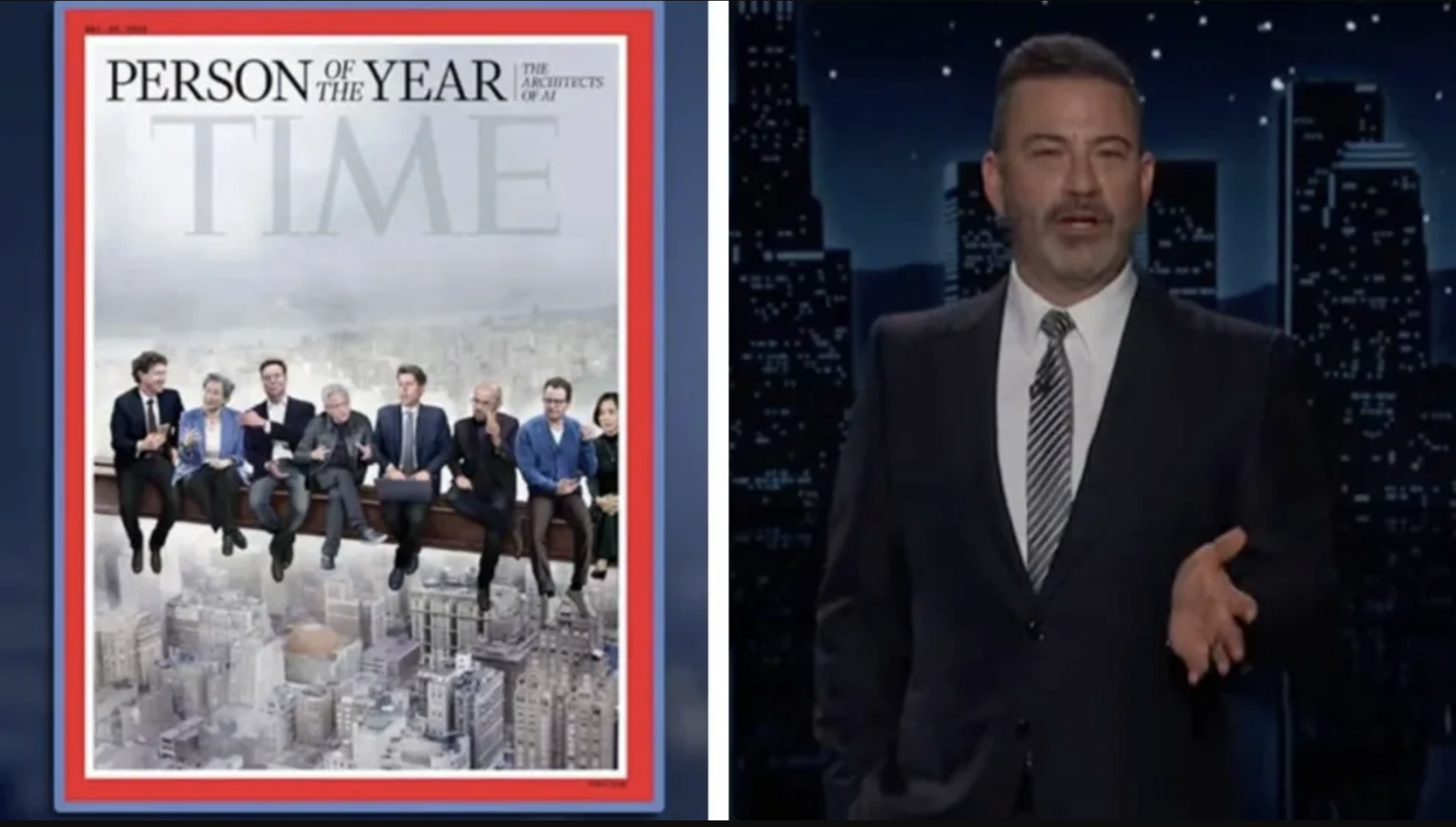
Featured prominently are some of the most powerful figures in tech today: Elon Musk, Sam Altman, and several other CEOs shaping the future of artificial intelligence. Time framed them as visionaries, builders of tomorrow.
Jimmy Kimmel had a different label.
“It looks like Photoshop from 2007,” he joked, before delivering a sharper blow: “the nerds of the apocalypse.” The audience laughed — but beneath the laughter was something far less comfortable.
For Kimmel, the issue isn’t that Time chose AI as the defining force of the year. The issue is who gets elevated to hero status, and why the media seems so eager to crown tech executives as saviors of humanity.
Through his trademark sarcasm, Kimmel posed a question that caused the room to quiet:
Do the people building AI truly understand the consequences of what they’re unleashing — or are they simply racing for power, profit, and influence?
Without naming specific scandals or controversies, his commentary evoked a growing list of anxieties surrounding Big Tech: AI replacing human labor, the manipulation of information, and enormous power concentrated in the hands of a very small elite.
What made the segment spread rapidly online wasn’t just the humor, but the timing. As artificial intelligence rapidly infiltrates education, healthcare, art, and politics, Time’s decision to celebrate AI’s most powerful figures struck a nerve. To many viewers, it felt less like recognition — and more like a warning sign.
Kimmel didn’t call for boycotts. He didn’t declare himself anti-technology.
Instead, he did what he does best: he pulled back the curtain of hype and forced audiences to confront the uncomfortable question underneath.
Who gets named “Person of the Year” — and who will live with the consequences of their decisions?
Within hours of the broadcast, social media erupted. Some praised Kimmel for doing exactly what satire is meant to do: challenge power. Others accused him of oversimplifying complex innovation or unfairly targeting tech leaders.
But regardless of which side viewers took, one thing became clear:
Time’s cover was no longer just a magazine cover. And Jimmy Kimmel’s remarks were no longer just a punchline.
In an era increasingly shaped by algorithms and artificial intelligence, the question Kimmel raised lingered long after the laughter faded — are we celebrating progress, or surrendering control without fully understanding the cost?
News

😳🔥 STILL MARRIED… BUT ALREADY MOVED ON? — MAFS Australia 2026 Bride Sparks Chaos After ‘Hard Launching’ New Boyfriend
A MAFS Australia 2026 bride has broken rule number one of the show, and hard launched her new partner… whilst still married…

We were so close… — MAFS Australia Groom Chris Breaks Down as Surrogacy Journey Takes Heartbreaking Turn
MAFS groom Chris has endured a bittersweet journey to fatherhood. Picture: Channel Nine By Claire Blackmore Married At First Sight Australia…

FINAL VIDEO… JUST 4 WEEKS BEFORE… — Footage shows Lynette Hooker smiling on a boat, a simple detail that has now become a heartbreaking moment for her family to revisit
The daughter of an American woman who went missing in the Bahamas after falling overboard on a boat ride with…

She’s a good swimmer, like, why was… — A Sh0cking Detail From Karli Aylesworth Raises Major Questions in The Bahamas
The daughter of an American woman who went missing in the Bahamas after falling overboard on a boat ride with…

HE CHANGES AFTER DRINKING… — Daughter of Missing Woman Reveals Concerning Behavior of Husband in Case in The Bahamas
A missing American woman’s husband previously threatened to throw her overboard before her sudden disappearance in the Bahamas, her daughter has…

HE SAID HE’D THROW HER OVERBOARD… — A Ch!lling Voice Recording in the Missing Case in The Bahamas Raises Disturbing Questions
A missing American woman’s husband previously threatened to throw her overboard before her sudden disappearance in the Bahamas, her daughter has…
End of content
No more pages to load