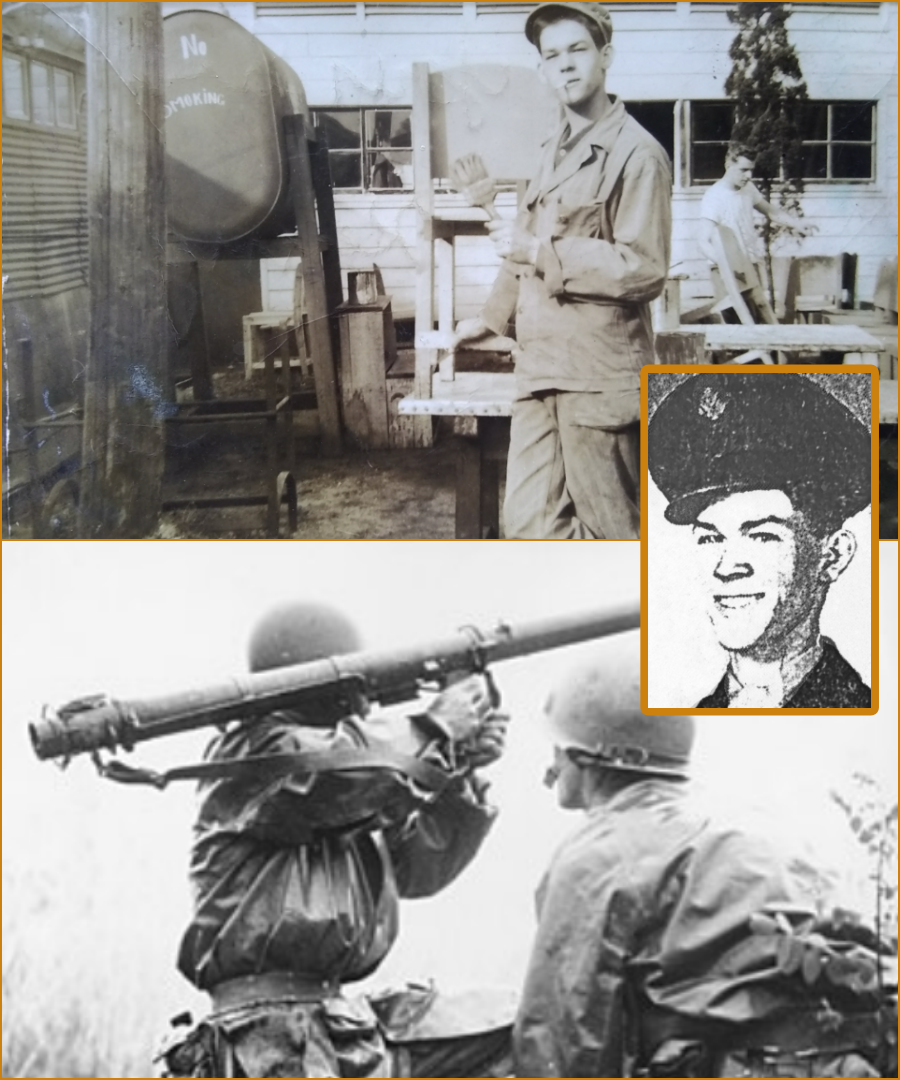
The true story of Kenneth R. Shadrick — the young private long believed to be the first American killed in the Korean War
On July 5, 1950, the Korean Peninsula was already burning.
Just ten days earlier, on June 25, North Korean forces had crossed the 38th parallel, launching a sudden and overwhelming invasion of South Korea. Within days, the South Korean army was collapsing under the weight of tanks and artillery. Seoul fell quickly. Refugees clogged the roads, carrying what little they could.
The United States, caught off guard, scrambled to respond.
American troops stationed in Japan were ordered into Korea with urgency. They were understrength, under-equipped, and many were unprepared for the kind of war they were about to face.
Among them was a 19-year-old private from West Virginia.
His name was Kenneth R. Shadrick.
A boy from the hills of West Virginia
Kenneth Ray Shadrick was born in 1930 in the small town of Wyoming, West Virginia. It was coal country—rolling hills, tight-knit communities, and hard lives shaped by mines and manual labor.
He grew up during the final years of the Great Depression and came of age in the shadow of World War II. By the time he was a teenager, stories of American victory overseas were still fresh in the national memory.
Like many young men from rural towns, Shadrick joined the U.S. Army seeking stability, pay, and perhaps a chance to see the world beyond the mountains he had always known.
He was assigned to the 24th Infantry Division, a unit stationed in Japan as part of the American occupation forces after World War II.
Life in Japan had been relatively calm.
Until the invasion.
A rushed deployment
When North Korean forces surged south in late June 1950, American commanders in Japan were ordered to send troops immediately to slow the advance.
One of the first units dispatched was Task Force Smith, drawn from the 24th Infantry Division. Their mission was simple and desperate: delay the North Korean army long enough for reinforcements to arrive.
They were lightly equipped—especially against tanks. Many of their anti-tank weapons were outdated, leftovers from World War II. Ammunition was limited. Intelligence about enemy strength was poor.
But they went anyway.
Shadrick was among the young soldiers sent into Korea in those first chaotic days.
They landed in a country they barely understood, facing an enemy that was battle-tested, well-armed, and advancing rapidly.
The road near Osan
On July 5, 1950, American forces took up positions near the town of Osan, south of Seoul.
The terrain consisted of rice paddies, low hills, and narrow roads. The air was hot and heavy. It was the kind of heat that soaked uniforms within minutes.
The American troops dug in along a ridge overlooking the road, waiting.
They knew North Korean forces were approaching.
What they did not fully grasp was how strong those forces would be.
Soon, the rumble of engines echoed across the fields.
North Korean T-34 tanks rolled down the road toward the American positions.
For many of the young soldiers, it was the first time they had ever seen enemy armor in combat.
They opened fire with everything they had.
Bazookas fired. Artillery shells exploded. Rifle shots cracked across the fields.
But the old anti-tank weapons were largely ineffective against the Soviet-built T-34s.
The tanks kept coming.
The moment that made headlines
As the battle intensified, chaos spread across the American lines.
Infantry units followed behind the tanks, advancing aggressively.
Somewhere in that confusion, Private Kenneth Shadrick was struck by enemy fire.
Accounts vary in detail, as often happens in the fog of war. But what is certain is this:
He was killed during the fighting near Osan on July 5, 1950.
Photographs taken shortly after the engagement showed American casualties lying along the roadside.
Among the fallen was Shadrick.
Reporters covering the early days of the war quickly circulated his name.
In the rush to identify and report American losses, news agencies declared him the first American killed in the Korean War.
The headline spread across newspapers in the United States.
A 19-year-old private from West Virginia had become the face of America’s new war.
The truth behind “the first”
In later years, historians would determine that other American servicemen had died in Korea slightly earlier—some in air missions, others in different circumstances during the chaotic opening days.
But in July 1950, the press did not yet have the full picture.
To the American public, Kenneth Shadrick was the first.
And in a symbolic sense, he became exactly that: the first name most people heard when the Korean War suddenly turned from distant headlines into personal loss.
Shock at home
Back in Wyoming, West Virginia, the war still felt distant.
Families listened to the radio for updates. Korea was far away—a place few could find on a map.
When the telegram arrived informing the Shadrick family of Kenneth’s death, it carried the same stark language used in countless wartime notifications:
“The Secretary of the Army has asked me to express his deep regret…”
He was only 19 years old.
For his family, the distinction of being “the first” meant nothing.
He was a son.
A brother.
A boy who had once run through the hills and sat at their kitchen table.
Now he was gone.
A nation waking up to war
The Korean War was often called “The Forgotten War” in later decades. It did not end in clear victory. It did not carry the triumphant images of World War II.
But in July 1950, it was terrifyingly real.
North Korean forces pushed American and South Korean troops steadily southward. Retreat followed retreat. The early days of the war were marked by confusion, inadequate preparation, and heavy losses.
The Battle of Osan, where Shadrick died, was a sobering lesson.
American forces were not as ready as many had assumed.
The war would not be quick.
And it would not be easy.
A young life in a larger conflict
Kenneth R. Shadrick did not command a battalion.
He did not receive a high military decoration.
He did not have time to build a long record of service.
He was 19.
He had been in the Army for less than a year.
He found himself in one of the first ground engagements of a war that would last three years and claim tens of thousands of American lives.
His death marked the beginning of a long and costly struggle.
The cost of being first
There is something uniquely tragic about being the first casualty of a war.
It means the conflict has crossed a threshold.
It means the headlines have turned into funerals.
It means families must confront the reality that sons will not be coming home.
For Shadrick, that burden was placed upon him by circumstance and timing.
He did not choose to be first.
He simply stood his post on a hot July morning as enemy tanks rolled toward his position.
Remembered in West Virginia
In his hometown, memorials and remembrances honor Kenneth R. Shadrick as one of their own.
His name is inscribed among those who gave their lives in service.
For West Virginians, he is not just a historical footnote.
He is a local boy whose life was cut short at the dawn of a new war.
The war that followed
After Osan, the war in Korea intensified.
American and United Nations forces would eventually stabilize the line at the Pusan Perimeter, then push north in a dramatic counteroffensive at Inchon under General MacArthur.
But the conflict would drag on until 1953, ending in an armistice rather than a peace treaty.
Nearly 36,000 Americans would die before it was over.
Shadrick’s death was only the beginning.
A name at the start of a long list
Today, historians clarify that he was not technically the very first American killed in the Korean War.
But the power of that early headline remains.
Because in July 1950, when Americans opened their newspapers and saw his name, they realized something profound:
Another war had begun.
And it would demand blood.
Kenneth R. Shadrick was 19 years old.
He stood on a ridge near Osan, facing tanks and gunfire in a country he had barely known weeks before.
He died in the opening chapter of a war that would shape the Cold War era.
And whether first in fact or first in memory, his name will always be linked to the moment America’s long, hard fight in Korea truly began.
News

ALL-STAR CONTROVERSY: MEGHAN’S “NEW HAIR” STUNTS NBA CROWD — STYLE STATEMENT OR CALCULATED SPOTLIGHT GRAB? 🏀🔥
The Duchess of Sussex appeared to tuck back some short strands around her face Prince Harry and Meghan Markle attend…

LILIBET’S DIANA LEGACY UNVEILED: NEW PHOTO IGNITES ROYAL FRENZY AS FANS SPOT THE ONE HEARTWARMING DETAIL THAT LINKS HER TO PRINCESS DIANA 👑💫
Meghan Markle shared a sweet pic of her 4-year-old daughter in pink for Valentine’s Day Princess Lilibet and Prince Harry;…

LILIBET PHOTO FIRESTORM 🤯 HARRY & MEGHAN UNDER SIEGE — ROYAL IMAGE BACKLASH ERUPTS
Meghan Markle, the Duchess of Sussex, praised the Jools’ Law campaign, which has pushed for changes to online safeguarding following…
“HE SAID IT WHEN NO ONE EXPECTED…” — Prince William’s Devastating Words About Princess Kate After Their Painful Split
The Mirror royal editor Russell Myers reveals in his explosive biography of the Prince and Princess of Wales what happened…

The Entire Stadium Suddenly Erupted for Princess Anne — But What She Whispered Next Is What Truly Left Everyone Stunned 🔥 No one expected that in the middle of a tense Six Nations match, tens of thousands of fans would rise to their feet cheering — not for a try, but for Princess Anne
Princess Anne’s ‘humble’ reaction to being cheered at the rugby: Lip reader reveals what ‘class act’ royal said when she…
ROYAL COMEBACK OBLITERATED: WHAT THE PUBLIC IS FORCED TO SEE IS MANIPULATED BY SUSSEXES – Princess Anne Detonates Harry & Meghan’s Master Plan
In recent months, Prince Harry’s renewed calls for reconciliation with King Charles III have been framed publicly as an emotional…
End of content
No more pages to load