Part 1
The hallway in my father’s house in Virginia Beach always smells like lemon oil and old brass. It’s a clean, sharp scent that usually commands a certain kind of respect, the kind you give to a museum or a tomb. Running the length of that hallway is the Whitmore family military wall. It’s a chronological map of ego, framed in dark oak. You start at the front door with my grandfather in his dress whites, chest puffed out on the deck of a cruiser in 1945. Then you move to my father, Franklin, a young Lieutenant Junior Grade on the bridge of a destroyer, looking like he owned the entire Atlantic. Then comes Scott, my younger brother, his commissioning photo still crisp, followed by shots of him at his first change of command.
I used to be on that wall. Between Franklin and Scott, there was a gap that belonged to me. My OCS graduation photo, my first commendation, a shot of me in my khakis. Now, when I walk down that hall, I see two small, jagged punctures in the drywall where the nails used to be. My father didn’t even bother to patch them. He left the holes there like an extracted tooth, a permanent reminder of the space I no longer occupy in his version of our history.
He stripped my name from the wall six months ago, right around the time he started telling the neighbors I’d been “quietly separated” from the service after a mental fitness evaluation. He says it with a specific tone—the measured, merciful cadence of a retired Commander discussing a horse that went lame before the big race. “Dana tried,” he’d say at the VFW mixers, swirling his scotch. “The Navy isn’t for everyone. Some people just aren’t built for the salt air.”
The truth is, I’ve served fifteen years in the United States Navy. I am a Lieutenant, intelligence designator 1830, currently attached to Naval Special Warfare Group for tactical operations support. I hold a TS/SCI clearance with access to programs my father couldn’t dream of. But my cover story is six words: I work in naval analysis, just DC.
To Franklin, “DC” is a dirty word. If you aren’t on a ship, if you aren’t feeling the vibration of a gas turbine through your boots, you aren’t in the Navy. You’re just a bureaucrat in a uniform. He’s repeated this lie at enough dinner tables and Thanksgivings that it’s become the family record. They hadn’t just forgotten me; they’d rewritten me.
I stood in that hallway now, my fingers hovering over the empty nail holes. I could hear his voice booming from the kitchen, that authoritative commander’s bark that never quite left him, even in retirement. He was talking to Scott about the memorial service tomorrow.
“It’s about the fleet, Scott,” my father was saying. “Real service. Not the paper-pushers. I hope Dana doesn’t make it awkward by showing up in that blazer of hers, acting like she knows the weight of those names on the plaque.”
I pulled my hand away from the wall. The tinnitus in my left ear started to ring, a high-pitched whine that sounds like a tea kettle in a room three doors down. It’s the permanent souvenir of a 2011 blast in Helmond Province that my father thinks was “psychosomatic.” He thinks I’m just sensitive. He thinks I’m weak.
I walked into the kitchen, my face a mask of professional neutrality. Franklin didn’t look up from his coffee. Scott gave me a pitying glance, the kind you give a relative who’s lost their mind but hasn’t realized it yet.
“The ceremony starts at ten,” Franklin said, his eyes fixed on the local paper. “The roped-off section is for veterans and active duty with surface deployments. You can probably find a seat in the back rows with the civilians. It’ll be less crowded for you there.”
I looked at the back of his head, at the stiff collar of his shirt. He had no idea that I had spent the last fourteen hours in a SCIF, routing satellite feeds for a team that was currently breathing dust in a place he couldn’t find on a map. He had no idea that the Admiral unveiling the plaque tomorrow had a tattoo on his wrist that only three people in the world understood.
I didn’t argue. I didn’t defend myself. I just reached into my pocket and felt the corner of the prayer card I’ve carried for fourteen years. It was worn soft, the edges rounded like a river stone.
“I’ll be there, Dad,” I said quietly. “I wouldn’t miss it for the world.”
As I turned to leave, I saw Scott’s phone on the counter. A notification popped up from the family group chat—the one I’d been removed from eighteen months ago. The header image was a photo of Franklin and Scott in front of the family wall. They were smiling.
I walked out of the house and into the damp Virginia air, the ringing in my ear getting louder. My phone buzzed in my pocket. It was a restricted number. I knew better than to answer it here, but the vibration felt like a heartbeat.
I drove to a nearby park, parked under a weeping willow that was shedding yellow leaves like scrap metal, and checked the message. It was a single line of encrypted text, a signal check from a world my father believed I wasn’t brave enough to inhabit. But as I read the coordinates for the morning, my eyes drifted to a black SUV parked three spaces down, its engine idling in the cold.
The driver was watching me through the rearview mirror, and for the first time in years, I felt the hair on my neck stand up.
Part 2
The SUV didn’t move when I stepped out of my car.
That was the first confirmation.
The second came when I walked past it—slow, controlled, like any civilian heading nowhere important—and the engine cut for half a second. Not off. Just enough to tell me someone inside had shifted attention.
I didn’t look in.
You never look in.
Instead, I crossed the park, gravel crunching under my shoes, and answered the encrypted message on my secondary device.
“Whitmore. Signal green.”
Static answered me first.
Then breathing.
Then a voice—raw, tight, and buried under layers of interference.
“We’re still alive… but not for long.”
The channel stabilized just enough for the feed to resolve into a thermal map. Four heat signatures. One dimming.
A tunnel system. Collapsed. Deep.
My chest tightened.
“Identify,” I said, already pulling up satellite overlays.
“SEAL element Echo-7… cave-in during exfil. We lost primary comms. You’re the only relay we’ve got.”
Of course I was.
Because I always was.
I patched into overhead ISR, rerouted through a relay bird that shouldn’t have been tasked to this grid, and forced the system to give me something usable.
The tunnel appeared in fragments—like a broken spine beneath the earth.
“Listen carefully,” I said. “I’m your eyes now.”
There was coughing on the other end. Someone choking on dust.
“Copy… Intel… we’ve got one pinned. Air’s bad.”
I marked oxygen depletion rates in my head automatically. Calculations I’d done a hundred times. Maybe a thousand.
“Name,” I said.
Silence.
Then:
“Ramos.”
The dimming signature.
I swallowed.
“Okay,” I said. “We’re getting him out.”
Fourteen hours.
That’s how long I stayed on that channel.
Fourteen hours of rerouting feeds, adjusting maps, guiding them through voids no human eye could see. Fourteen hours of listening to men breathe like drowning swimmers.
At hour six, my left ear started bleeding.
At hour nine, I couldn’t hear anything on that side anymore.
At hour eleven, Ramos stopped responding.
“Ramos, stay with me,” I said, even though I knew.
Even though we all knew.
At hour thirteen, the team reached a vertical shaft—collapsed, but not sealed.
“Climb,” I told them. “One at a time. Follow my vector.”
“Ramos—” one of them started.
“Negative,” I said, my voice breaking for the first time. “You don’t have the air.”
There was a long silence.
Then a whisper.
Not from the team.
From Ramos.
Faint. Barely there.
“Tell my guys… I didn’t quit.”
The line went dead.
I closed my eyes.
Then I kept talking.
Because that’s the job.
Part 3
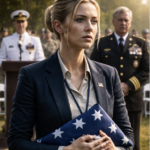
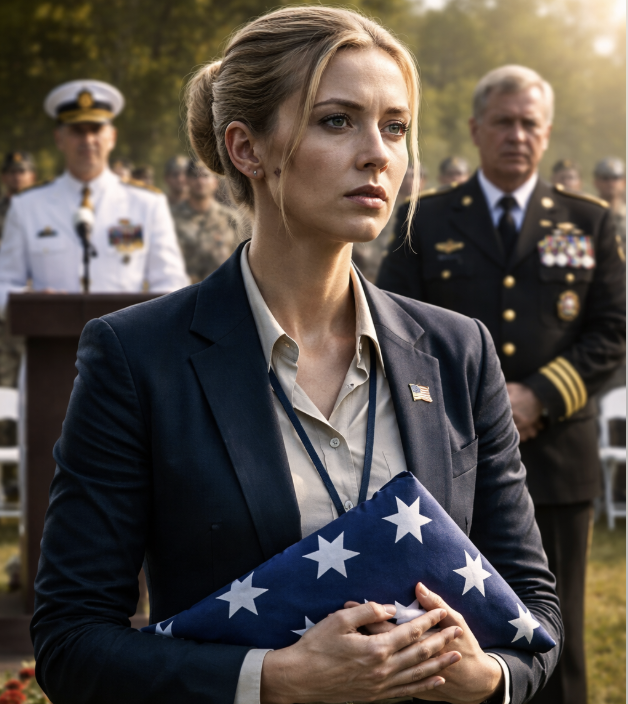
The memorial service started at exactly ten.
White chairs. Polished brass. Flags snapping in a clean Virginia wind.
I stood in the back, just like my father had suggested.
Civilian section.
Invisible.
Franklin stood near the front with the other veterans, his posture rigid, his medals catching the sunlight like small, controlled fires. Scott stood beside him, jaw tight, eyes forward.
Names were read.
One by one.
Each one landing like a weight on the chest.
When they got to the last name, there was a pause.
The Admiral stepped forward.
He didn’t look at the crowd.
He looked straight at me.
“Petty Officer First Class Daniel Ramos.”
My throat tightened.
“His final transmission,” the Admiral continued, “was relayed through an intelligence officer who remained on station for fourteen continuous hours under compromised conditions… ensuring the survival of three others.”
A murmur moved through the crowd.
My father frowned.
The Admiral’s gaze never left mine.
“That officer is present today.”
Now people were turning.
Looking.
Searching.
“Lieutenant Dana Whitmore,” he said.
The world went very quiet.
I didn’t move at first.
Didn’t breathe.
Then I stepped forward.
One step.
Then another.
Past the rows.
Past the line my father had drawn in his mind years ago.
Franklin’s face had gone pale.
Scott looked like he’d been struck.
I stopped in front of the Admiral.
He didn’t salute me.
He did something else.
He reached out… and pressed a folded flag into my hands.
“For Ramos,” he said quietly. “He made it because of you.”
I shook my head once.
“No, sir,” I said, my voice steady despite everything. “He didn’t make it.”
The Admiral held my gaze.
“I know,” he said. “But the others did.”
Behind me, I heard my father’s voice—small for the first time in my life.
“Dana…?”
I turned.
Looked at him.
At the man who had erased me.
Who had rewritten me.
I didn’t say anything dramatic.
Didn’t need to.
Because for the first time…
He saw me.
Not the version he told people about.
Not the absence on the wall.
But the truth.
And sometimes—
that’s louder than anything you could ever say.
News
“TRUST ME…” — ‘CARRIER’ GIRL GRABS SNIPER R-IFLE AFTER SEAL GOES DOWN… ONE SH0T LATER, THE ENTIRE BATTLEFIELD GOES SILENT…
Part 1 Dust came first in Kunar Province. It always did. It got into everything—the threads of your gloves, the…
Can I Sit Here? — SEALs General’s Simple Question Turns Into BASE-WIDE LOCKDOWN After K9 Detects De-adly Threat”
Part 1 At 0247, the room smelled like copper, bleach, and the kind of fear people leave behind after they…

Prince Harry & Meghan Markle SPARK BACKLASH AFTER EASTER VIDEO OF Archie & Lilibet: PRIVACY HYPOCRISY?
Critics claim The Sussexes are turning ‘private family moments’ into ‘promotion tools’. Prince Harry and Meghan Markle have been questioned…

Meghan Markle accused of using F-A-K-E children to pose as Archie & Lili – “Two different versions!”
Both of the Duke and Duchess of Sussex’s children inherited Prince Harry’s red hair Meghan Markle during a visit to…
IT WASN’T ME… — Tanner Horner sh0cks as he blames an “alterna-te pers0nality” in the case involving Athena Strand
Killer FedEx driver Tanner Horner blamed the murder of 7-year-old Athena Strand on his alter-ego “Zero,” and claimed that he…

HE’S FIGHTING… – NBA YoungBoy reacts after reports of NBA Ben 10 in critical conditi0n — as J Prince Jr. breaks silence with a message that’s turning heads…
The hip-hop community has been shaken following a violent shooting in Houston involving NBA Ben 10, a known associate of…
End of content
No more pages to load