Part 1
At 0247, the room smelled like copper, bleach, and the kind of fear people leave behind after they survive something by inches.
I was sitting on the concrete floor with my back against the cinderblock wall, knees bent, hands stained dark with blood that had dried in the lines of my knuckles. Not mine. Private First Class Aaron Greer’s. He was twenty-three, built like a kid who still thought his body would always answer when he asked things from it, and he was asleep now on the cot under one weak lamp. Four minutes earlier I’d checked the pressure dressing on his thigh again. The bleed had held. The IV line ran clean. His pulse was steady under my fingers.
Beside my left leg, Ranger lay with his head on his front paws and his amber eyes open.
He never slept the way regular dogs slept. Ranger rested. He evaluated. He collected the world in pieces and kept them filed where nobody could touch them. The room could have gone pitch-black and he still would have known where the door was, how Greer was breathing, and whether the footsteps in the hallway belonged to someone tired, angry, or dangerous.
I leaned my head back against the wall and listened to the base breathe.
Fort Bragg at that hour had its own rhythm. A truck coughing awake somewhere far off. Metal clanging once, then silence. Boots on concrete in the corridor. A radio crackle. The low, steady hum of an institution that never really went to sleep, just changed shifts and pretended.
Greer had walked into a doorframe during night training, which was the story everyone would tell later because it sounded stupid enough to be true. The truth was messier. He’d clipped the metal corner hard, opened his thigh, and nicked an artery where an artery had no business being that exposed. I’d been called from my bunk at midnight and worked by headlamp in a room that had no proper surgical setup and one cabinet stocked by a man who had clearly never touched a human body in an emergency.
Eight minutes. That was what it took to stop him from dying.
I reached for the small green notebook on the floor, opened it on my knee, and wrote: 0244. Pulse stable. Holding.
Then I closed it and sat still again.
Six weeks earlier I had arrived on base in the back of a government van with two other corpsmen, four plastic cases of supplies, and Ranger. Institutions don’t welcome you. They absorb you. I’d been issued a bunk, a badge, a schedule, and a reporting time. That was it.
At 0600 the next morning, I met Master Chief Wade Briggs.
Briggs was forty-seven, broad through the chest, and had a face that looked like it had been cut out of old wood with a dull knife. Nothing soft on it. Not his mouth, not his eyes, not the way he stood with his weight balanced like he expected the floor to disappear. He shook my hand once, looked at Ranger, then looked back at me like he was reading a label on a sealed crate and deciding whether the contents matched the paperwork.
He didn’t believe in resumes. Men like him had buried too many people because somebody somewhere had trusted a file more than a human being.
There were seven operators in the briefing room that morning, and every one of them sized me up in the first three seconds. It wasn’t rude. It was what they did. They took inventory. Female. Twenty-six. Five-four in boots. Navy corpsman. Dog. Brown hair. Calm face. Small hands. Unknown quantity.
Petty Officer First Class Kyle Stone was the only one arrogant enough to make his inventory out loud.
“Standard corpsman rotation, Master Chief?” he asked Briggs, but he looked at Briggs instead of me when he said it.
“Her file’s solid,” Briggs answered.
Stone’s jaw shifted. “Files and field time aren’t the same.”
“No,” Briggs said. “They’re not.”
He moved on with the briefing.
I didn’t react. I wrote the date in my notebook and listened.
Ranger sat at my left heel, no leash, no movement. At one point Stone glanced at him and Ranger met his eyes in that still, unworried way working dogs do when they’ve already made their own assessment and don’t care if you agree.
Three days later Briggs sent all of us on an eleven-mile conditioning run with forty-five pounds on our backs through pine scrub and loose red clay. Before we stepped off, Stone muttered to another operator that the medical attachment might need its own medevac before the halfway point. The other man laughed because he was twenty-eight and not wise enough yet to know when a laugh made him cheap.
I adjusted my straps and ran.
At mile four the terrain pitched up and the clay turned slick over stone. At mile six the heat came off the ground in waves. At mile eight I heard Stone’s breathing change and saw him glance back. I was three paces behind him, moving clean, not talking, not performing for anyone.
He turned forward again. He didn’t apologize. He also didn’t make the joke a second time.
That was fine. Endurance wasn’t proof of anything except endurance.
What changed things happened on day nine.
Part 2
Day nine started quiet.
Too quiet.
The kind of quiet Ranger noticed before anyone else did.
We were in the mess hall just after 1300. Steel trays. Protein that tasted like cardboard. Conversations low and functional. Operators don’t waste words when they’re eating.
I sat alone at the end of a long table, halfway through a cold meal I hadn’t realized I was too tired to taste.
Ranger was under the table, still.
Not resting.
Still.
His ears weren’t relaxed. They were angled—precise, calculating. His head slightly lifted, nostrils flaring just once.
That was the first signal.
The second was when he stood.
No bark. No growl.
Just stood—and pressed his shoulder into my leg.
Hard.
I froze.
Across the room, Briggs noticed.
He didn’t say anything. Just watched.
Then the door opened.
A man stepped in wearing a general’s insignia, flanked by two security officers who were trying very hard not to look like security.
Conversations stopped.
Chairs shifted.
Everyone stood—except me.
Not because I didn’t respect rank.
Because Ranger didn’t move.
The general scanned the room, then walked directly toward my table like he had already decided something before stepping inside.
He stopped beside me.
“Can I sit here?” he asked.
His voice was calm. Controlled.
Too controlled.
I looked at Ranger.
Ranger didn’t look at him.
Ranger was staring at the man’s right side—just below the ribcage.
Unblinking.
That was the third signal.
“Sir,” I said quietly, “I need you to stay exactly where you are.”
The room went dead.
One of the security officers stepped forward—
—and Ranger snapped his head toward him.
Not aggressive.
Worse.
Certain.
Briggs stood up slowly.
“What is it?” he asked.
I didn’t answer him.
I stood.
“Sir,” I said again to the general, “how long have you been on base?”
“Thirty minutes,” he said.
“Who cleared you?”
A pause.
Too long.
That was the fourth signal.
Ranger stepped forward.
Placed himself between me and the general.
Then he sat.
Rigid.
Locked.
That was not a casual behavior.
That was detection protocol.
Briggs’ voice dropped half an octave.
“Everyone out,” he said.
No one argued.
Chairs scraped.
Boots moved fast—but controlled.
Within ten seconds, the mess hall was empty except for five people.
Me.
Ranger.
Briggs.
The general.
And one security officer who hadn’t moved.
I didn’t take my eyes off Ranger.
“Ranger,” I said quietly, “confirm.”
He didn’t bark.
He leaned forward—
—and pressed his nose toward the general’s side.
Then he froze.
Every muscle locked.
That was confirmation.
Explosive detection.
Part 3
The world doesn’t slow down in moments like that.
It sharpens.
“Sir,” I said, voice flat now, “you need to remove your jacket slowly.”
The general didn’t move.
“Now,” Briggs added.
The security officer shifted his stance.
Wrong move.
Ranger’s ears flicked—
—and I knew.
“Briggs,” I said, “him.”
Too late.
The officer’s hand moved toward his waist.
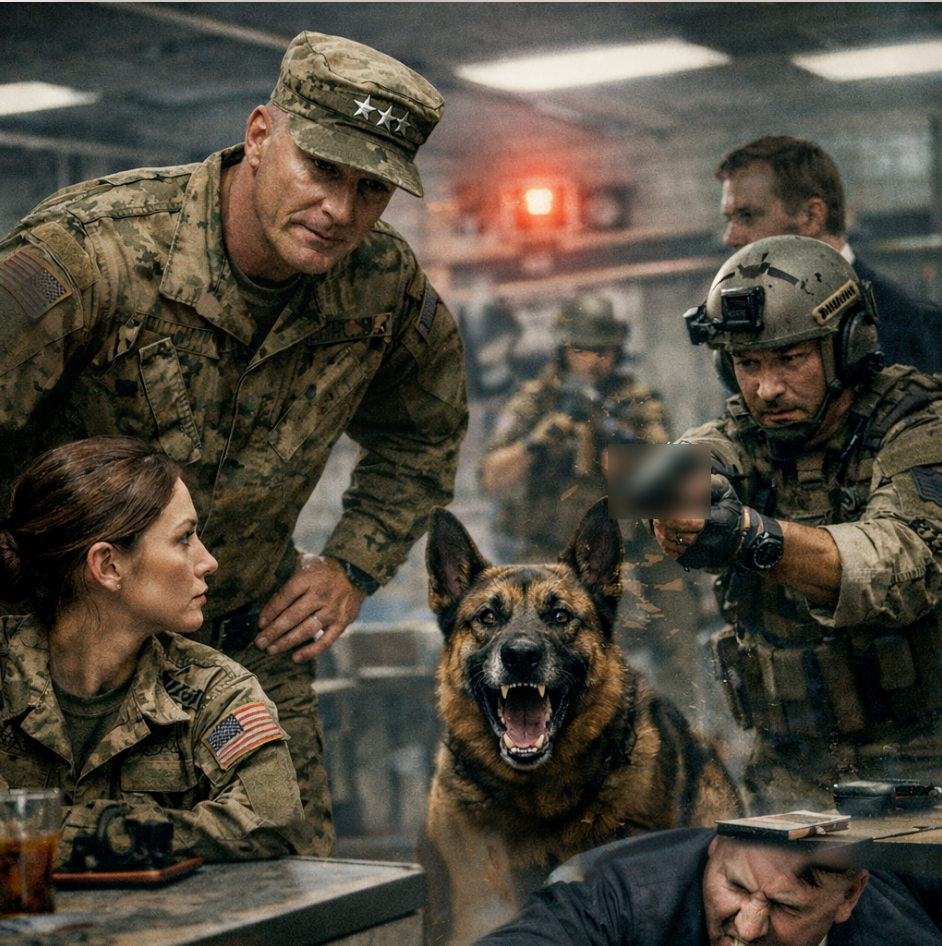
Ranger launched.
No hesitation. No warning.
A blur of muscle and controlled violence.
He hit the man center mass, jaws locking onto his forearm before the weapon cleared the holster. The impact drove him backward into a table hard enough to flip it.
The general stumbled—instinct, not guilt.
I grabbed him.
“Stay still!”
Briggs was already moving.
Two steps. One strike.
The second officer was on the ground before he understood the fight had started.
Ranger didn’t maul.
He controlled.
Pinned.
Crushed the arm just enough to disable.
The weapon clattered across the floor.
Silence came back in pieces.
Heavy breathing.
Metal ringing.
Boots outside—rapid now.
Briggs kicked the weapon away and dropped a knee onto the attacker’s spine.
“Clear,” he said.
I turned back to the general.
“Jacket,” I repeated.
His hands were steady.
That told me everything.
He unbuttoned slowly.
Opened it.
Inside—
nothing.
No vest.
No device.
Just a man who had walked into a test he didn’t announce.
Briggs exhaled once.
“Jesus Christ…”
I looked down at Ranger.
Still locked.
Still alert.
Still not done.
“Stand down,” I said.
He released instantly.
Back at my side.
Like nothing had happened.
Minutes later, the base flooded the room.
MPs. Command. Intelligence.
Questions came fast.
Answers didn’t.
Not yet.
The general adjusted his jacket, then looked at me.
Really looked this time.
Then at Ranger.
“What is he trained for?” he asked.
“Everything,” I said.
Briggs gave a short, humorless laugh.
“Apparently more than our screening protocols.”
The general nodded slowly.
Then he said something that shifted everything.
“That man,” he said, nodding to the one Ranger had taken down, “was cleared through three layers of security.”
Silence.
“He wasn’t supposed to be,” the general added.
That landed.
Hard.
Ranger hadn’t just stopped an incident.
He had exposed a breach.
At the highest level.
The general looked back at me.
“Corpsman,” he said, “effective immediately—you and that dog are no longer just attached to this unit.”
A pause.
Then:
“You’re coming with me.”
Ranger leaned lightly against my leg.
Calm again.
Like the world had just passed another test.
And filed it away.
News
HE NEVER LEFT THE LINE… — Branded ‘Weak’ By His Own Father, She Silently Guided SEALs Through 14 Hours Of Hell… Until One Final Whisper Changed Everything
Part 1 The hallway in my father’s house in Virginia Beach always smells like lemon oil and old brass. It’s…
“TRUST ME…” — ‘CARRIER’ GIRL GRABS SNIPER R-IFLE AFTER SEAL GOES DOWN… ONE SH0T LATER, THE ENTIRE BATTLEFIELD GOES SILENT…
Part 1 Dust came first in Kunar Province. It always did. It got into everything—the threads of your gloves, the…

Prince Harry & Meghan Markle SPARK BACKLASH AFTER EASTER VIDEO OF Archie & Lilibet: PRIVACY HYPOCRISY?
Critics claim The Sussexes are turning ‘private family moments’ into ‘promotion tools’. Prince Harry and Meghan Markle have been questioned…

Meghan Markle accused of using F-A-K-E children to pose as Archie & Lili – “Two different versions!”
Both of the Duke and Duchess of Sussex’s children inherited Prince Harry’s red hair Meghan Markle during a visit to…
IT WASN’T ME… — Tanner Horner sh0cks as he blames an “alterna-te pers0nality” in the case involving Athena Strand
Killer FedEx driver Tanner Horner blamed the murder of 7-year-old Athena Strand on his alter-ego “Zero,” and claimed that he…

HE’S FIGHTING… – NBA YoungBoy reacts after reports of NBA Ben 10 in critical conditi0n — as J Prince Jr. breaks silence with a message that’s turning heads…
The hip-hop community has been shaken following a violent shooting in Houston involving NBA Ben 10, a known associate of…
End of content
No more pages to load