The CCTV footage is only a few seconds long, but it has become one of the most haunting videos ever linked to South African music history. Grainy, silent, and mercilessly ordinary, it captures the final moments of Kiernan “AKA” Forbes’ life — and the brutal speed with which everything was taken from him.
It is night on Florida Road in Durban, a place known for its restaurants, nightlife, and constant movement. In the footage, AKA appears relaxed. He is smiling. He leans in and embraces a friend — a casual, familiar gesture that speaks of comfort and trust. There is no visible tension, no sense of danger, no warning that death is only seconds away.
Then, without drama or hesitation, a man wearing a white sweater steps into frame.
He walks directly toward AKA. There is no argument. No struggle. No chase. Just a few purposeful steps forward — and then gunfire at point-blank range. AKA collapses instantly. The moment is over almost as soon as it begins. A life that shaped a generation ends in silence on a city street.
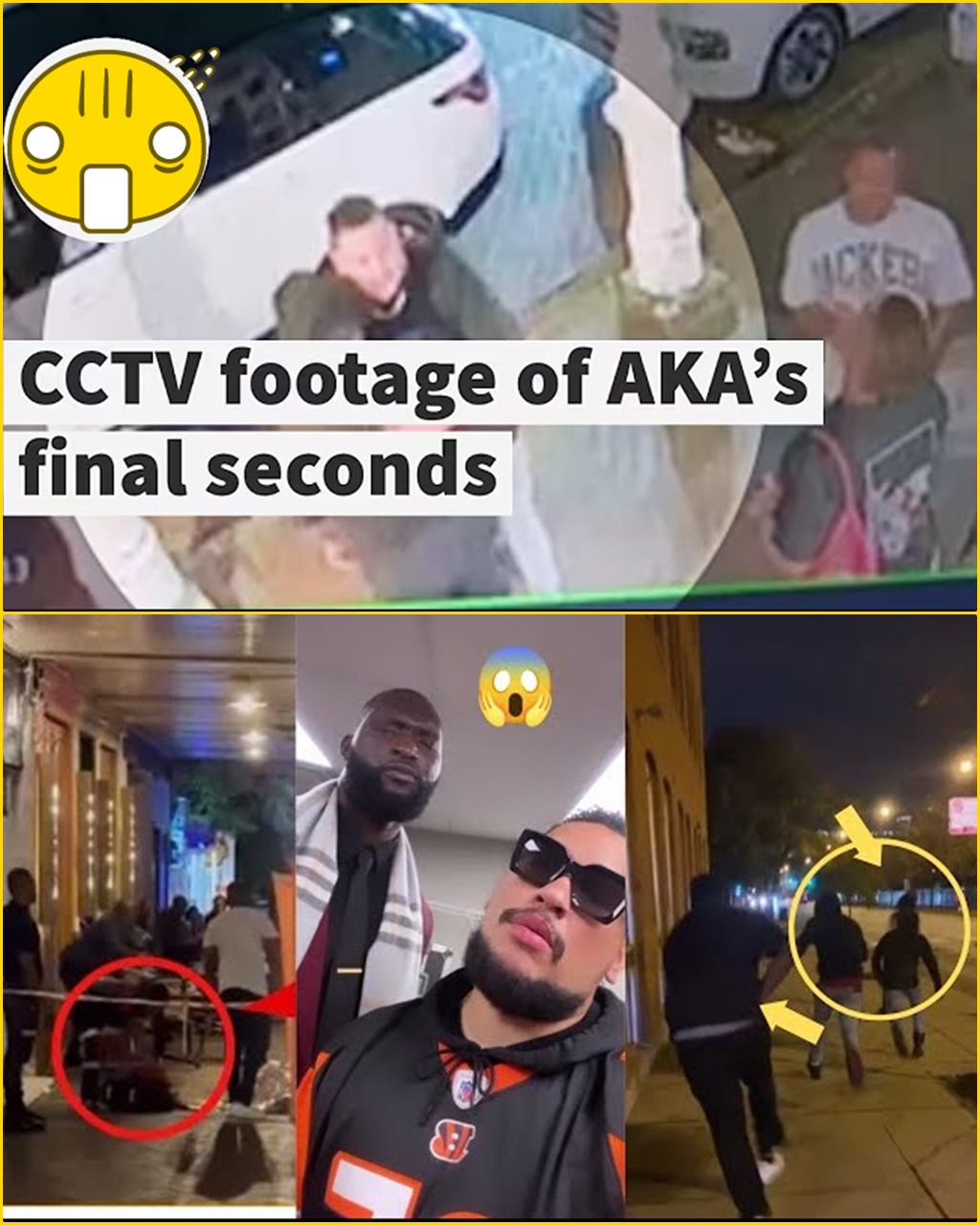
What makes the footage unbearable is not only the violence, but the normality that precedes it. The hug. The smile. The ease of a man who had survived fame, controversy, pressure, and public scrutiny — only to be killed in an instant that offered no chance to react, no chance to escape, no chance to say goodbye.
For fans, the video feels like a betrayal of memory. AKA was not just a rapper. He was a symbol of ambition and self-belief in post-apartheid South Africa. From his early days breaking into the mainstream to becoming one of the most influential figures in African hip-hop, AKA built a legacy rooted in confidence, creativity, and unapologetic self-expression.
He was outspoken. He was divisive. He was loved and criticised in equal measure. But he was undeniably present — a voice that shaped conversations about music, masculinity, fame, and identity. Seeing him reduced to a frozen moment on CCTV feels cruelly disproportionate to the life he lived.
The release and circulation of the footage have reopened wounds many had tried to close. For his family, it is a fresh trauma layered on top of grief. For his friends, it is a reminder of how close they were to sharing his fate. For fans, it is an image that refuses to fade — replayed, paused, analysed, and argued over across social media.
Some say the footage should never have been shared. Others argue it exposes the stark reality of violence that has become too normalised. What cannot be denied is its power. The video strips away celebrity, status, and mythology. In those final seconds, AKA is not a superstar — he is simply a man standing on a street, unaware that someone has already decided his fate.
The setting only deepens the shock. Florida Road is not a hidden alley or a lawless zone. It is a public, busy area, filled with cameras, lights, and people. The killing did not happen in secrecy. It happened openly, boldly, as if the shooter believed there would be no immediate consequence. That confidence has unsettled the public almost as much as the act itself.
In the aftermath, questions have multiplied. Was AKA targeted for who he was, or for reasons still hidden? How could such an attack unfold so quickly in a public space? And what does it say about safety when even the most recognisable faces are not protected?
Authorities continue to investigate, but the footage has already shaped public perception. It has turned grief into anger, sadness into fear. Many fans now speak of a loss of innocence — not just for the music industry, but for everyday life. If someone as famous and visible as AKA can be killed in seconds, what does that mean for everyone else?
There is also a deeper, quieter impact. The video has forced people to confront how fragile life truly is. One second you are laughing with a friend. The next, everything ends. No foreshadowing. No final speech. Just absence.
In the days following his death, tributes poured in from across Africa and beyond. Fellow artists spoke of his influence and generosity. Fans shared lyrics that now read like prophecies. Murals appeared. Songs climbed charts. But the CCTV footage lingers behind all of it, an uninvited presence that refuses to let the story become clean or comfortable.
Some moments are not meant to be iconic. They are not meant to be replayed. Yet history is often shaped by images we wish we had never seen. AKA’s final seconds, captured by an unblinking camera, have become one of those images — a reminder that fame does not shield, that violence does not announce itself, and that the line between life and death can be terrifyingly thin.
In the end, what remains is not the gunman in white, nor the grainy footage itself. What remains is the memory of who Kiernan Forbes was before that moment — an artist, a father, a friend, a voice that mattered. The CCTV shows how his life ended. It does not define how he lived.
And perhaps that is where the focus must return. Not to the moment he was taken — but to the legacy that cannot be erased in seconds, no matter how brutal those seconds were.
News
NO ONE SAW THIS COMING…: Gia Fleur Goes Public With New Romance — The Easter Getaway That Changes EVERYTHING
Gia Fleur has a new man, and she’s happier than ever. The Married At First Sight bride went Instagram official with…
I THOUGHT IT WAS THE END: Surfer Mauled by Shark in South Australia — But the Hidden Twist Behind His Survival Is Sending Chills Everywhere
A young surfer has told of his terror as he realised a shark had grabbed his foot and knocked him…
LIVE TV MELTDOWN: He Shouldn’t Have Said That… — Aussie Billionaire’s Bru-tal Comment Stuns Channel Seven Presenter
Billionaire Gerry Harvey has left Channel Seven’s Emma Freedman gasping in shock after dropping the F-bomb on live TV on…

EXECUTION OVER A CHAIN: Chicago’s “Top G” Kevin ‘Tugg’ Watson Gu-nned Down LIVE on Facebook in South Austin
The killing of Kevin “Tugg” Watson on August 13, 2025, remains one of the most disturbing and widely discussed incidents…

EXECUTED ON CAMERA: The Sh0cking Truth Behind the Facebook Live K!lling of Tugg Watson Revealed
What Really Happened to Tugg Watson? The tragic death of Tugg Watson sent shockwaves across social media and beyond, not…

DOUBLE DISASTER: Sydney Royal Easter Show Rocked by Back-to-Back Incidents — Visitors Left H0RRIFIED
Two terrifying incidents have unfolded in front of shocked crowds at the Sydney Royal Easter Show within hours of one another. More than 80,000…
End of content
No more pages to load