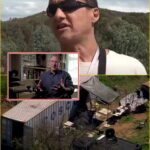
A former police hostage negotiator says he was sure Dezi Freeman’s seven-month run from the law “was going to end in tears” and that the fugitive would never surrender.
Dr Vincent Hurley — who spent 29 years as a NSW police officer, including eight as a negotiator — said it could be almost impossible to negotiate with a sovereign citizen like Freeman, who was shot dead by police on Monday after a three hour stand-off.
The 56-year-old had been on the run since he shot two police officers dead last August.
Freeman’s lifestyle and belief system was wedded to a political ideology of hating the state, said Dr Hurley, now a criminologist at Macquarie University, who explained being taken alive would have been the “ultimate humiliation”.
“It goes against his very existence,” Dr Hurley said.
Retired police negotiator Vince Hurley, who now lectures in criminology, says killing Dezi Freeman would have been a last resort. (Australian Story)
But Dr Hurley said Victoria Police’s team of negotiators and its elite Special Operations Group would have wanted to capture Freeman alive.
“That’s their ultimate aim. They want to get him before the court to answer the charge.”
Freeman killed Detective Leading Senior Constable Neal Thompson and Senior Constable Vadim De Waart-Hottart, and injured a third officer, while they carried out a search warrant at a rural property in Porepunkah in Victoria’s north-east.
Days of preparation before striking
The Special Operations Group was formed in 1977 and is Victoria Police’s elite tactical unit.
The Special Operations Group is one of the most secretive police units in Australia. (Victoria Police)
It is staffed by some of Victoria Police’s most highly trained officers who keep their identities secret — even within police ranks — and are known in court only by an operator number.
“They are the police that the regular police rely on when things get serious,” as described by the force, and are called upon in high-stakes situations involving the state’s most dangerous criminals.
Dr Hurley shed light on some of the strategies the Special Operations Group may have used in the lead-up to descending on the Thologolong property where Freeman was hiding.
A police car at the Thologolong property the morning after Dezi Freeman was killed. (ABC News: Maren Preuss)
Police would have had Freeman under surveillance for several days and would have been trying to find out what calibre firearms he had, Dr Hurley said.
That would allow officers to calculate the distance the fugitive could cover and the objects he could shoot through.
“They’d want to know his physical state — if he was weak physically,” Dr Hurley said.
“If he put up a fight, how much force would they be required to use?”
Dezi Freeman’s time on the run puts spotlight on sovereign citizens
Officers would be looking out for anyone assisting Freeman and monitoring his daily routine, Dr Hurley said, using that information to devise multiple strategies for his arrest.
The ABC understands up to eight officers from the Special Operations Group fired their weapons towards Freeman on Monday.
Police used non-lethal baton rounds and tear gas during the three-hour stand-off — a time frame Dr Hurley said was not unusual for a negotiation that did not involve a suicide intervention.
On Monday, Chief Commissioner Mike Bush said Freeman exited the container with what looked like a blanket around his shoulders, and a firearm underneath, which he presented to officers.
Victoria Police Chief Commissioner Mike Bush departs after speaking to media at the scene of the shooting. (AAP: James Ross)
He told reporters that Special Operations Group members were being supported following the fatal incident, and would receive a debriefing.
“He was given every opportunity to give himself up peacefully and safely,” Chief Commissioner Mike Bush said.
“He didn’t take that, so we deployed other tactics.”
Every siege a different challenge, former negotiator says
Eddie Kardas, who was once a Victoria Police negotiator and now runs a conflict resolution training and consulting firm, said no two sieges were the same.
Police officers attend the scene where fugitive Dezi Freeman was shot dead in Thologolong, near Walwa. (AAP: James Ross)
“There’s going to be different considerations with every single siege,” he said, emphasising that operational procedures would have changed since his time in the force.
“If you look at Dezi Freeman, he’s already murdered two, badly injured a third police officer,” Mr Kardas said.
“You know he’s armed. The risk of life, loss of life to police when you contain a person like that is incredibly high.”
Negotiators would likely have made contact with Freeman via loudspeaker, while taking cover, telling him that he was surrounded and to keep his gun out, he said.
The Thologolong property where Freeman was found by police. (ABC News)
“They would give him really strict instructions — ‘We want to see your hands first, then come out. We want you to kneel down, we want you to put your hands behind your head. We want you to lie flat on your stomach’,” Mr Kardas said.
“He would be given a really, really safe way to resolve this, without further loss of life.
“From what I can understand, that’s occurred. They surrounded the place, they made contact, they tried talking him out in a peaceful manner.
“He chose not to end it that way.”
Has Video Duration: 42 seconds.
Watch
Victoria Police pore over Dezi Freeman’s hideout this week.
Police may have done practice run with siege equipment
The Special Operations Group used its heavily armoured vehicle, known as a BearCat, to flush Freeman out of the shipping container he was hiding in.
“The last thing they would want to do is actually go into the container, because they wouldn’t know if it was booby trapped,” Dr Hurley said.
Dr Hurley says a BearCat vehicle was likely used to flush the fugitive out of his hiding space, which could have been booby trapped. (AAP: Sarah Malik)
Instead, Dr Hurley said it appeared police used a “claw” extending from the vehicle to penetrate the shipping container with some kind of irritant.
It was possible police had a shipping container somewhere in Victoria where they did a practice run, he said.
There were likely snipers on the property and armed police officers stationed at multiple points, Dr Hurley said.
“They would be in place well and truly before they even started the negotiations … they wouldn’t want him escaping a second time.”
Aerial vision from the property shows police vehicles parked near shipping containers. (ABC News)
And he said with vehicles and a range of other items on the property, police would also have been making sure Freeman “couldn’t get to those other points of cover”.
Dr Hurley said the highly disciplined Special Operations Group officers would not have shot at Freeman unless he had made the first move.
But it was not surprising that multiple officers may have fired at Freeman, he said.
“It’s just an instinctive thing that is done, because there is no luxury of time,”
he said.
Dezi Freeman was on the run for seven months before he was shot by police on Monday. (Supplied)
The entire incident would have also been captured by body-worn cameras, and probably the Victoria Police Air Wing, he said, noting it would all form part of a coronial investigation.
Former Queensland policeman of 26 years Scott Harris said the siege would have been a particularly difficult one to resolve.
“And highly challenging to de-escalate the offender when considering his sovereign citizen ideation, and everything that had led up to police eventually locating him and calling for his surrender on the day of the siege,” said Mr Harris, who now heads up a business helping workplaces understand security challenges.
“From all reports, [Freeman] was provided opportunities to surrender peacefully and the police have done everything they can to bring the incident to a safe conclusion for everyone, including the offender.”
Operation would have provided ‘massive learning experience’
Dr Hurley said the situation police encountered with Freeman would have been a “once in a lifetime” operation.
“There’s only been one other in Australia [like this], certainly in recent history, that was Malcolm Naden,” he said.
Malcolm Naden was jailed for life in 2012 after seven years on the run. (AAP: NSW Police Media)
Naden was one of Australia’s wanted men, spending nearly seven years on the run after murdering his cousin and a neighbour, before finally being captured in March 2012.
Dr Hurley said because the Freeman situation was rare — given he was a sovereign citizen who had been on the run for seven months — it would be a “massive learning experience” for police.
In the end, he said, there was probably very little that police negotiators could do to convince Freeman of a different conclusion to one of the most high-profile manhunts in Australia’s history.
“He was never going to surrender because he was that indoctrinated in his own thoughts that he was never going to give the state — the police or the courts — the luxury of saying ‘we got you alive’,” Dr Hurley said.
“That was never going to happen.”
News

‘ENERGY’ THAT CHANGED EVERYTHING: Kyle Sandilands LINED UP FOR SURPRISE NEW ROLE as SECRET NETWORK TALKS HEAT UP
As Kyle Sandilands’ blockbuster legal stoush with the Australian Radio Network (ARN) heads to Federal Court, it seems the shock…

Drama EXPLODES: Married At First Sight Australia Star Bec Zachariah Blames Secret Health Struggle for Brut-al Treatment of Alissa Barmonde
MAFS Australia has already delivered no shortage of drama this series. And now bride Bec has opened up about a…
Our Kids Are Still Waiting for Him… — Wife Breaks Silence After Beloved Father-of-Four Ki-l-led in Sh0cking Melbourne Crash
A devastated wife has spoken out after her husband spent the week fighting for life after being mowed down outside his home…

WORDS TURNED D-E-A-DLY? — Jaro City’s Lil Mikey Gu-nned Down After Explosive Argument Tied to Viral Diss
The hip-hop community is once again grappling with tragedy following the fatal shooting of Jaro City rapper Lil Mikey, an…
IT WAS ALL GONE IN MINUTES — Community Heartbreak as Heroic Grandparents Lose Home in Sh0cking Blaze
An Adelaide community is rallying around two much‑loved grandparents and volunteers who have lost everything in a ferocious house fire….

HE SAID TOO MUCH? — NC Rapper Gu-nned Down Moments After Sh0cking Facebook Live Confession
A shocking and deeply disturbing incident has rocked the hip-hop community after a North Carolina rapper was fatally shot just…
End of content
No more pages to load