Was Tupac Headed Toward a Whole Different Future Right Here?
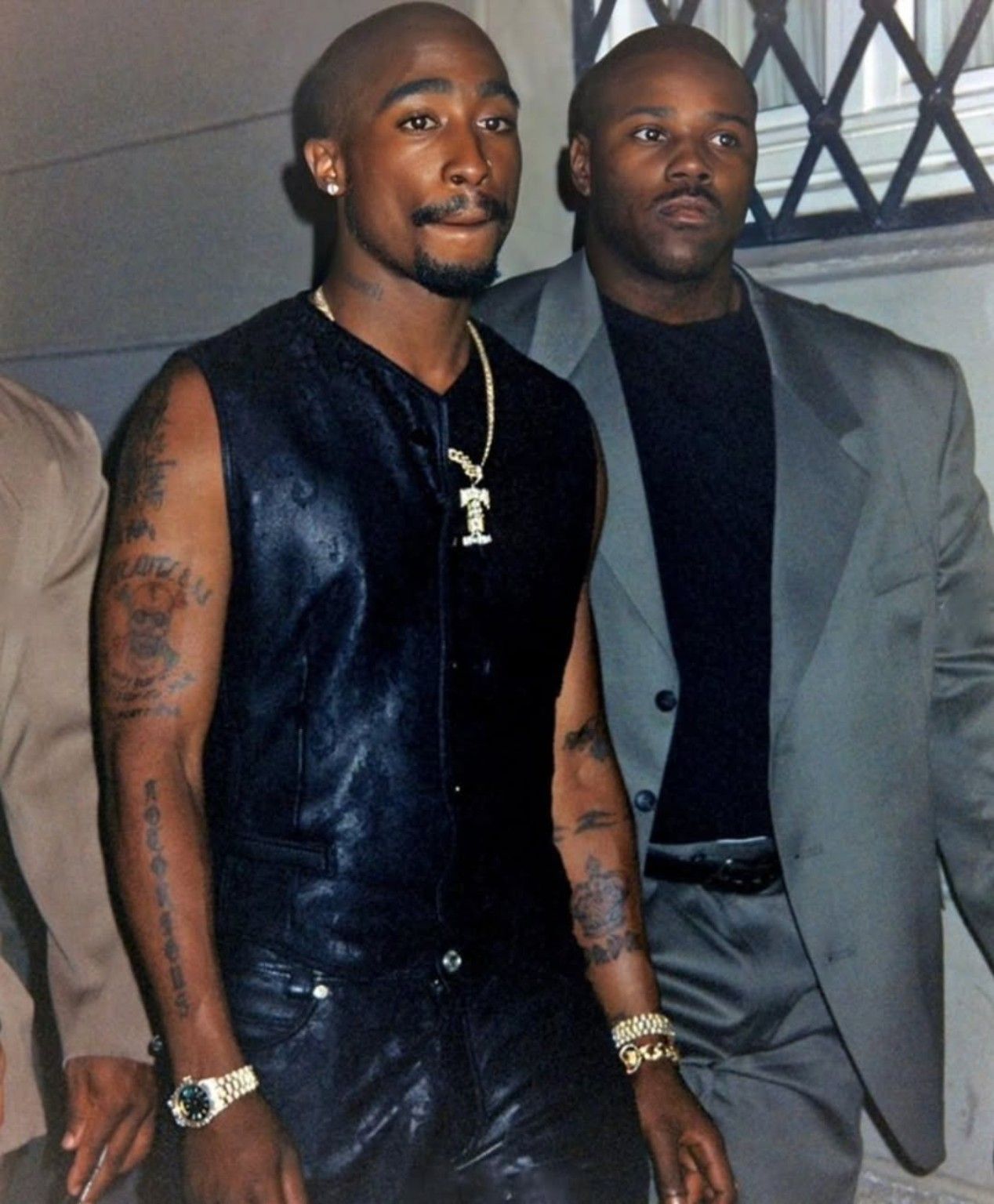
July 1996. Milan. The lights are sharp, the fashion is louder than life, and the front row of the Versace show is packed with global royalty — models, moguls, icons. And there sits Tupac Amaru Shakur. Calm. Focused. Almost serene.
This is not the image many people instinctively associate with Tupac. Not the bandana-tied firebrand pacing a stage. Not the defiant glare from courtroom steps. Not the furious poet tearing into enemies on wax. This Tupac is dressed in tailored luxury, seated among Europe’s elite, watching fashion instead of war.
And just weeks later, everything stops.
Looking back now, that Milan moment feels like a fracture in time — a still frame that asks an impossible question: was Tupac already evolving past rap, or was he still trapped by the moment that would ultimately claim him?
A Man Living at Two Speeds
By mid-1996, Tupac was living at an almost unbearable velocity. Artistically, he was unstoppable. All Eyez on Me had just detonated across the world — a double album overflowing with charisma, rage, vulnerability, and ambition. Commercially, he was at the absolute peak of his powers.
But beneath the success was exhaustion.
Legal battles. Industry feuds. Paranoia. Violence. Tupac had survived prison, betrayal, and a previous shooting. Every move he made seemed shadowed by consequence. Yet here he was, in Milan — not posturing, not provoking, simply observing.
People who were there recall how striking it was. He wasn’t trying to dominate the room. He wasn’t loud. He wasn’t reckless. He looked like someone absorbing a new world — a global, creative space far removed from the claustrophobic confines of American rap beef.
For a man who had always insisted he was more than just a rapper, Milan looked like proof.
Beyond Rap: Tupac’s Expanding Vision
Even before 1996, Tupac had been clear: rap was never the final destination.
He acted. He wrote poetry. He studied theater. He spoke passionately about politics, race, media, and legacy. He wanted to build institutions, mentor youth, create art that lived beyond charts and cycles.
By the time he reached Milan, those ambitions were accelerating.
Fashion was not accidental. Tupac understood symbolism. Sitting front row at Versace wasn’t just about clothes — it was about positioning himself as a global cultural figure, not confined to one genre, one audience, or one narrative.
Friends later said he talked about leaving Death Row. About forming new labels. About doing films overseas. About stepping away from the constant warfare that was draining him.
In Milan, he looked like someone imagining a future where survival wasn’t a daily negotiation.
The Weight He Couldn’t Shake
And yet — evolution doesn’t erase history.
For all his forward momentum, Tupac was still deeply entangled in the conflicts of his time. The East Coast–West Coast rivalry wasn’t just media hype; it was personal, emotional, and fueled by real violence. Tupac felt hunted, disrespected, unfinished.
Even as he explored new worlds, the old one kept pulling him back.
There’s a tragic irony in that Milan image: while Tupac sat quietly in Europe, the forces that would end his life were already in motion. Decisions made years earlier. Feuds that had taken on lives of their own. A culture that rewarded escalation over peace.
You can evolve creatively — but escaping the gravity of your environment is far harder.
The Question That Haunts Us
Was Tupac on the brink of something entirely different?
It’s tempting to romanticize that moment, to believe Milan was the doorway to a calmer, longer life — films, fashion, global influence, elder statesman status. And maybe it was. There’s evidence he was consciously trying to pivot, to breathe, to grow.
But it’s also possible that Tupac was living in contradiction — expanding outward while still burning inward. A man capable of reinvention, yet unable to fully detach from the pain and fury that had shaped him.
Both truths can exist at once.
That’s what makes the image so powerful. It’s not just what he became — it’s what he might have been.
A Still Frame Before the Fall
When we look at Tupac in Milan now, we’re not just seeing a rapper at a fashion show. We’re seeing a crossroads frozen in time.
A moment where the noise briefly quieted.
Where the future felt open.
Where he looked less like a target and more like an artist stepping into a wider world.
Weeks later, that possibility vanished.
And maybe that’s why the question still hurts: not because we’ll never know the answer — but because the image suggests the answer might have been yes.
Yes, Tupac was evolving.
Yes, he was becoming something bigger.
Yes, the future could have been different.
We just never got the chance to see it.
News
NO ONE SAW THIS COMING…: Gia Fleur Goes Public With New Romance — The Easter Getaway That Changes EVERYTHING
Gia Fleur has a new man, and she’s happier than ever. The Married At First Sight bride went Instagram official with…
I THOUGHT IT WAS THE END: Surfer Mauled by Shark in South Australia — But the Hidden Twist Behind His Survival Is Sending Chills Everywhere
A young surfer has told of his terror as he realised a shark had grabbed his foot and knocked him…
LIVE TV MELTDOWN: He Shouldn’t Have Said That… — Aussie Billionaire’s Bru-tal Comment Stuns Channel Seven Presenter
Billionaire Gerry Harvey has left Channel Seven’s Emma Freedman gasping in shock after dropping the F-bomb on live TV on…

EXECUTION OVER A CHAIN: Chicago’s “Top G” Kevin ‘Tugg’ Watson Gu-nned Down LIVE on Facebook in South Austin
The killing of Kevin “Tugg” Watson on August 13, 2025, remains one of the most disturbing and widely discussed incidents…

EXECUTED ON CAMERA: The Sh0cking Truth Behind the Facebook Live K!lling of Tugg Watson Revealed
What Really Happened to Tugg Watson? The tragic death of Tugg Watson sent shockwaves across social media and beyond, not…

DOUBLE DISASTER: Sydney Royal Easter Show Rocked by Back-to-Back Incidents — Visitors Left H0RRIFIED
Two terrifying incidents have unfolded in front of shocked crowds at the Sydney Royal Easter Show within hours of one another. More than 80,000…
End of content
No more pages to load