When Dragons Roar, Bl00d Will Spill: What Just Turned the Fate of Westeros Upside Down?
After an agonizing wait, House of the Dragon has returned for its third season, bringing with it a surge of energy that feels a world away from the stagnation of its predecessor. If the second season was frequently criticized for its glacial pacing and a finale that functioned more as a prologue than a resolution, this premiere wastes no time. It ruthlessly discards the show’s previous lethargy, thrusting the Targaryen civil war into a whirlwind of momentum and brutality.
The Collapse of Political Maneuvers
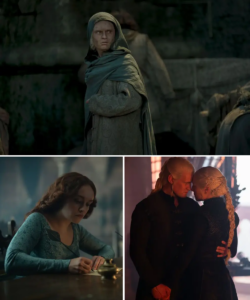
The balance of power in Westeros is now profoundly precarious. Rhaenyra Targaryen (Emma D’Arcy) currently holds the upper hand, bolstered by a formidable dragon force and poised to crush King’s Landing. Conversely, Alicent Hightower (Olivia Cooke) finds herself increasingly isolated; her desperate gambit—an attempt to trade her eldest son, the broken King Aegon (Tom Glynn-Carney), for her own and Helaena’s safety—has spectacularly unraveled. Aegon’s flight from the capital with Larys, coupled with the rogue defiance of Aemond (Ewan Mitchell), has plunged the Greens into chaos, exposing the total failure of their internal calculations.
Scale and Cinematic Ambition
From a professional analytical standpoint, the introduction of new figures like Ormund Hightower (James Norton) does more than just bolster the ensemble—it intensifies the stakes between competing factions. The undisputed highlight of this new season is the “Battle of the Gullet.” This is more than just a set piece; it is a testament to HBO’s evolving mastery of large-scale action.
Unlike the dialogue-heavy sequences that dominated the hallways of the Red Keep in previous seasons, this naval battle is a showcase of sophisticated CGI fused with cinematic vision, capturing the visceral chaos of maritime warfare. Bringing the Triarchy—led by Abigail Thorn’s fierce Sharako Lohar—into the fray as a vengeful third party adds a complex new layer to the conflict. This intervention serves as more than a tactical pivot; it underscores that the battlefield has expanded, no longer constrained within the Targaryen bloodline.
Fidelity to Source Material vs. Narrative Momentum
The writers’ willingness to deviate from George R.R. Martin’s Fire & Blood may provoke debate among purist readers, yet for a general audience, it is a necessary tactical shift to maintain the narrative’s edge. Sacrificing absolute fidelity for grand scale and rapid pacing is a trade-off that benefits the medium of serialized television.
House of the Dragon Season 3 demonstrates a maturation in storytelling. After laboring to establish the vulnerabilities and internal fractures of its characters in the first two seasons, the saga has entered its “slaughter” phase—a stage where every ill-conceived decision is paid for in blood and fire. If the slow burn of the previous season was merely the quiet preparation, Season 3 is the thunderous arrival of the storm. This is no longer a war of ideals; it is a fight for survival where the lines between righteousness and brutality have irrevocably blurred. Viewers have every reason to expect a brutal and unpredictable path ahead.
SOURCE: HELLO MAGAZINE
https://www.hellomagazine.com/film/909356/house-of-the-dragon-season-three-review/