The tragic figures of lives lost in the wake of Venezuela’s twin earthquakes
In one harrowing moment, Venezuela has been thrust into an unprecedented humanitarian crisis. A pair of back-to-back earthquakes—measuring 7.2 and 7.5 on the Richter scale—has done more than just destroy physical infrastructure; it has exposed the fragility of a nation already exhausted by decades of political instability and deep economic decay. The country now faces a grim prospect: the death toll may not stop at the thousands. According to dire warnings from the United States Geological Survey (USGS), fatalities could reach as high as 10,000, potentially marking this as one of the deadliest earthquakes in Latin America in the last century.
A Graveyard of Concrete in the Heart of La Guaira
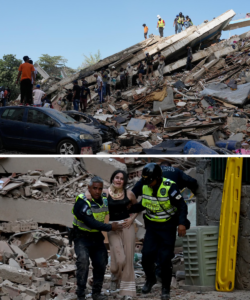
The epicenter of the tragedy is the state of La Guaira, where high-rise apartment complexes were transformed into concrete tombs in the wake of the tremors. The devastation is total: cracked highways, and skyscrapers twisted like crushed metal. More alarmingly, widespread power outages in Moron and surrounding areas have paralyzed the entire logistical chain, from critical seaports to major oil refining complexes.
Amidst this chaos, faint hopes remain trapped beneath mountains of rubble. Jennifer Palacios, 25, a resident of the Hugo Chavez housing complex, has lost contact with her six-year-old son and five other relatives. In a state of profound desperation, she sat on a solitary plastic chair outside the ruins of her own home, voicing a plea that cuts to the core of all who hear it: “It’s the community that has managed to get people out alive. We need them to bring cranes to move the slabs. There are still people trapped.”
Palacios’s words serve as an implicit critique of the administrative machinery’s lethargy. In reality, while heavy specialized equipment has struggled to reach the sites, it is the bare hands of local residents and volunteers from Caracas and Valencia that have become the sole force of rescue.
Political Fallout in the Wake of Disaster
The appearance of interim President Delcy Rodriguez in La Guaira, accompanied by promises to “militarize” the region to accelerate rescue efforts, has done little to soothe public indignation. While the government claims to have distributed 2,600 tons of food, the reality on the ground presents a stark contrast: while some areas see a military presence, others remain completely void of aid. This inconsistency in disaster response raises significant questions about the administrative capacity of the Rodriguez government—an administration already struggling to assert its legitimacy following the January arrest of her predecessor by the United States.
An Unexpected International Hand
Perhaps the most surprising development in this catastrophe is the unlikely diplomatic “handshake” emerging from the ruins. Venezuela, a nation that has spent decades in political isolation, has suddenly become the focal point of a global aid mission. Warships, helicopters, and aircraft from the U.S., alongside rescue teams from Spain, India, Mexico, and Colombia, are creating an unprecedented flow of assistance. The U.S. pledge of $150 million in aid and the easing of sanctions is a strategic maneuver, but it also serves as a testament to the fact that this tragedy is significant enough to thaw the most rigid diplomatic barriers.
A Personal Perspective: When Natural Disaster Exposes Infrastructural ‘Disaster’
Viewed through an analytical lens, these earthquakes act as a brutal “stress test” for a nation that has long since lost its resilience. With oil production—the country’s economic lifeblood—already under threat due to paralyzed power grids and crippled port infrastructure, Venezuela’s future has never been more uncertain.
The fact that nearly seven million people may be affected by this disaster is not merely a statistic; it represents a new crisis of displacement and survival. We are witnessing not just destruction caused by geology, but a society eroded by poverty now struggling to hold onto its last remnants of hope. As the dust settles over the ruins, the questions regarding Venezuela’s capacity to recover will weigh heavier than ever. Is this a moment for the nation to unite through its grief, or is it the final blow to an already fragile stability? The answer remains buried beneath the rubble in La Guaira.
SOURCE:7 NEWS