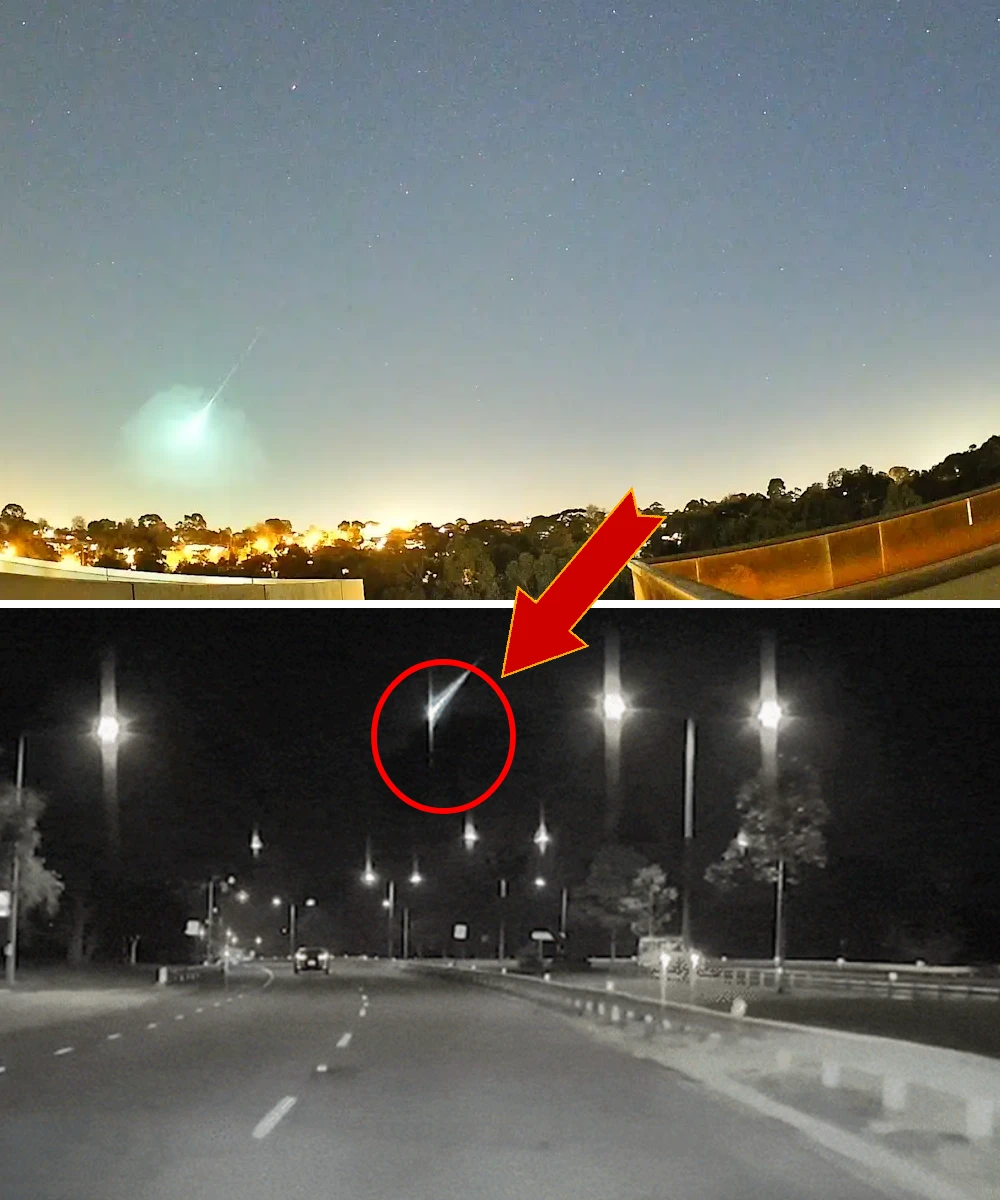
Explaining the streak of light that appeared in the Melbourne sky last night, leaving residents in complete awe
A breathtaking celestial display lit up the skies over Melbourne this past Sunday evening, leaving onlookers in awe as a brilliant streak of light tore through the night. This fleeting yet spectacular moment quickly became the talk of the city just before 10:00 PM.
An Unexpected Visitor from the Cosmos
Identified by experts as a large meteor—commonly referred to as a “fireball” or “bolide”—the object began its fiery descent into Earth’s atmosphere at approximately 9:50 PM. The event was not merely a matter of hearsay; it was captured in its entirety by the dashcam of a driver traveling through Keilor Downs, in Melbourne’s north-west.
The reach of this phenomenon extended far beyond a single location. Residents in the eastern suburbs were also fortunate enough to witness the meteor’s signature emerald-green glow, creating a mystical spectacle against the backdrop of the night sky. Dozens of other Victorians reported similar sightings, describing the sudden flash they encountered while driving through the city late that evening.
Expert Analysis
Addressing the public’s fascination, Dr. Kirsten Banks, an astrophysicist at Swinburne University of Technology, provided a professional assessment to nine.com.au. She confirmed that the phenomenon was unmistakable: it was “definitely a meteor.”
Analyzing the footage and photographs, Dr. Banks explained that the vivid green hue was no coincidence: “The green particularly in the photo tells me that it’s a bright meteor known as a fireball. They often leave a bright-green glow behind them caused by the oxygen atoms in the air interacting with the fireball as it plunges through the atmosphere.”
According to the astrophysicist, the fireball concluded its journey in a burst of green light as the friction with Earth’s atmosphere caused it to vaporize completely. While the meteor was large enough to produce a mesmerizing light show, it lacked the mass required to survive the journey and impact the Earth’s surface.
The Luck of the Observer
When asked why such events are rarely witnessed, Dr. Banks noted that it largely comes down to probability and the luck of the observer: “While they are common, catching one with your own eyes comes down to a bit of luck. We just miss most of them because the majority of earth’s surface isn’t inhabited by humans. Some meteors are quick short flashes of light, like in a meteor shower, but bigger ones like this are a bit more sluggish as they enter the atmosphere.”
This event not only provided impressive footage but also served as a poignant reminder of the mysterious and elusive beauty of the cosmos directly above us—where any given moment can become an unforgettable memory for those fortunate enough to witness it.