The young man who died after invading the large feline enclosure at the Arruda Câmara Zoobotanical Park (Bica) in João Pessoa (Paraíba, Brazil) had a history of psychiatric disorders and was the only one of five siblings who was not adopted. Gerson de Melo Machado, 19, known as Vaqueirinho, once said he dreamed of caring for lions in Africa.
Diagnosed with schizophrenia—the same condition as his mother and grandmother—Gerson’s cognitive development was compared by prison authorities to that of a “5-year-old child,” and he lived on the streets. Verônica Oliveira, a guardianship counselor who accompanied him for eight years, described Gerson’s constant struggle on social media.
“I knew this child, divested of his mother’s parental authority, prevented from being adopted like his four siblings. You only wanted to be your mother’s son again, who is schizophrenic and was unable to care for you. Your grandmother, also with mental disorders. But society, without knowing your history, chose to throw you into the lions’ cage,” Verônica wrote.
His vulnerable mental state fueled an old and dangerous dream of taming big cats. Verônica reported that Gerson frequently expressed the desire to travel to Africa. In a previous incident, he had even cut a fence at an airport and climbed into the landing gear bay of an aircraft, only to be intercepted by cameras before takeoff.
“Gerson, my foolish boy… How many times, in the Guardianship Council room, did you say you were going to catch a plane to go on an African safari to care for lions. You even tried. And I thanked God when the airport informed me that you had cut the fence… Thankfully, they observed it on camera before a tragedy occurred,” she shared in her post.
The Struggle for Treatment and ‘Behavioral Issues’
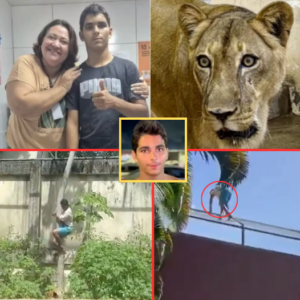
In a video released on social media after Gerson’s death, the counselor affirmed that the young man did not receive appropriate treatment. According to her, despite the visible diagnoses of mental disorder, the State often labeled his case only as a “behavioral problem” during his institutional care. She recounted that they spent ten years “fighting to guarantee his rights.”
— The psychiatrists insisted on saying that he was just a boy who didn’t adapt to the space [care facility] because he had behavioral problems. The Mangabeira Guardianship Council will not remain silent. We fought hard trying to guarantee Gerson’s rights. My feeling today is one of revolt, she affirmed.
The Director of the Psychosocial Care Center (Caps) Caminhar, Janaina D’Emery, stated that the 19-year-old had been monitored since childhood, first at Caps for children and then in adult services. She informed that the young man had “great difficulty adhering to treatment” due to the lack of a family support network. Gerson was at Caps the Thursday before his death but did not return the next day.
— We understand that Gerson, due to the lack of this support network, made his treatment difficult. So, there was no adherence. […] he participated here in December, then disappeared. […] he returned in June, and then disappeared again. When we sought information, he was in a psychiatric hospital in Recife. He arrived last week and came straight to the service, where we welcomed him again and offered treatment for continuity. Unfortunately, this fact happened on Sunday. The last day he was here was Thursday. On Friday, he did not show up again, Janaína emphasized, in a video sent to GLOBO.
Police Encounters and ‘Institutionalized Inmate’
Despite his mental condition, Gerson accumulated an extensive police history. According to Edmilson Alves, known as Selva, director of the Desembargador Flósculo da Nóbrega Penitentiary, the young man had 16 police encounters—ten as a minor and six as an adult—primarily for crimes of damage and theft.
Days before the incident at the zoo, on the 24th, Gerson was detained twice in just one hour: first for damaging an ATM and then for intentionally throwing a rock at a police vehicle. According to the prison director, the young man claimed he preferred prison to living on the streets, becoming an “institutionalized inmate” (preso institucionalizado).
— Last week we talked so much about Vaqueirinho. I made a video talking about his mental state, what we had gone through in the prison, and that he was a person who needed help, needed treatment. His place was not the prison either, and the Court decided for him to go to Caps. Caps couldn’t hold him, he ran away, he said. — He never knew any life other than prison. We call him an institutionalized inmate.
The director and the unit’s disciplinary chief, Ivison Lira, had publicly warned about Gerson’s situation days before the death, calling it an “announced tragedy.” For Ivison, Vaqueirinho’s reasoning was equivalent to that of a “5-year-old child.”
— We knew it was an announced tragedy. Vaqueirinho without due treatment, without monitoring, living on the streets. Here is the result. Unfortunately, we saw that his reasoning was that of a 5-year-old child. He didn’t process much. Everything was conditioned on exchange, on candies, things like that, so that he wouldn’t rebel. But it was easy to deal with him that way. He needed greater attention, Ivison lamented.
News

She was bu.ll.ied in the army, but when they saw her brother, everyone fell silent, bowed their heads, and apologized
Chapter 1: A Rose Among Thorns Fort Liberty, North Carolina, was always thick with the smell of iron discipline and…

She was beautiful, wealthy, and talented, but she couldn’t overcome the trauma of being bu.lli.ed in the past until she read this quote
Chapter 1: Flawless Perfection Nellis Air Force Base in Nevada glowed under the sunset like a massive block of molten…

The sinful secrets of a $200 million widow: Demi Moore spirals in a bathroom meltdown after one wrong touch!
HOW MUCH ARE you willing to lose before you win? That seems to be the question facing the women of Landman in this…
THE COUNTDOWN TO D3:ATH BEGINS: THE CHOSEN SEASON 6 PREMIERE DATE REVEALED ALONG WITH HARROWING GLIMPSE OF THE CROSS!
The countdown is over—season six of The Chosen is almost here, and the first glimpse at Jesus’ crucifixion has fans…

No peace for Offset: Even while recovering, a string of sh0cking scandals continues to haunt the rapper
Getty While Offset‘s recovering from the shooting at Florida’s Hard Rock Hotel and Casino, he’s also catching heat over $100K he…

Erykah Badu bluntly refuses to do this regarding Kanye West
Erykah Badu might vibe with Kanye West‘s music … but, she doesn’t want to talk about him in the streets — turning…
End of content
No more pages to load