They M0cked the “Logistics Girl” — Until She Took Down a Base-Wide Coup in Minutes
Part 1
The Pacific wind came off the water like it had a personal grudge.
It cut through the chain-link at Naval Support Base Coronado, shoved salt into the back of my throat, and slapped the hood of the silver sedan that dropped me at the gate. The sky had that hard October brightness California gets when the sun is out but the air still feels sharp enough to wake old injuries. I stepped onto the gravel in jeans faded at the knees, a navy hoodie that made me look smaller than I was, and boots scuffed from places nobody at that gate would ever imagine.
That was the point.
A woman in civilian clothes gets processed with the scenery. A woman in uniform gets remembered.
The sentry took my ID without lifting his head all the way. Petty Officer Harris, according to the tag on his chest. Twenty-two, maybe twenty-three. Freckles. Tired eyes. Coffee breath. He already had one hand reaching for the stamp before he really saw the card.
“Merrick Fallon,” he muttered. “Administrative transfer. Logistics analyst.”
He handed it back like he was returning a grocery receipt.
Behind him, another sentry leaned on the guard shack and said, “Logistics? Great. Maybe this one can find the stuff the last one lost.”
That got a laugh.
Then, because men are often their truest selves when they think they’re talking around you instead of to you, the second sentry added, “They sent us a kid.”
I heard it.
I kept walking.
The trick to undercover work is not pretending not to notice. It’s letting people believe the noticing did no damage.
I adjusted the strap of my duffel and took in the gate area in one sweep: rust bleeding through the paint on the fence post, one security camera mounted too high to catch faces at ground level, coffee stains on the concrete by the guard shack, boot prints in damp salt residue by the entrance lane. Little things. Always little things first. A base tells on itself in the small neglects before it does in the big ones.
Naval Support Base Coronado was already talking.
The headquarters building sat ahead of me in a slab of gray concrete and dull glass that looked more tired than intimidating. Inside, the lobby buzzed with fluorescent lights and old HVAC. It smelled like printer toner, floor wax, and stale coffee. A television bolted high in one corner played a fire safety video to absolutely nobody. A bulletin board near the reception desk held three expired notices, a crooked family readiness flyer, and a 5K registration sheet from summer that was still pinned up like optimism had just forgotten to come back for it.
The petty officer at the desk looked up only because I stopped directly in front of him. He had an energy drink sweating on top of a stack of forms and the kind of exhausted posture you only get from too many double shifts.
“Help you?” he asked.
“Transfer from Norfolk,” I said. “Reporting as ordered.”
He held out a hand while still typing with the other. I passed over my paperwork.
He scanned it lazily, line by line without actually reading it, the way people skim menus at restaurants they’ve been to too many times. That was fine. The people in Washington who scrubbed my orders had done good work. My real personnel jacket would have given him nosebleeds. This version was intentionally beige.
He called upstairs, listened, grunted, then slid a temporary access card across the desk.
“Third floor,” he said. “Lieutenant Colonel Hayes. End of the hall on the right.”
I took the card and rode the elevator up alone.
My reflection in the metal doors looked exactly like what I needed it to look like: too young, too plain, too civilian. No ribbons. No rank on a collar. No sign that six years of classified operations and one career’s worth of other people’s worst nights were packed quietly into the body standing there.
I found Hayes behind a desk that looked like it had lost a fight with paperwork.
He was in his fifties, temple hair going silver, ribbons aligned perfectly above a chest that had the sunken look of a man surviving on coffee and obligations. File folders leaned in stacks around him. A mug sat by his right hand, liquid inside gone black and cold. He finished signing something before he looked up, stamped it harder than necessary, and finally focused on me.
“You the transfer?”
“Yes, sir.”
He skimmed the one-page summary like it insulted him by existing. “Merrick. All right. Welcome to Coronado. You’re going to logistics support under Lieutenant Commander Hastings. She needs bodies more than I need another person answering phones up here.”
He rubbed a hand once over his jaw and added, “You know the new supply tracking system?”
“Some.”
“That puts you ahead of half the people using it.” His voice had that dry, worn edge of someone who no longer expected his complaints to change the world. “We’re behind on critical requisitions, motor pool is screaming, communications is hanging together with tape and prayer, and every readiness report I send up makes us look like we borrowed our logistics model from a collapsing republic.”
His eyes landed on me fully for the first time then.
Part 2
He studied me longer than necessary.
Not suspicion.
Assessment.
The kind that comes from someone who’s learned the hard way that the paperwork never tells the truth.
“You don’t look like logistics,” he said finally.
“I don’t look like much, sir.”
That almost got a smile.
Almost.
“Fair enough,” Hayes muttered. Then he pointed toward the door. “Hastings is down the hall. If she scares you off in the first hour, I’ll consider that a mercy for both of you.”
I nodded once and left.
Lieutenant Commander Hastings did not disappoint.
She had a voice that could cut through engine noise and a presence that made people move faster without being told twice. Late thirties. Tight bun. Eyes like sharpened glass. The logistics office around her was chaos—open crates, half-logged inventory, screens full of red alerts.
She looked up when I stepped in.
“Let me guess,” she said. “They finally sent me help.”
“Yes, ma’am.”
She took one glance at my file and snorted. “Administrative transfer. Of course.” Then she tossed it onto a desk already buried under paperwork. “You can start by fixing that.”
She pointed at a terminal flashing error codes.
“System’s been down since yesterday,” she added. “If you get it running, I’ll reconsider my opinion of you.”
Behind me, someone muttered, “Place your bets.”
I didn’t respond.
I sat down.
Hands on the keyboard.
And within thirty seconds, I knew exactly what was wrong.
Not incompetence.
Not system failure.
Manipulation.
Subtle. Layered. Buried inside routine updates. The kind of corruption that doesn’t break things outright—it just delays, reroutes, disappears.
Supplies marked “delivered” that never arrived.
Requests rerouted to dead queues.
Critical equipment flagged as “non-essential.”
Someone wasn’t stealing loudly.
They were bleeding the base quietly.
I fixed the visible issue in under four minutes.
The system came back online.
Green across the board.
The room went still.
Hastings walked over slowly, eyes narrowing at the screen.
“How?”
“Patch conflict,” I said. “Old update clashing with new routing protocols.”
That was the lie.
She didn’t call it out.
But she didn’t believe it either.
“Lucky guess,” someone behind me said.
I stood up.
“Or not,” I replied.
That earned a few looks.
Not respect.
Not yet.
But attention.
And attention was the first crack.
—
It didn’t take long after that.
People tested me.
Small things at first.
Wrong data.
Bad instructions.
“Accidental” omissions.
Then it escalated.
One afternoon, I walked into the motor pool and found three enlisted men leaning against a Humvee, watching me like I was a show.
“You lost, analyst?” one of them asked.
“No,” I said.
“Because this isn’t admin,” another added. “Heavy equipment. Might be too much.”
Laughter.
Then one of them stepped closer.
Too close.
“Maybe you should stick to paperwork,” he said quietly.
That was the moment.
The line.
I didn’t step back.
I didn’t raise my voice.
I just looked at him.
And said, “You’re missing two transmission units, one hydraulic pump, and a classified comms relay you reported as installed yesterday.”
Silence.
His face changed.
“You don’t know what you’re talking about.”
“I do,” I said. “And I know where they went.”
Now the others weren’t laughing.
They were watching him.
Not me.
Power shifts fast when truth enters the room.
He took a step back.
Just one.
That was enough.
I turned and walked out.
But I could feel it.
The base was starting to notice.
—
That night, I didn’t go back to quarters.
I went to the records room.
Restricted access.
Poorly secured.
Predictable.
Within an hour, I had what I needed.
Names.
Transactions.
Patterns.
And one name that kept surfacing like a body refusing to stay buried.
Hastings.
I stared at it for a long time.
Then I closed the file.
Because now I knew.
This wasn’t just incompetence.
This was controlled decay.
And I was standing in the middle of it.
Part 3
The next morning, everything changed.
Not gradually.
Not quietly.
Explosively.
The base alarm didn’t scream—it pulsed.
Short. Sharp. Urgent.
Emergency mobilization.
I was already moving before the announcement finished.
Communications failure.
Multiple systems down.
Supply chain locked.
Motor pool offline.
Exactly the kind of collapse that doesn’t happen by accident.
People were running.
Shouting.
Guessing.
No one was in control.
Except someone was.
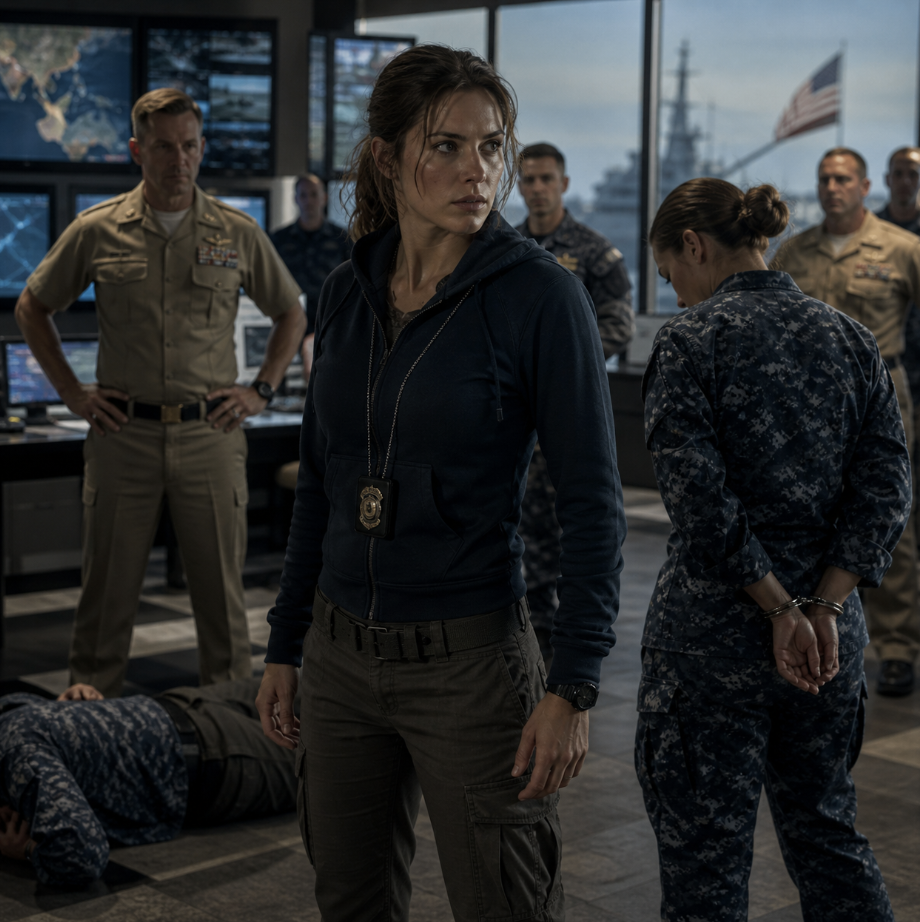
I found Hastings in the operations room, issuing orders with surgical precision.
Too precise.
Too calm.
“You,” she said when she saw me. “Get back to logistics. Stay out of the way.”
I didn’t move.
“Ma’am,” I said, “this isn’t a system failure.”
Her eyes snapped to mine.
For a second—just a second—the mask slipped.
Then it was back.
“Not the time, Fallon.”
“No,” I said quietly. “This is exactly the time.”
The room went still.
I stepped forward.
“Because you built it.”
Silence hit like a shockwave.
Every head turned.
Hastings didn’t react.
Didn’t blink.
“Careful,” she said.
“I tracked the reroutes,” I continued. “The missing equipment. The falsified logs. It all leads to you.”
A long pause.
Then—
She smiled.
And that was worse than anger.
“You’re smarter than you look,” she said.
Then she reached for her radio.
And everything broke.
Men moved.
Not confused anymore.
Organized.
Armed.
This wasn’t sabotage.
This was a takeover.
—
The first one came at me from the left.
Slow.
Predictable.
I stepped inside his reach, twisted, dropped him before he understood what happened.
The room exploded into motion.
Shouts.
Metal.
Impact.
I moved through it like I always had.
Fast.
Precise.
Efficient.
No wasted motion.
No hesitation.
Because this wasn’t new.
This was home.
—
“Who the hell are you?” someone yelled.
I didn’t answer.
I didn’t have time.
But Hayes did.
Because he had just walked into the doorway—
And froze.
Watching.
Understanding.
The way I moved.
The way I fought.
The way trained men were going down like they had made a very serious mistake.
His voice came out low.
Disbelieving.
“…that’s not logistics.”
No.
It wasn’t.
—
Hastings was backing toward the exit.
“Too late,” she said. “This base is already gone.”
I stepped into her path.
“No,” I replied.
“It isn’t.”
She reached for something under her jacket.
I was faster.
Always faster.
Her weapon hit the floor before she could raise it.
And just like that—
It was over.
—
The aftermath was quieter than it should have been.
People standing.
Breathing.
Trying to understand what had just happened.
Hayes walked toward me slowly.
His eyes weren’t confused anymore.
They were sharp.
Focused.
“Fallon,” he said.
I met his gaze.
Then I reached into my jacket.
And handed him the real ID.
Not the beige version.
The truth.
His hand tightened as he read it.
Then he looked back at me.
Everything changed in his expression.
Respect.
Shock.
And something close to relief.
“You’ve got to be kidding me,” he said under his breath.
“No, sir.”
He exhaled once.
Then straightened.
“Yes… ma’am.”
The room went silent again.
Because rank doesn’t need to be announced loudly when it lands like that.
And Hayes turned to the others.
“You heard her.”
Not me.
Her.
“Stand down.”
—
Later, as the base slowly returned to something resembling order, I stood outside again.
Same wind.
Same salt.
Same fence.
But the base wasn’t talking the same way anymore.
It sounded… cleaner.
Behind me, Harris—the sentry from the gate—approached carefully.
“Ma’am,” he said.
Different tone now.
Different man.
“Permission to ask a question?”
I nodded.
He hesitated.
Then—
“Why come in like that? Like… like one of us?”
I looked out at the water.
Then back at him.
“Because,” I said, “if I walked in as who I really was…”
I let the wind carry the rest for a second.
“…I wouldn’t have seen who you really were.”
He swallowed.
Nodded.
Understood.
At least a little.
—
And as I picked up my duffel again, I heard it.
Not laughter this time.
Not dismissal.
Something quieter.
Stronger.
Respect.
The kind that isn’t given.
Only earned.
One truth at a time.