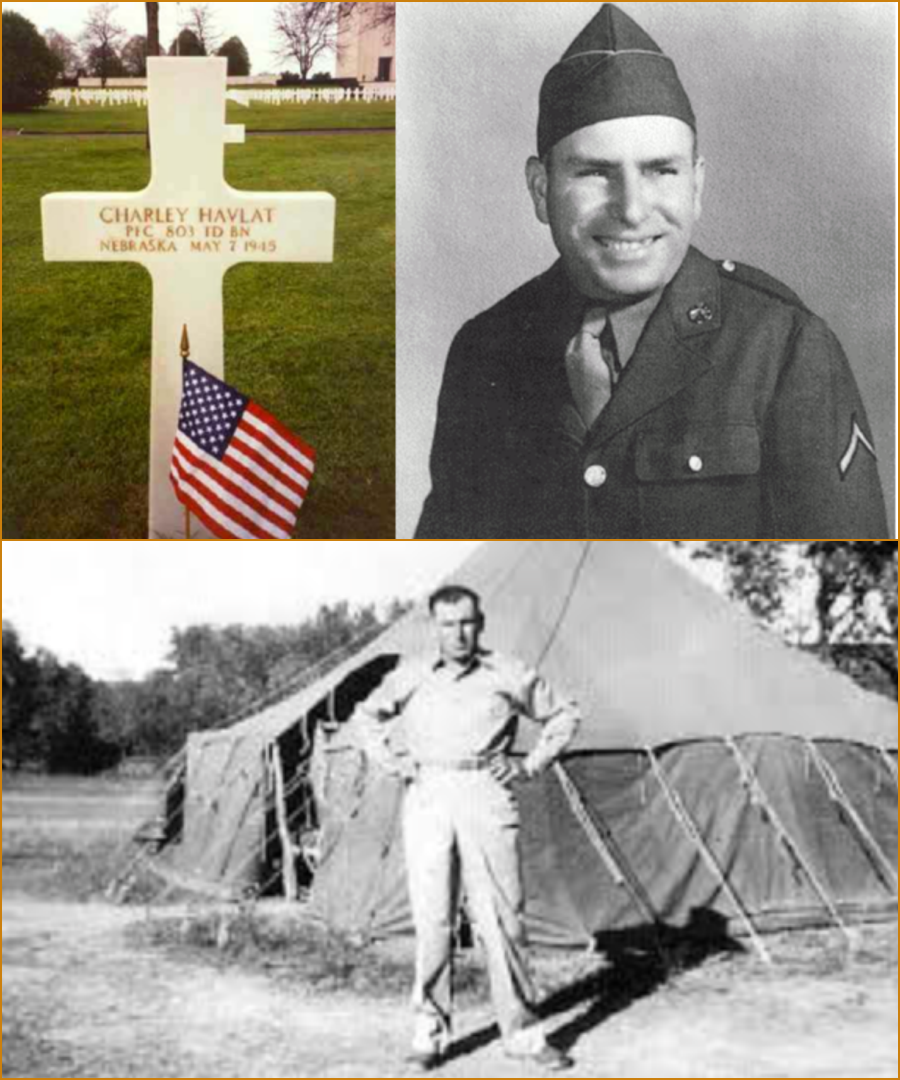
The true story of Charley Havlat — the American soldier believed to be the last to die in combat in Europe during World War II
The war in Europe was almost over.
It was May 1945, and across the continent, German units were surrendering in waves. Cities that had once echoed with artillery now stood in uneasy silence. White flags hung from windows. Roads were filled not with advancing tanks, but with prisoners marching toward captivity.
Everyone knew it was the end.
But in one small corner of what is now the Czech Republic, the guns had not yet fallen silent.
A farm boy from Nebraska
Charley Havlat was born in 1910 in the farming country of Nebraska, the son of Czech immigrants. His family spoke their native language at home, and the rhythms of farm life shaped his early years—long days in the fields, cold winters, and the quiet determination that came with rural life.
He wasn’t a career soldier.
He wasn’t even a young recruit.
By the time the United States entered World War II, Havlat was already in his thirties—older than many of the men who would serve beside him. Like thousands of others, he left behind the familiar soil of home and put on a uniform, not because he dreamed of war, but because it was his duty.
He was assigned to the 803rd Tank Destroyer Battalion, a unit trained to hunt enemy armor. By 1945, he had seen years of combat across Europe—France, Germany, and beyond. The war had taken its toll on everyone.
But in early May, there was a different feeling in the air.
A sense that it was finally ending.
The last days of the war
In the first week of May 1945, German resistance in Europe was collapsing. Hitler was dead. Berlin had fallen. German officers were negotiating surrender terms with the Allies.
On May 7, the German High Command would sign the unconditional surrender that would end the war in Europe.
But that morning, many units at the front didn’t yet know the details. Communication was slow, and in some areas, fighting continued simply because orders had not yet reached the troops.
Havlat’s unit was operating near a small village in western Czechoslovakia called Volary. The area was mountainous and wooded, with narrow roads and scattered farmhouses.
German troops were still present in the region—some trying to surrender, others trying to escape westward to avoid the advancing Soviet forces.
It was a chaotic, uncertain situation.
A strange, tense morning
On the morning of May 7, Havlat and the men of his unit were advancing cautiously through the countryside.
They had heard rumors that the war was ending.
Some soldiers talked about it quietly.
“Maybe this is the last day,” one man said.
Another replied, “I won’t believe it until they say it over the radio.”
Still, no one let their guard down. Too many times before, rumors had turned out to be false. Too many men had died because they assumed the fighting was finished.
So they moved forward as they always did—alert, cautious, weapons ready.
The encounter
As the American column approached a wooded area near the village, they spotted movement ahead.
German soldiers.
It wasn’t clear what the Germans intended. Some enemy units in those final days were surrendering without a fight. Others, especially isolated groups, still fired on sight.
The Americans took cover.
Havlat was among those moving forward, scanning the tree line.
There was a brief moment of stillness.
Then, suddenly, gunfire erupted.
The German soldiers opened fire on the Americans. Bullets snapped through the air, striking trees and kicking up dirt.
The Americans returned fire, diving for cover behind rocks and vehicles.
In the opening moments of that short, chaotic skirmish, Charley Havlat was hit.
A bullet struck him, and he collapsed to the ground.
Medics rushed to his side, but the wound was severe. Despite their efforts, there was little they could do.
Within minutes, he was gone.
The cruelest timing
What made Havlat’s death especially tragic was the timing.
Just hours later, the official German surrender in Europe would be signed.
The war—at least on paper—was already over.
But the news had not yet reached that quiet patch of forest in Czechoslovakia.
And so, in one of the final shots fired on the European front, Charley Havlat became what many historians consider the last American soldier killed in ground combat in Europe during World War II.
He died on May 7, 1945.
The official end of the war in Europe—Victory in Europe Day—would be celebrated the very next day, on May 8.
News reaches home
Back in Nebraska, Havlat’s family was preparing to celebrate the end of the war.
Like millions of American families, they had endured years of anxiety, waiting for letters, reading casualty lists, and praying their loved ones would return safely.
When the news of Germany’s surrender spread, church bells rang. People gathered in town squares. Flags were waved. There was relief, joy, and exhaustion.
But for the Havlat family, the celebration would soon be replaced by grief.
A telegram arrived.
Their son, their brother, their family member—killed in action in Europe.
The war had ended.
But for them, it had taken one last life.
A quiet legacy
Charley Havlat was not a famous general.
He didn’t receive the Medal of Honor.
He didn’t command divisions or shape grand strategies.
He was an ordinary soldier.
A farm boy from Nebraska.
A son of immigrants.
A man who left home to fight in a war far across the ocean.
And he died in the final hours of the largest conflict the world had ever seen.
In many ways, his story represents thousands of others—men who survived years of brutal combat, only to fall just before the end.
Remembering the last fallen
Today, Havlat’s name appears on memorials and in military records as a reminder of the war’s final cost.
In the Czech Republic, near the place where he died, a memorial honors him and the other American soldiers who fought in the region. Each year, people gather to remember the end of the war and the lives lost, even in its final moments.
His story is often told not because of how he fought, but because of when he died.
It serves as a sobering reminder:
War doesn’t end cleanly.
It doesn’t stop at the exact moment papers are signed.
And for some families, the last day of war is the day everything changes forever.
The final American casualty in Europe
On May 8, 1945, celebrations erupted across the Allied world. Crowds filled the streets of London, Paris, and New York. Strangers hugged. Church bells rang. Radios blared the news:
Germany had surrendered. The war in Europe was over.
But somewhere in Nebraska, a family mourned.
Because the last American soldier to die in combat in Europe had already fallen—just hours before the guns finally went silent.
And his name was Charley Havlat.
News

MYSTERIOUS DE-ATH — CHIRAQ’S 7-FT “ASS-A-SSIN” King Loweko, Known As “The Dev-il Of Low,” STILL SURROUNDED BY QUESTIONS
Chicago’s street history has produced countless names surrounded by fear, rumors, and legend — but few have sparked as much…
CAMERA FOOTAGE — VIDEO CAPTURES MOMENTS BEFORE DE-ADLY SH00TING LINKED TO Cleezy5, AS TWO MASKED MEN ARE SEEN APPROACHING
The Baton Rouge music scene is mourning after the sudden death of Cleezy5, also known as West Clark, who was…

💔 I CANNOT GO BACK THERE… — FAMILY OF Kumanjayi Little Baby LEAVES HOME AS A CHI-LLING DETAIL BEGINS TO EMERGE
The family of the little girl allegedly murdered by an ex-con have abandoned the home she was snatched from, saying…
B0MBSHELL — Prince William AND Catherine, Princess of Wales REVEAL SOMETHING UNEXPECTED ABOUT A LITTLE-SEEN FAMILY MEMBER
The Prince and Princess of Wales shared a new photo. Add us as preferred source4 By Sophia Papamavroudi 12:20, Fri, May…
DETAIL SPARKS FRENZY — King Charles III AND Queen Camilla VISIT TO Arlington National Cemetery TRIGGERS INTENSE DISCUSSION
The gaffe was not the first flag-related mistake of the royal couple’s visit to the United States A diplomatic gaffe…

😲 OMG — Meghan Markle UNEXPECTEDLY REVEALS A DETAIL ABOUT PRINCESS LILIBET IN A SIMPLE, EVERYDAY MOMENT
Meghan Markle has revealed Princess Lilibet’s American accent in a new video posted yesterday. Prince Harry and Meghan Markle’s four-year-old daughter made…
End of content
No more pages to load