Chapter 1: The Moment the Laughter Stopped
The sun beat down on the training yard like a merciless judge.
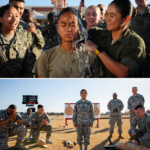
Dust hung in the air, clinging to sweat-soaked uniforms and raw skin. Boots formed a perfect half-circle around the pit — dozens of soldiers, watching, waiting, some smiling far too easily.
In the center stood Private Ava Carter.
Her breathing was uneven, chest rising sharply beneath her fatigues. One sleeve hung loose, torn at the shoulder. Her left arm trembled — not from fear, but from pain she refused to show.
“Still standing?” Sergeant Holt sneered, circling her like a predator. “I’m impressed. Most people know when to quit.”
Ava said nothing.
Silence was her shield. She had learned that early.
A ripple of laughter moved through the unit.
“Come on,” Holt barked, louder now. “You think silence makes you tough? Out here, it just makes you weak.”
He stepped in close, close enough that Ava could smell tobacco and sweat on his breath.
“You don’t belong here,” he said quietly, just for her. “And today, everyone’s going to learn that.”
Ava lifted her eyes.
Not defiant.
Not pleading.
Just… steady.
That look irritated him more than words ever could.
“Take her down,” Holt ordered.
Two soldiers moved in immediately.
“Hey—!” one of the younger recruits muttered, hesitation flickering in his eyes.
Holt didn’t even turn. “Do it.”
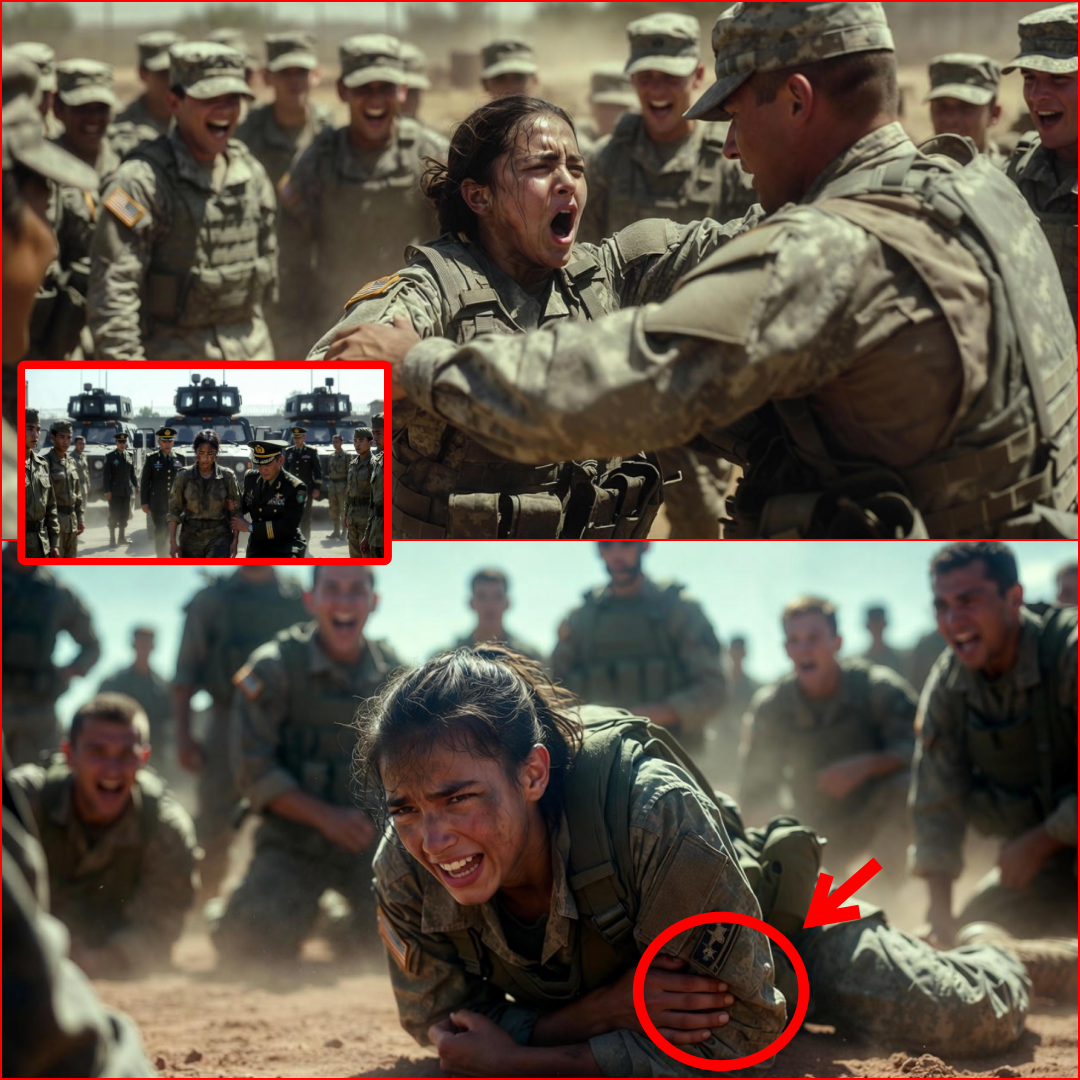
The first punch came fast — a sharp blow to Ava’s ribs that knocked the air from her lungs. She staggered but didn’t fall. A knee followed, then another hit from behind. The crowd roared, some cheering, some laughing nervously, others turning away.
“Stay down!” someone shouted.
Ava didn’t.
She swung back — clumsy, desperate, but real. Her fist clipped one attacker’s jaw, drawing a surprised grunt.
That was when Holt smiled.
“There it is,” he said. “The mistake.”
He stepped forward and grabbed her injured arm.
“No—!” Ava gasped.
The sound that followed was unmistakable.
A sharp, sickening crack.
Ava screamed — not loud, not long — just once, raw and uncontrollable, before she collapsed to her knees. Her arm bent at an angle it never should have.
For half a second, no one spoke.
Then the laughter exploded.
Some soldiers howled. Others clapped. Someone whistled.
“Holy sh—”
“She’s done.”
“Guess that’s the end of her.”
Ava’s vision blurred. Pain surged through her body in violent waves, but beneath it, something else burned — something colder.
She pressed her forehead to the dirt, breathing through clenched teeth.
Not like this.
Holt crouched beside her.
“Lesson learned?” he asked loudly, for everyone to hear. “You push back, you get broken.”
He stood and raised a hand. “Clear the pit.”
The laughter began to fade as soldiers shuffled backward, still buzzing, still high on the spectacle.
That was when Ava spoke.
Her voice was hoarse.
But steady.
“Sergeant Holt.”
He stopped.
Ten seconds passed.
No laughter.
No movement.
Just the wind dragging across the dirt.
Holt turned slowly. “What did you say?”
Ava lifted her head. Blood streaked her lip. Sweat and dust masked her face, but her eyes — her eyes were clear.
“You just made a reportable error,” she said.
A few soldiers exchanged looks.
Holt laughed, short and sharp. “You think anyone’s going to listen to you?”
Ava swallowed, pain flaring, but she continued.
“Article 128,” she said. “Assault resulting in grievous bodily harm. Witnessed by over a hundred personnel.”
The yard went still.
One soldier muttered, “She knows the code…”
Holt’s smile faltered — just a fraction.
“That won’t save you,” he snapped. “You’re nothing but—”
“I’m also recording,” Ava interrupted.
She tilted her chin toward the tower overlooking the yard.
The camera.
Always on.
Always rolling.
A ripple of unease spread through the unit.
Holt’s face darkened. “You think a camera tells the whole story?”
“No,” Ava said quietly. “But it starts one.”
She tried to stand.
Failed.
Pain surged, white-hot, and she collapsed again, biting back a cry.
For a moment — just a moment — someone stepped forward.
“Sergeant,” a voice said. “Maybe we should call medical.”
Holt shot him a glare sharp enough to cut steel.
“She’ll walk,” Holt said. “Or she’ll crawl.”
Ava looked up at the circle of boots around her.
Some faces were smug.
Some were guilty.
Some were afraid.
She memorized every single one.
Because this wasn’t the end.
This was the beginning.
As medics finally rushed in and hands lifted her onto a stretcher, Ava locked eyes with Holt.
“You should’ve let me quit,” he muttered.
Ava didn’t blink.
“No,” she said softly. “You should’ve stopped.”
The stretcher rolled away.
Behind her, the training yard stood frozen — a unit that didn’t yet realize it had just crossed a line it would never uncross.
And somewhere deep inside Ava Carter, beneath the pain and humiliation, something settled into place.
A promise.
Chapter 2: Pain Is a Language They Understand
The hospital ceiling was too white.
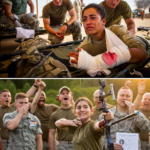
Ava stared at it as the lights slid past above her, each one flashing like a silent accusation. Her arm was immobilized, wrapped tight, suspended against her chest. Every bump of the stretcher sent lightning through her nerves.
“Easy,” a medic said. “You’re going to be fine.”
Ava didn’t answer.
Fine wasn’t the word.
She remembered the sound instead — the crack.
The laughter.
The way boots had edged closer, not to help, but to see better.
They wheeled her into the infirmary and transferred her onto a bed. The curtain was drawn, but voices leaked through anyway.
“—should’ve stopped it.”
“—Holt went too far.”
“—camera was on.”
Good, Ava thought.
Let them talk.
The doctor confirmed what she already knew: a clean break, severe trauma, weeks of recovery minimum.
“You’re lucky,” he said. “Another inch and—”
“Can I still train?” Ava asked.
The doctor blinked. “With a broken arm? Absolutely not.”
Ava nodded slowly.
Then she smiled.
That night, sleep refused to come.
Pain kept her awake, but pain wasn’t the problem. Pain was familiar. Pain was manageable.
Humiliation was not.
At 02:17, the door creaked open.
Ava’s eyes snapped open instantly.
A shadow slipped inside and closed the door carefully behind him.
“You shouldn’t be here,” Ava said calmly.
Private Lewis froze. “How did you—”
“You breathe loud,” she replied. “And you hesitate.”
Lewis swallowed and stepped closer, his face pale. “I… I just wanted to check on you.”
Ava studied him. He’d been there. He’d watched.
“Did you enjoy it?” she asked.
Lewis flinched. “No.”
“Did you laugh?”
“No.”
“But you didn’t stop it.”
Lewis looked down. “I couldn’t.”
Ava shifted, ignoring the pain. “You could have tried.”
Silence filled the room.
Lewis exhaled shakily. “They’re saying you’ll be discharged from training. Medical separation.”
Ava’s jaw tightened. “Holt’s saying that.”
Lewis nodded. “Command’s… considering it.”
Ava closed her eyes for a moment.
So that was the plan. Break her body, erase her name, move on.
When she opened her eyes again, they were cold.
“Lewis,” she said. “Do you want to make it right?”
He hesitated. “I don’t want trouble.”
Ava met his gaze. “Then leave.”
He didn’t.
“What do you need?” he asked quietly.\
Three days later, Ava walked out of the infirmary.
Her arm was still broken. Her uniform still marked her as weak.
And everyone knew it.
Whispers followed her across the compound.
“That’s her.”
“She’s finished.”
“Should’ve stayed down.”
Holt made sure she was assigned light duty — humiliating, visible tasks. Cleaning equipment. Sorting supplies. Always watched.
He passed her one afternoon and leaned close.
“Enjoying retirement?” he murmured.
Ava didn’t look at him.
“Not yet,” she said.
That night, the storm hit.
Rain hammered the barracks roof, drowning out footsteps. Ava moved quietly, her injured arm strapped tight, her good hand steady.
Lewis waited by the maintenance shed.
“You’re sure about this?” he whispered.
Ava checked the time. “You said Holt runs night drills off-record.”
Lewis nodded. “Three men. No supervisors.”
“Good.”
They moved.
The training yard was slick with mud, floodlights half-lit. Holt stood laughing with two soldiers, relaxed, careless.
Ava stepped into the light.
One of them noticed first. “What the hell—”
Ava didn’t stop.
Holt turned. “You’ve got a death wish coming out here.”
Ava stopped five feet from him.
“I told you,” she said evenly. “You made an error.”
Holt laughed. “You think I’m scared of a cripple?”
Ava dropped the sling.
Holt’s smile widened — until he saw her eyes.
She moved fast.
Her knee slammed into the first soldier’s gut. He folded instantly. The second lunged — Ava pivoted and smashed her elbow into his throat.
Holt reached for her injured arm.
She let him.
The moment his grip tightened, Ava stepped in and drove her forehead into his nose.
The crack echoed.
Holt screamed, stumbling back, blood pouring down his face.
“You—!” he roared.
Ava didn’t give him time.
She kicked his knee sideways. He went down hard, choking in the mud.
Ava stood over him, rain soaking her hair, chest heaving.
“You taught me something,” she said. “Pain distracts people.”
She planted her boot on his chest.
“But fear?” She leaned down. “Fear makes them honest.”
Holt spat blood. “You’re done. I’ll bury you.”
Ava smiled — slow, dangerous.
“No,” she said. “You already buried yourself.”
Sirens cut through the rain.
Floodlights snapped on.
Boots thundered closer.
Ava stepped back as Holt was dragged up, screaming, cursing, exposed.
Officers stared at the scene — the injuries, the witnesses, the cameras Lewis had quietly activated.
Ava slipped her sling back on.
As she was escorted away, Holt locked eyes with her, terror finally replacing rage.
“This isn’t over,” he hissed.
Ava paused.
“Oh,” she said softly. “It is.”
Because this time, everyone was watching.
Chapter 3: The Silence After the Storm
The courtroom was quieter than the training yard had ever been.
No boots scraping.
No laughter.
No orders barked without consequence.
Just the low hum of air conditioning and the weight of eyes fixed forward.
Ava Carter sat straight-backed in her uniform, her arm still healing, still stiff. The cast was gone, but the damage remained — not just in bone, but in memory. Across the room, Sergeant Holt sat rigid, jaw clenched, his nose still faintly crooked from where it had never healed quite right.
He didn’t look at her.
He couldn’t.
The presiding officer cleared his throat. “This tribunal is now in session.”
Ava exhaled slowly.
This was it.
They played the footage first.
The screen flickered to life, and the training yard appeared — dusty, sunlit, familiar. The laughter echoed through the speakers, louder than anyone remembered. Then came the crack.
Several people in the room shifted uncomfortably.
Someone swallowed hard.
When Ava’s scream cut through the audio, Holt flinched.
The video continued — her voice, calm despite the pain. The camera tower angle. The witnesses standing still.
Ten seconds of silence.
Then the footage ended.
The presiding officer turned to Holt. “Do you deny this?”
Holt opened his mouth.
Closed it.
His attorney leaned in, whispering urgently.
Holt shook his head. “No,” he said finally. “But context matters.”
Ava almost smiled.
Context had always been his shield.
Until now.
Private Lewis was called next.
His hands trembled as he took the stand. He avoided Holt’s eyes entirely.
“Why didn’t you intervene?” the officer asked.
Lewis swallowed. “Because I was afraid.”
“Afraid of what?”
“Of becoming her,” he said, voice cracking. “Of being next.”
Silence rippled through the room.
More witnesses followed. One by one, the unit unraveled — stories overlapping, excuses collapsing. Each testimony chipped away at the image Holt had built for years.
Control.
Authority.
Fear.
When it was Ava’s turn, she stood slowly.
The pain flared, but she welcomed it.
She faced the panel.
“I didn’t fight back to prove I was strong,” she said evenly. “I fought back because silence was killing me.”
She paused.
“You didn’t just break my arm,” she continued, eyes locking onto Holt at last. “You taught an entire unit that cruelty was acceptable. That laughter was permission.”
Holt’s knuckles whitened.
Ava’s voice hardened. “I decided that lesson ends with me.”
The presiding officer nodded once. “Thank you, Private Carter.”
Two hours later, the verdict was read.
Sergeant Holt was stripped of rank. Dishonorably discharged. Charges pending.
The room exhaled as one.
Holt stood abruptly, chair scraping back.
“This isn’t justice,” he spat. “This is a witch hunt.”
No one responded.
As guards escorted him out, Holt finally looked at Ava.
Not with rage.
With something closer to disbelief.
“You ruined everything,” he said hoarsely.
Ava met his gaze, calm as ever.
“No,” she replied. “You did.”
The compound felt different afterward.
Lighter.
Conversations were quieter at first — cautious — but something fundamental had shifted. Orders were questioned. Abuse was reported. The laughter had changed tone.
Ava returned to training weeks later.
The first day back, she stepped onto the yard where it had all begun.
No one laughed.
No one cheered.
They watched.
She ran drills one-handed until sweat soaked her uniform. She sparred with recruits who underestimated her and learned quickly. She fell. She rose.
Again.
And again.
And again.
One evening, as the sun dipped low, Lewis approached her.
“You could’ve walked away,” he said quietly. “After everything.”
Ava wiped her hands on her pants. “I thought about it.”
“What changed?”
She looked across the yard — at soldiers training harder, cleaner, fairer.
“I didn’t want revenge,” she said. “I wanted change.”
Lewis nodded. “You got both.”
Months later, Ava stood in front of a new unit.
This time, she wore stripes.
Her arm ached in the cold morning air, a reminder she’d carry forever. But it no longer defined her.
She addressed them without shouting.
“You think strength is about breaking people,” she said. “It’s not.”
She stepped forward.
“Strength is about stopping when you could keep going. About speaking when silence is easier.”
The recruits listened.
Really listened.
As they dismissed, one young woman lingered.
“They said you broke a sergeant with one sentence,” she said in awe.
Ava smiled faintly. “No.”
She glanced at her healed arm, then back at the yard.
“I broke a system that thought I wouldn’t fight back.”
That night, alone in her barracks, Ava removed her boots and sat quietly.
For the first time since the crack, since the laughter, since the silence — she felt whole.
The storm had passed.
What remained wasn’t fear.
It was resolve.
And this time, it belonged to her.
END
News

ONE SMALL DETAIL… BUT EVERYONE IS TALKING — A moment from Lilibet is drawing attention, revealing striking similarities to Meghan Markle
Princess Lilibet has proven she’s following in her mother’s footsteps as she showed off her love of being barefoot when…

💔 HEARTBREAKING VOICEMAIL — Brian Hooker Ch0kes Through a Message to His Daughter as His Wife Is Swept Away, Revealing a Moment of Utter Despair and Trag3dy
The daughter of a Michigan woman who went missing in the Bahamas during a nighttime boat ride with her husband is desperately…
THEY FOUND THE FLOAT… — Ch!lling Voicemail From Husband in The Bahamas Raises a Wave of New Questions
The daughter of a Michigan woman who went missing in the Bahamas during a nighttime boat ride with her husband is desperately…

A key royal expressed “disappointment” in Meghan — A shadowy, mysterious angle that leaves everyone watching stunned…
When the Duke and Duchess of Sussex shocked the world and announced they were quitting their royal duties – one…
I JUST WANT MY MOM BACK… — Daughter Breaks Down as Search for Missing American in The Bahamas Enters Agonizing New Phase
The daughter of a Michigan woman who went missing in the Bahamas during a nighttime boat ride with her husband is desperately…
MYSTERY IN THE SEA RESCUE — A Small Detail That Changed Everything for Lynette Hooker
An American woman is missing in the Bahamas after she reportedly went overboard while traveling on a dinghy and strong…
End of content
No more pages to load