THE FOOTAGE IS HARD TO WATCH… — Haunting new video has revealed the inside of the murky Maldives “shark cave” where five divers tragically lost their lives, as chilling new theories continue emerging about what went wrong beneath the surface.
The “shark cave” where five divers were tragically killed in the Maldives has been seen in haunting footage – as new theories emerge.
The murky “shark cave” where five Italian divers were tragically killed in the Maldives has been seen in haunting new footage – as fresh theories behind their deaths emerge.
Four bodies were discovered at a depth of 160ft (48 metres) following a gruelling search operation by expert Finnish divers.
The bodies of Monica Montefalcone, an associate professor of ecology at the University of Genoa, her daughter Giorgia Sommacal, marine biologist Federico Gualtieri and researcher Muriel Oddenino were found on Monday.
The group, accompanied by Gianluca Benedetti who was found the same day the group went missing, were located inside Thinwana Kandu cave, also known as “shark cave”.
Ahmed Shaam, a Maldives government spokesperson said “the four bodies were found inside the cave, not only inside the cave but well inside the cave into the third segment of the cave, which is the largest part. Pretty much together.”
The body of the fifth victim, Gianluca, was recovered on Thursday near the mouth of the cave.
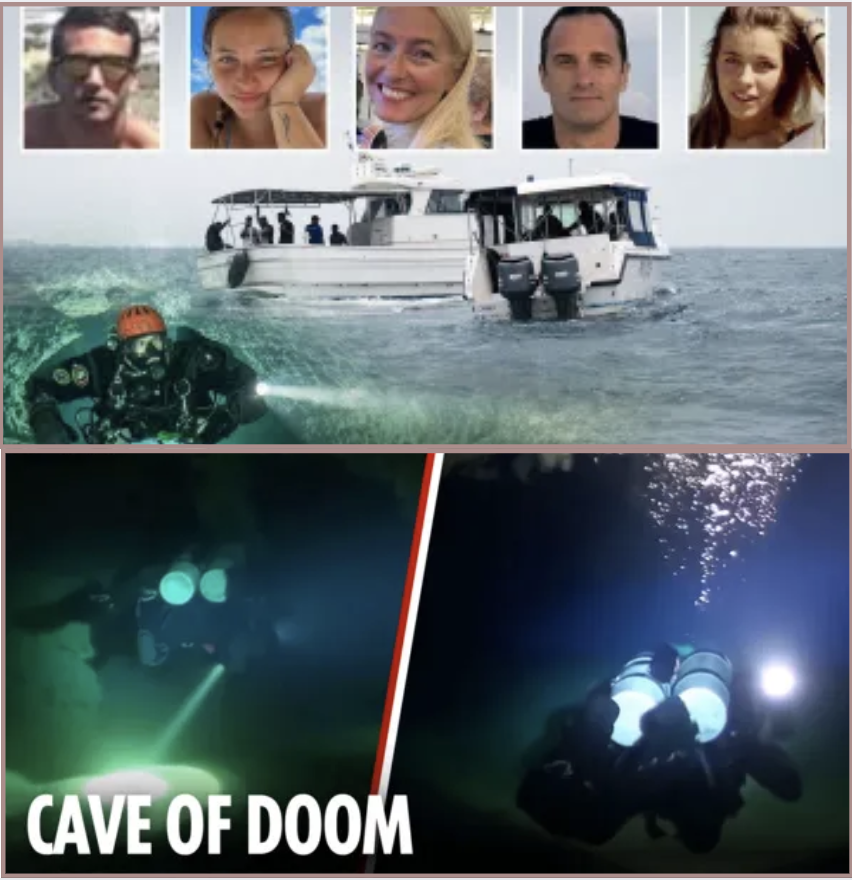
Chilling footage has shown the inside of the Thinwana Kandu cave, locally referred to as “Shark Cave”.
It is located about 60 miles (97 kilometres) from the capital Male, is about 60 metres long and is divided into three chambers.
In the terrifying clip, a diver traverses a series of narrow winding passages inside the structure.
The cave appears to be devoid of life, aside from one lone sting ray hovering around the eerie complex.
The divers who were found in the Maldives Shark Cave. Left to right – Giorgia Sommacal, Federico Gualtieri, Muriel Oddenino, Gianluca Benedetti and Monica Montefalcone. Picture: Supplied
Several terrifying theories have been put forward as to what transpired on the daring dive to the murky cave.

One involves the adverse weather conditions confronting the Atoll on the trip.
A yellow weather warning was issued just a day earlier, as powerful 30mph (48km/h) winds swept through the popular holiday destination.
The husband of Monica Montefalcone, one of the five Italians who died in a scuba diving accident in the Maldives, said she was “one of the best divers on earth”. Picture: Supplied

Giorgia Sommacal was with her mother Monica during a scuba diving accident in the Maldives. Picture: Supplied
Monica’s husband Carlo Sommacal told La Repubblica daily “she would never have put her daughter’s life or the lives of the other children at risk out of recklessness.

“Something happened down there.”
It has been confirmed that Monica and Muriel were conducting the trip for research.
Carlo described his late wife as “one of the best divers on earth” and insisted that she would not have taken the risk had she been aware of the warning.
“If there really was a yellow alert, they must have dived in earlier. I’m ready to swear anything about Monica’s behaviour,” he said.
An American hobby diver has speculated it could have been “murder”.
Self-described deep-sea diver Marc Randazza said on X: “I’ve been diving for 30 years. Rescue and deep dive certified.
“These divers were effectively dead the moment they went in the water.”
“At 150ft, with recreational gear and without a special gas mix, you’re already dead.”
“There was no possible way they were coming back, whether they panicked or not.”
“That dive plan was never going to end with any of them alive.”
The diver division of the Maldives National Defence Force preparing to dive in search of the bodies on Saturday. Picture: Supplied
The elite unit of Sami Paakkarinen, Jenni Westerlund, and Patrik Grönqvist located the remaining four bodies after Maldivian authorities recovered one of them on Thursday, Italy’s foreign ministry said.

The bodies have been found but a recovery mission will take place over the next few days.
A Maldivian government spokesperson told BBC: “Further dives [are] to be carried out in the coming days to recover the bodies.”
They also said specialised equipment for the recovery, provided by the UK and Australia, will be used alongside underwater scooters and gas tanks which can recycle air.
Each attempt to dive and retrieve the bodies lasts about three hours, and are immediately aborted if any obstacles are encountered.
Expert divers located the bodies of the victims at the deepest section of the cave.
But now the more difficult task of bringing them back to land is underway.
Maldivian authorities are expected to recover two of the four bodies on Tuesday, and another pair on Wednesday.
“The international search & recovery team deployed to the Maldives has successfully completed the first operational objective of the mission following today’s initial technical cave dive at the Dhekunu Kandu site, in Vaavu Atoll,” DAN Europe, the diving safety organisation in charge of the operation, said.
“This marks an important milestone in an operation that remains technically demanding, emotionally challenging, and operationally complex.”
They said that the coming days “will be dedicated to the highly delicate recovery procedures”.
Rescue teams in the Indian Ocean archipelago of the Maldives searched for a second day on May 15 for the bodies of four missing Italians following the country’s deadliest diving accident, officials said. Picture: Mohamed Afrah / AFP
The unit, which was assembled in 48 hours and dispatched by DAN Europe, searched the Alimatha cave complex near the Vaavu Atoll.

Paakkarinen, who has been cave diving since 2004, and Grönqvist, gained international renown for their role in recovering surviving divers in the 2014 Plura incident in Norway.
The elite Finnish team can dive to depths of nearly 500ft (152 metres), a key skill which helped them locate the tourists.
But the mission is incredibly dangerous.
On Saturday a Maldivian military rescue diver lost his life trying to recover the bodies, bringing the total death toll to six.
Mohamed Mahudhee died from decompression illness when bubbles form in the bloodstream from coming out of water too quickly.
The Italian foreign ministry are still investigating the cause of death for the five Italian divers.
One military diver tragically died on Saturday searching for the bodies. Picture: Supplied
There were 20 other tourists on the Duke of York yacht when the five Italians departed the vessel before going missing.

They have all returned to Italy following the terrifying ordeal.
But it has since emerged that the Duke of York yacht did not have a permit allowing dives of more than 100ft (30 metres).
The Italian team were found at a depth of 160ft – in clear breach of the rules.
Shafraz Naeem, a veteran of the Maldives National Defence Force, has revealed that only the most experienced divers can descend to such depths.
The ex-military diver said: “I’ve done at least 50 dives in the Alimatha caves, taking the right precautions and using the right equipment,” he said, according to Il Giornale.
“Each time it was a fantastic experience, but I was fully aware of the extreme risks I was taking.”
“Expertise and precaution are necessary.”
“For me, descending to Alimatha wasn’t difficult. I’m a cave diver, and I always had the right gas mix, the right equipment, and a backup system.”
Naeem has questioned why the group were allowed on the mission in the first place.
At such depths he stressed that just one “unexpected event can quickly turn into tragedy”.
This article originally appeared in The Sun and was reproduced with permission