Part 1: The Office of Vain Hopes
In a small coastal town in Maine, where fog often blankets the weathered wooden houses, lived a man everyone respectfully called “Uncle Thomas.” A veteran with rugged hands and the scars of time etched across his face, Thomas spent at least ten hours a day in a study filled with the scent of old paper and fountain pen ink.
Thomas no longer held a rifle. He held a pen.
He was a special volunteer for the Soldiers’ Family Association. His job was to write replies to thousands of mothers and wives who waited day and night for news from distant battlefields like Afghanistan or Iraq. Thomas possessed a strange gift: he could inhabit the soul of any soldier. He wrote of the smell of hot sand in Kandahar, the bitterness of field coffee, and the soul-aching homesickness felt under a desert moon.
“Uncle Thomas, you are our guardian angel,” a young wife once came to his house to thank him. Because of his letters, they felt their loved ones were still out there, still breathing, and still loving them.
But in that study, there was one drawer that remained permanently locked.
Part 2: The Woman at the Window
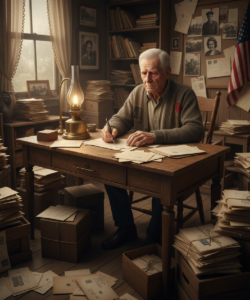
Thomas’s wife, Martha, lived in a different world. Alzheimer’s had robbed her of the concept of time and the present. Every afternoon, she sat by the window overlooking the trail leading to the house, her clouded eyes suddenly brightening whenever she saw the shadow of the mail carrier.
“Thomas! A letter! Peter’s letter is home!” Martha would cry out, her voice trembling with joy.
Thomas would step out, smiling gently, and take the letter from the mailman—who had grown long accustomed to this ritual. He would open the letter and read it aloud to her. It was always a long letter, telling of how Peter had just been promoted to Sergeant, and how he promised to come home for the upcoming Christmas holiday.
Martha would press the letter to her chest, tears welling in her eyes. “Such a good boy. He’s just like you when you were young.”
Thomas would nod, but his gaze would always drift away. He knew better than anyone what was written there, for he was the one who had stayed up the night before, polishing every word under the glow of an oil lamp. He bought the stamps himself, forged the postmarks himself, and mailed them to himself.
Part 3: The Secret in the Locked Drawer
One winter morning, as snow began to shroud the pine trees in white, Thomas received a peculiar letter. It didn’t come from the association office, nor did it bear a battlefield postmark. It was a pale blue envelope, resting neatly on the living room tea table.
On the envelope was written: “To the soldier who has written to me for the past 10 years.”
Thomas opened the letter with trembling hands. Inside was Martha’s handwriting. Not the shaky scrawl of a sick patient, but the sharp, lucid script of the woman he had loved since high school.
“My dearest Thomas,
I am writing this in one of those rare moments when my mind is at its clearest. I know you will be surprised, and perhaps afraid. But I need you to know the truth.
I know Peter is gone. I remember clearly the day those two officers in pristine uniforms walked through our door 10 years ago. I remember my own screaming when they handed you that folded triangular flag. I remember it all.
So, I want to thank you. Thank you for the 3,650 letters you wrote in our son’s name. Every day, I pretended to forget so that you could continue your work. I watched you grow thin, saw you weeping silently in your office as you tried to recall our son’s voice to put onto paper. You thought you were deceiving me so that I could live, but in reality, I was letting you deceive me, because it was the only way to keep you from collapsing under the weight of losing him.”
Part 4: The Twist – A World of Menders
Thomas dropped the letter. The world around him seemed to crumble. For a decade, he had prided himself on being the “Guardian of Hope,” the craftsman mending the shattered souls of other soldiers’ families. He thought he was the strong one, the pillar for his poor wife.
But it turned out he was the weakest of all. He was the one who needed those letters to cling to Peter’s existence.
He walked into his office and opened the locked drawer. It didn’t just contain pens and paper. Inside were thousands of real letters that other mothers had sent to their sons, returned by the post office because the recipients were “Killed in Action.” Instead of returning them to those grieving mothers and killing their last shred of hope, Thomas had kept them all. He wrote back to them in the names of their fallen sons, telling stories of “imaginary lives” in a world without war.
Thomas wasn’t just lying to his wife. He was running a massive network of artificial hope for the entire town, perhaps even the whole state.
Part 5: Light at the End of the Road
Thomas walked back into the living room. Martha sat there again, her eyes returned to the vacant, clouded stare of Alzheimer’s. She looked at him and smiled innocently: “Thomas, did Peter send a letter?”
Thomas stood still, looking at his wife. He understood that the lucid letter had been the final effort of Martha’s soul before sinking entirely into the dark. She had given him an exit, a forgiveness for the greatest lie of his life.
He sat down beside her and took her withered hand. “He did, Martha. Peter just sent a letter. He said… he’s very happy. And he thanks us for always waiting.”
Thomas picked up his pen once more. But this time, he didn’t write about the battlefield. He wrote about a field of sunflowers where Peter stood waiting for them. He wrote to the other mothers, telling them their sons had been promoted to “Guardian Angels.”
He realized that in this life, sometimes the truth is not as important as how we love one another. Thomas continued to write, not to escape death, but to honor life—even if that life existed only on pages of blue ink.
That winter, the old veteran Thomas passed away peacefully in his office chair. On the desk was the final letter he had written to himself, containing only one line: “Mission accomplished. I’m going home to Peter now.”
News

SHOCKER! Rapper OJ da Juiceman’s Wild Move Just Hours After Prison Release!
Getty Rapper OJ da Juiceman isn’t skipping a beat after spending a few weeks in lockup … in fact, TMZ has learned…

TEKASHI 6IX9INE IS BACK! The Rapper Goes on a Wild Spending Spree After 3 Months Behind Bars!
Tekashi 6ix9ine celebrated his release from a federal lockup the only way he knows how — at a strip club! The…

Where were Princess Beatrice and Princess Eugenie during the Royal Family’s Easter service?
The Duchess of Sussex has shared a rare glimpse of Prince Archie and Princess Lilibet as they celebrate Easter at home in the US. Meghan posted…

Stop searching! Harry IS in the Easter video with the family—notice this tiny detail
Archie and Lilibet featured in the cute update (Image: Instagram) Meghan Markle has shared an extremely rare glimpse of Prince Archie…
FORGET ARCHIE! THE WORLD IS IN TOTAL SHOCK OVER THE HIDDEN SECRET ON PRINCESS LILIBET’S EASTER EGG!
Archie and Lilibet featured in the cute update (Image: Instagram) Meghan Markle has shared an extremely rare glimpse of Prince Archie…

Imitating Meghan and nearly dying: Audience reveals the moment of collapse from following Harry’s wife’s words
I’ve just woken up from a dream about a slice of chocolate cake. Yesterday at lunch, I hovered outside a…
End of content
No more pages to load