My Wife Delivered Our Daughter To A Biker Gang — Then Butt-Dialed Me While She Screamed For Help… They Never Expected Her Father To Land On Their Roof
Part 1
The nurse handed me a clear plastic bag under the sick white lights of the emergency room.
Inside were my daughter’s clothes.
Or what was left of them.
Her jeans were torn from hip to knee, stiff with dried mud and brownish-red stains. Her white sweater, the one she wore when she wanted to feel “normal” around people who didn’t know our last name, had been cut open by paramedics. One sleeve was missing. There was a single pale-blue ribbon tangled in the fabric, a ribbon I recognized from her hair.
I stood there holding that bag like it weighed a thousand pounds.
My name is Mason Vance. On paper, I was the billionaire founder of Vance Global Security, a private defense firm with contracts on three continents and enough lawyers to make governments speak politely. Before that, I was a soldier. Before that, I was a boy from Kentucky who believed evil was something you could recognize from a distance.
But standing in that hospital hallway, I was none of those things.
I was just a father.
And my daughter Ivy was behind two swinging doors with a tube down her throat, bruises on her face, and machines breathing for her while a doctor told me they were not sure she would wake up.
I sat down because my knees stopped listening to me.
The waiting-room chair was hard orange plastic, the kind built to punish grief. A vending machine hummed in the corner. Somewhere a child cried behind a curtain. Rain beat against the windows in nervous little taps, like the whole city wanted in but didn’t dare.
“Mr. Vance?”
I looked up.
A young officer stood in front of me with a notepad in his hand and gum in his mouth. His badge read Blake. He had the pale, bored look of a man who had already decided the truth was inconvenient.
“How is the investigation going?” I asked. My voice sounded like gravel dragged across concrete. “Who did this?”
Officer Blake shifted his weight. His pen never touched the paper.
“We went out to the site,” he said. “Old clubhouse off Route 9. Locals call it the Viper’s Den.”
I stood.
I’m six-four. Years of carrying rifles, gear, and men heavier than me had left me built like a locked door. Blake noticed. His hand drifted toward his belt.
“And?” I asked.
He gave a little shrug. “Looks like a party got out of hand.”
The room went quiet around me.
“A party,” I repeated.
“Some guys at the gate said your daughter was there voluntarily. Drinking. Dancing. Things got rowdy. She ran out, tripped near the road. It happens.”
I stared at him until his gum stopped moving.
“My daughter has three broken ribs,” I said. “A fractured eye socket. Internal injuries. Defensive wounds on both hands. She didn’t trip. She fought.”
Blake’s mouth twitched. It was not quite a smile, but close enough.
“Medical report isn’t final,” he said. “And rich kids make bad choices too, sir.”
Sir.
He said it like an insult.
I thought about his throat. I thought about how quickly a windpipe collapses under the right pressure. Then I looked at the bag in my hand and remembered Ivy needed me outside a prison cell.
“Get out of my face,” I said.
Blake snapped his notebook shut.
“I’m just doing my job. But the Vipers aren’t a group you want trouble with, money or no money.”
He walked away, boots squeaking on the polished floor.
That was the first moment I understood the law had not failed.
It had been bought.
I walked toward the glass entrance because I needed air. My hands were shaking, not from fear. I had left fear in a desert fifteen years ago. This was something worse. This was rage with nowhere to go.
I called my wife again.
Clara should have been there an hour ago.
When the automatic doors slid open, she came in wearing a cream trench coat and red lipstick that had not been smudged by crying.
“Mason,” she said, rushing toward me.
She hugged me stiffly. She smelled like white wine and peppermint.
“Where were you?” I asked.
“At the gala,” she whispered. Her eyes moved past me, scanning the lobby. “Are there reporters?”
I pulled back.
“Reporters?”
“We have to control the narrative,” she said. “If the board hears Ivy was at some biker place, the stock could—”
“Our daughter is in a coma.”
Part 2
Clara blinked.
Not shocked.
Annoyed.
The realization hit me so hard it felt physical.
She wasn’t scared for Ivy.
She was scared for herself.
“Mason,” she said carefully, lowering her voice, “you need to think rationally. The Vipers donate to campaigns, judges, police unions. Half the city attends their charity rides. If we go after them publicly and Ivy survives—”
“If?”
Her mouth tightened.
The silence between us turned cold.
Then my phone vibrated in my pocket.
Unknown number.
I answered immediately.
Static crackled through the speaker. Then a man’s voice laughed low and ugly.
“You should’ve taught your girl respect, Vance.”
My hand clenched around the phone.
“Who is this?”
Another laugh.
“She cried real pretty.”
Something shattered inside me.
Not loudly.
Quietly.
Like ice cracking under deep water.
“Listen carefully,” I said.
“No,” the voice replied. “You listen. Your money means nothing out here. This town belongs to us.”
The line disconnected.
Clara grabbed my arm. “Mason, stop. If you escalate this—”
I looked down at her hand.
She let go.
That was when I noticed it.
Mud on the hem of her coat.
Dark red dirt.
The same color the paramedics had described from the Viper property.
My pulse slowed instead of speeding up.
Combat does that to you sometimes. The worse things get, the calmer you become.
“Where exactly was the gala?” I asked.
Her eyes flickered.
“Downtown.”
“You drove yourself?”
“Yes.”
“What route?”
“Mason, what does that matter?”
I stared at her.
And she looked away first.
I knew.
Maybe not every detail.
But enough.
I walked past her without another word and entered the ICU wing.
Ivy looked impossibly small in that hospital bed.
Machines breathed for her in soft mechanical sighs. Brues darkened one side of her face. Her fingers twitched faintly against the blanket.
I sat beside her and took her hand carefully.
“I’m here, bug,” I whispered.
That’s what I used to call her when she was little.
She loved fireflies. Used to catch them in jars and cry when I made her let them go.
A tear slid down my face before I realized it.
Then I noticed movement.
Her lips.
Barely moving.
I leaned closer.
“…Mom…”
My chest tightened.
“I know,” I whispered.
Her eyes fluttered under swollen lids.
“…laughed…”
Every nerve in my body went numb.
Not shock.
Confirmation.
I kissed her forehead gently and stood.
Then I made three phone calls.
The first was to my head of intelligence.
“Everything on the Vipers. Financials. Members. Cops on payroll. I want names in one hour.”
The second call was to my pilot.
“Fuel the Hawk. Night configuration.”
A pause.
“Yes, sir.”
The third call was to a man named Jonah Creed.
Former Force Recon.
Current head of my private tactical division.
One of the few people alive I trusted completely.
“I need six operators.”
“No police?”
“No police.”
A long silence.
Then Creed answered quietly, “Understood.”
By midnight, rain hammered the city hard enough to blur the skyline.
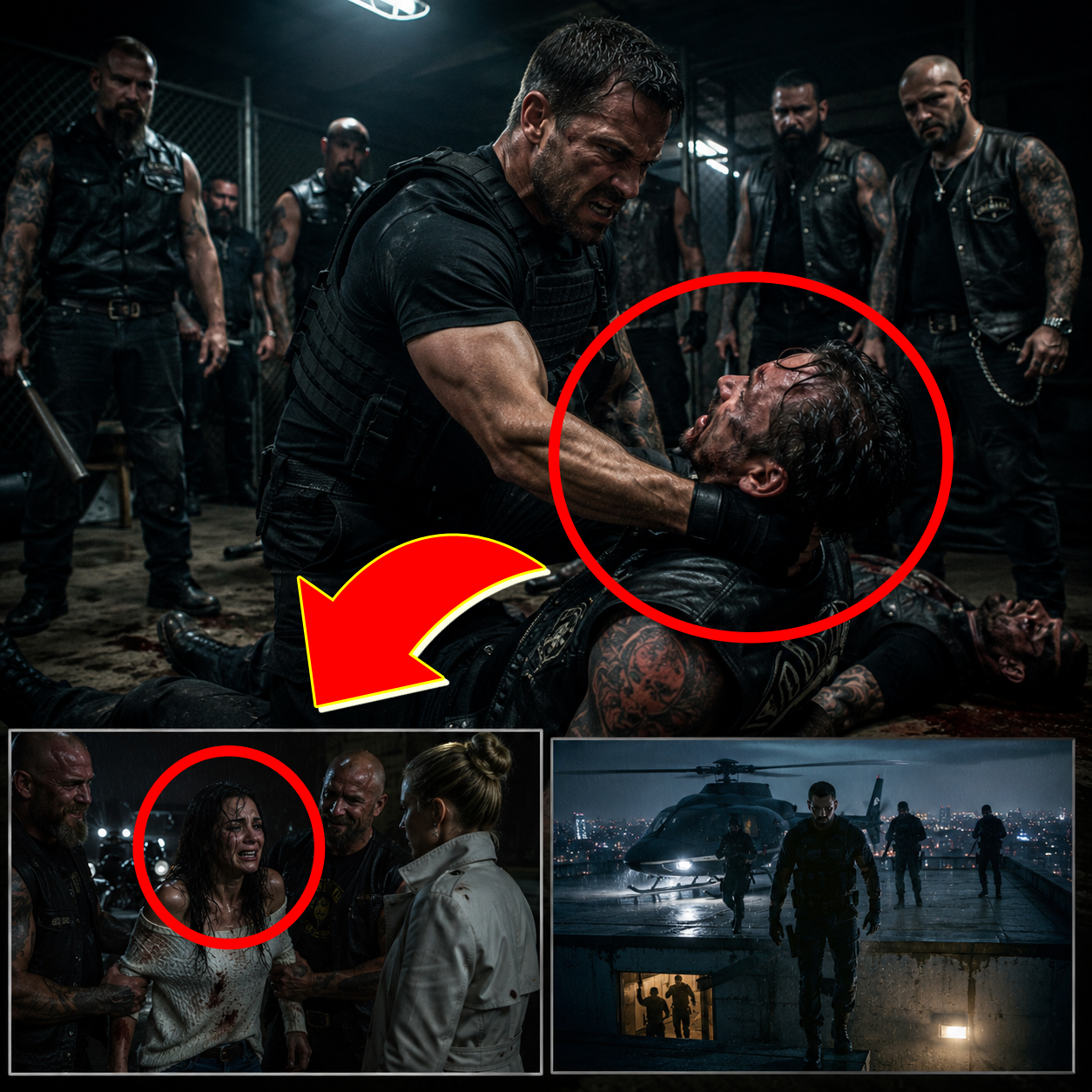
I stood inside the hangar wearing black tactical gear for the first time in eight years.
Creed approached holding a tablet.
“Forty-seven confirmed inside the clubhouse,” he said. “Maybe more. Heavy weapons in the basement. Security cameras on all entrances.”
He hesitated.
“There’s something else.”
He handed me the tablet.
Security footage from a gas station two miles from the Viper property.
Timestamp: 11:43 PM.
Clara’s car.
Parked outside.
And Clara herself standing beside a tall biker with a snake tattoo across his throat.
The biker kissed her.
Not briefly.
Not secretly.
Like it had happened many times before.
My men stayed silent.
I kept watching.
Then new footage appeared.
Ivy climbing out of the back seat.
Confused. Unsteady.
Clara pointing toward the clubhouse doors while the bikers laughed.
I stopped breathing.
One of the bikers grabbed Ivy’s wrist.
She tried to pull away.
Clara lit a cigarette.
And turned her back.
Creed spoke carefully. “Mason…”
I handed the tablet back.
“Lock and load.”
The helicopter blades began to spin.
Rain exploded sideways across the runway.
Inside the cabin, six armed men checked weapons in total silence while the city lights faded beneath us.
I looked out into the storm and thought about the sound Ivy made on that hospital bed.
Mom laughed.
Not cried.
Not screamed.
Laughed.
By the time the Viper’s Den appeared below us through the rain, something inside me had died permanently.
The clubhouse sat alone in the woods like a rotten tooth.
Motorcycles lined the yard.
Music pulsed through the walls.
They were still celebrating.
Creed looked at me over the roar of the helicopter.
“We go in quiet?”
I stared at the building below.
“No,” I said.
“We go in unforgettable.”
Part 3
The helicopter descended through sheets of rain until the roof of the clubhouse filled the windshield.
Music thumped beneath us.
Drunk men.
Laughing men.
Men who believed they were untouchable.
The Hawk touched down hard enough to shake the building.
Before anyone inside could react, my operators moved.
Magnetic locks slammed onto the steel exit doors.
Industrial wedges jammed every emergency exit from the outside.
Bolt cutters snapped the external generator lines.
Then the entire building went black.
The music died instantly.
So did the laughter.
For three beautiful seconds, all I heard was thunder.
Then came shouting.
“What the hell—”
“Power’s out!”
“Check the back!”
Men crashed into locked doors from inside. Metal boomed through the storm.
I stepped toward the rooftop intercom box connected to the clubhouse PA system.
Creed handed me the mic.
I pressed the button.
Static screamed through the speakers below.
Then I spoke softly.
“You made her scream.”
Silence inside.
“You laughed while my daughter begged for help.”
A crash echoed below us as someone fired blindly through a window.
“You thought nobody was coming.”
I closed my eyes for one second and pictured Ivy holding fireflies in a glass jar.
Then I opened them again.
“Now it’s my turn to make you silent.”
Gunfire exploded from inside the clubhouse.
Windows shattered outward.
My operators took cover behind rooftop ventilation units while rounds tore through the rain.
“They’re panicking,” Creed shouted.
“Good.”
I picked up the thermal scope.
Bodies glowed orange through the roof beneath my feet. Running. Colliding. Trapped animals.
Then one heat signature moved differently.
Toward the basement.
Fast.
“Rear stairwell,” I barked.
Two operators moved instantly.
Seconds later, screams echoed from below.
Not battle screams.
Fear.
Pure fear.
Creed’s radio crackled.
“We found a room.”
The way he said it turned my blood cold.
We breached through the rooftop access door three minutes later.
The smell hit first.
Rot.
Mold.
Blood.
The hallway below looked like hell abandoned halfway through construction. Graffiti covered the walls. Chains hung from ceiling pipes. Several rooms had mattresses on the floors with restraints bolted into concrete.
One of my men stopped beside a wall.
Photographs.
Dozens of them.
Girls.
Young women.
Bruised.
Crying.
Missing posters torn from newspapers.
Creed looked at me grimly.
“This isn’t just a biker gang.”
No.
It was a hunting ground.
Then we reached the basement.
Officer Blake was there.
Alive.
Armed.
Standing beside a steel table covered in cash bundles and narcotics.
The moment he saw me, his face collapsed.
“You,” he whispered.
Behind him were three fresh concrete sections in the floor.
Uneven.
Recently poured.
Creed slowly removed his gloves.
“Oh God,” one operator muttered.
Blake raised his pistol with shaking hands.
“You don’t understand,” he stammered. “These guys own everybody. Judges, deputies, city council—”
“And you?”
His eyes darted wildly.
“I had no choice.”
I looked at the concrete graves.
Then at him.
“Yes,” I said quietly. “You did.”
Blake fired first.
He missed.
Creed disarmed him in less than two seconds and slammed him against the wall hard enough to crack tile.
The room fell silent except for Blake crying through broken teeth.
Then another voice spoke from the darkness.
Clara.
“I can explain.”
She stood near the far doorway drenched in rainwater, mascara running down her face.
For the first time all night, she looked afraid.
Not guilty.
Afraid.
“They threatened me,” she whispered. “Mason, please… you have to believe me…”
I stared at her.
“You delivered our daughter to them.”
Tears spilled down her cheeks.
“I didn’t think they’d go that far—”
My hand slammed into the steel table beside me hard enough to dent it.
“You heard her scream.”
Clara flinched.
“You laughed.”
She collapsed to her knees sobbing.
Outside, sirens finally approached through the storm.
Too late.
Way too late.
Creed stepped beside me quietly.
“The police are here.”
I looked around the basement one final time.
At the graves.
At the chains.
At the terrified faces of the surviving Vipers.
Then I looked at Clara.
And suddenly I felt nothing.
No rage.
No grief.
Nothing.
That frightened me more than anything else.
Weeks later, the headlines called it the largest organized trafficking investigation in state history.
Bodies were recovered from beneath the clubhouse floor.
Seven officers resigned.
Three judges disappeared before federal warrants could reach them.
The Vipers collapsed overnight.
And Clara Vance sat alone in a concrete cell awaiting trial.
But none of that mattered to me.
Because every morning, I still sat beside Ivy’s hospital bed.
Waiting.
Hoping.
Listening to the machines breathe for her.
Then one rainy afternoon, her fingers moved inside mine.
Tiny movement.
Barely there.
But real.
My throat closed instantly.
“Ivy?”
Her eyelids trembled.
Slowly… painfully… they opened.
Confused green eyes found mine.
And after everything—
The blood.
The graves.
The storm.
The screams—
My daughter whispered one broken word.
“Dad?”