CHAPTER ONE — THE CIVILIAN
The words landed lightly, almost lazily.
“Mind if I try?”
They weren’t shouted. They weren’t barked with authority. There was no edge of challenge in them. If anything, they sounded amused.
And yet, the range fell silent.
For a moment, even the ocean wind seemed to pause. The metallic clatter of bolts locking forward stopped. Fingers eased off triggers. A dozen Marines, mid-reset, turned in unison.
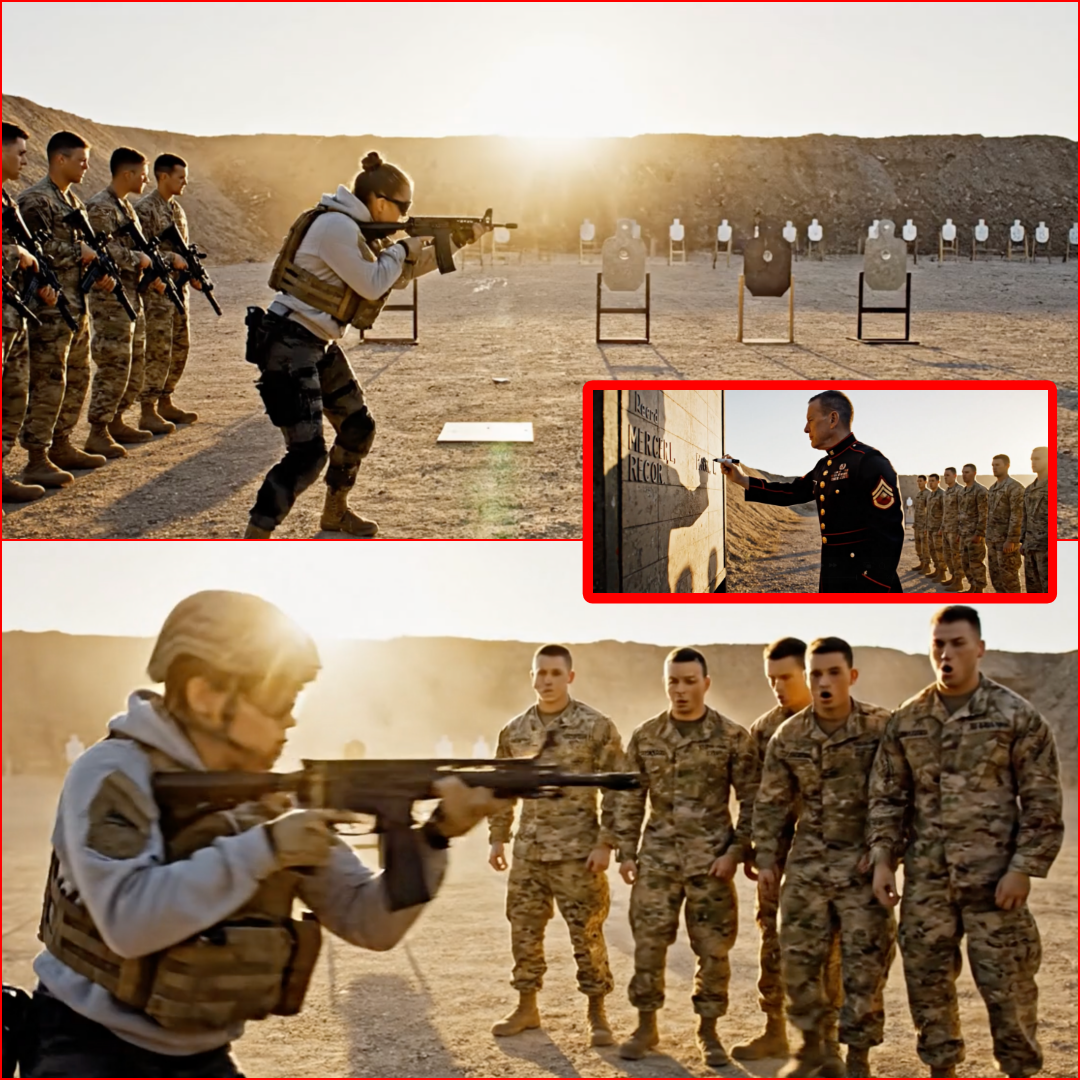
The Marine Corps shooting range sat on a stretch of coastal concrete that had seen generations of boots grind across it. Salt hung in the air, mixing with burned cordite and gun oil. It was the kind of place where mistakes stayed with you—sometimes forever.
All morning, the unit had been running the same drill.
Sprint twenty yards. Drop to kneeling. Load. Fire two controlled shots. Transition. Clear a staged malfunction. Move again. Finish with a precision shot on steel.
On paper, it was basic.
In practice, it was unforgiving.
Sweat ran down spines despite the cold wind coming off the Pacific. Rifles were slick in gloved hands. Breathing had to be controlled, even as lungs screamed. Hesitate for half a second, and the timer punished you mercilessly.
At the far end of the range, bolted to a steel frame, stood the whiteboard.
Most of the numbers on it changed weekly.
One never had.
Fifteen years.
The record time—written in thick black marker, slightly faded now—had survived countless erasures around it. Instructors updated best runs, circled near misses, crossed out failures.
But that one line remained untouched.
A ghost.
The Marines knew the story. Everyone did.
The man who’d set it had been a freak of nature. Fast without rushing. Precise without slowing down. His transitions had been so clean that instructors still used the footage as a teaching aid.
Three weeks after setting the record, he deployed.
He never came back.
Now, standing just inside the range boundary, was someone who clearly didn’t belong.
She wore a gray hoodie, slightly oversized, sleeves pushed up to her forearms. Her hair was tucked under a faded baseball cap pulled low. No rank. No patches. No boots.
Running shoes.
Dusty.
She looked like someone waiting for a friend. Or killing time. Or hopelessly lost.
A few Marines smirked.
“Civilian,” someone murmured under their breath.
Another muttered, “Must be a tour.”
The range officer turned slowly.
Gunnery Sergeant Mark Hale had been running ranges longer than some of these Marines had been alive. His face was lined, sun-worn, eyes sharp beneath his campaign cover. He had zero patience for distractions, especially on a live-fire range.
His gaze dropped immediately to her feet.
No boots.
Then her sleeves.
No unit markings.
“You’re not on the roster,” he said.
His tone wasn’t hostile. Just final.
She smiled.
“I know.”
That threw him slightly. Not many civilians smiled after that sentence.
Her eyes flicked toward the whiteboard, then back to the course laid out in concrete lanes and steel targets.
“It’s a simple drill on paper,” she said calmly. “Sprint. Load. Fire for accuracy. Clear the malfunction. Move. Repeat.”
A ripple of attention moved through the Marines.
She knew the sequence.
“It’s brutal in practice,” she continued, as if discussing the weather. “Pure skill under pressure. It punishes hesitation more than mistakes.”
Someone in the formation shifted his weight.
Hale narrowed his eyes. “You familiar with this drill?”
“I am.”
No brag. No hesitation. Just certainty.
Hale studied her longer now. The way she stood—weight balanced, shoulders relaxed. Not stiff like a spectator. Not loose like someone pretending.
Professional.
“Where’d you learn it?” he asked.
She shrugged slightly. “Around.”
That earned a few quiet chuckles.
Hale exhaled through his nose. He could shut this down immediately. He should.
But something about her bothered him—in the wrong way. Like a loose thread.
“All right,” he said finally. “One run. Unloaded weapon. No live fire.”
A few Marines straightened, surprised.
Hale reached out and took the timer from a corporal. “This isn’t a game. You screw up, we stop.”
She nodded. “Fair.”
One of the Marines handed her a rifle.
The moment her hands closed around it, the mood shifted.
It was subtle—but undeniable.
She didn’t fumble. Didn’t adjust awkwardly. The rifle settled into her grip as if it belonged there. She rolled her shoulders once, testing the sling, eyes already tracing the course.
The snickers died.
Hale watched her closely now.
“On my signal,” he said.
She stepped to the starting line.
The wind lifted the edge of her hoodie. Her shoes planted firmly, toes angled just right. Her breathing slowed.
The range was silent.
Hale raised the timer.
Beep.
She exploded forward.
Not reckless. Efficient.
Her stride was compact, powerful. She hit the kneeling position in one fluid motion, rifle coming up as if guided by instinct.
Click. Load.
Dry fire—snap.
Transition.
The staged malfunction was cleared so fast a few Marines missed it entirely. No wasted motion. No overcorrection.
She moved again.
Her footwork was precise, clean. No sliding. No stutter steps.
Snap. Snap.
The steel target rang.
Someone swore under their breath.
Hale’s jaw tightened.
She crossed the finish line and froze—weapon safe, posture perfect.
Hale looked down at the timer.
Then back at her.
The Marines leaned forward as one.
“That was a practice run,” Hale said slowly.
She nodded. “I know.”
He hesitated.
Then, against every instinct that years of service had drilled into him, he reset the timer.
“Load live,” he said.
The range inhaled.
She met his gaze. For the first time, something flickered behind her calm.
Not fear.
Respect.
“Yes, Gunny.”
And just like that, the civilian stepped into legend territory.
The beep sounded again.
And everything changed.
CHAPTER TWO — THE TIMER DOESN’T LIE
The sound of the beep cut clean through the air.
She moved before most of them even processed it.
Her first step dug into the concrete, shoes biting hard as she launched forward. No hesitation. No wasted energy. Every stride was measured, controlled—like a sprinter who knew exactly how many steps it took to reach the line.
Hale’s eyes tracked her automatically, years of range discipline overriding his surprise. He watched her feet, her shoulders, the angle of the rifle as it came up.
She dropped to kneeling in one smooth motion.
No thud. No shuffle.
Click. Load.
The magazine seated with a solid, confident motion. Her thumb rode the bolt without looking. The rifle came up and—
Crack. Crack.
Two clean shots.
The steel target rang sharply, the sound echoing across the range. Several Marines flinched despite themselves.
“Jesus,” someone whispered.
She was already moving.
The transition point—where most Marines lost time—didn’t slow her at all. She cleared the staged malfunction with a single, practiced movement. No overthinking. No double-checking.
Hale felt a prickle crawl up his neck.
This wasn’t luck.
She sprinted again, boots and gear clattering behind her in memory only—because she had none of it. No extra weight. No plate carrier. No helmet.
And still—
Crack.
Another hit.
She slid into the final position, breath controlled, eyes steady. The last target fell with a dull metallic clang.
She froze.
Weapon safe.
Timer still running.
Hale stared at the numbers.
Then he stopped it.
A beat passed.
Then another.
“Time?” a corporal asked quietly.
Hale didn’t answer.
He turned the timer toward himself again, thumb hovering, eyes narrowing as if the device itself had betrayed him.
Then he turned it around so the formation could see.
A ripple moved through the Marines like an electrical current.
“No way.”
“That’s not—”
“Gunny, that’s—”
Hale raised a hand. Silence snapped back into place.
She stood there, breathing lightly, hands relaxed on the rifle. No grin. No celebration.
Just waiting.
“That was a clean run,” Hale said finally. His voice was flat, controlled. “But you ran light.”
“Yes, Gunny.”
“No gear. No boots. No pressure.”
She met his eyes. “You want me in full kit?”
A murmur rippled through the line.
Hale’s jaw flexed.
“You beat the best time today,” he said. “Not the record.”
She tilted her head slightly. “Then run it again.”
The words weren’t arrogant.
They were inevitable.
Hale studied her for a long moment. He could feel the attention of every Marine on him now. This wasn’t just a drill anymore. This was becoming a challenge—to the range, to the record, to the legend written on that board.
“Who are you?” one of the sergeants muttered.
She glanced toward him. “Does it matter?”
He didn’t answer.
Hale exhaled slowly. “Full kit,” he said at last. “Standard issue. Same as everyone else.”
A corporal stepped forward, already moving. “Gunny?”
“Do it.”
Body armor. Helmet. Magazine pouches. The weight changed her silhouette immediately—but not her posture.
As the vest settled onto her shoulders, a younger Marine leaned toward his buddy. “She’s going to slow way down.”
“Everyone does,” the other replied.
She adjusted the straps once. Checked the sling.
That was it.
No pacing. No shaking out nerves.
Hale raised the timer again.
“This is the last run,” he said. “You stop when I say stop.”
She nodded.
“On my signal.”
The wind gusted across the range, carrying the smell of salt and burned powder. Somewhere, waves crashed against rock.
Beep.
She moved.
Heavier now—but still fast.
Her sprint was slightly shorter, her steps tighter. She compensated without thinking. Kneeling position—solid. The rifle came up.
Crack. Crack.
Dead center.
A Marine near the back swallowed hard.
The transition point—the record killer—came up fast.
She hit it.
The malfunction snagged for half a second.
A flicker of tension surged through the line.
Then her hands adjusted, smooth and decisive, and the rifle snapped back into action.
She was already moving again.
Hale leaned forward without realizing it.
Crack.
Hit.
She slid into the final position, armor scraping lightly against concrete. Her breathing hitched once—just once—then steadied.
The last shot rang out.
Steel sang.
Silence followed.
Hale stopped the timer.
Every Marine stared at the numbers.
Hale didn’t move.
Didn’t speak.
The whiteboard loomed in the background, the old record almost daring them to say it out loud.
“Gunny,” someone whispered. “That’s… that’s under.”
Hale looked up slowly.
At her.
“You want to tell me again you’re a civilian?”
She removed her helmet, tucking it under one arm. Sweat dampened her hairline, but her eyes were sharp, focused.
“I never said I was a civilian,” she replied quietly.
The range held its breath.
Then Hale turned toward the whiteboard.
And reached for the marker
CHAPTER THREE — THE NAME ON THE BOARD
The squeak of the marker against the whiteboard cut deeper than any gunshot.
Every Marine on the line watched in rigid silence as Gunnery Sergeant Hale erased the number.
Fifteen years.
Gone in three slow swipes.
The board looked naked without it—like something sacred had been disturbed.
Hale hesitated, marker hovering in the air. For the first time since the run began, uncertainty flickered across his face. Not doubt in her ability.
Doubt in what came next.
“You understand,” he said without turning around, “that once I write a new time up here, it becomes official. That means paperwork. That means questions.”
She stood behind him, helmet tucked under her arm, rifle cleared and grounded. “I understand.”
“You sure you want that attention?”
A beat.
Then: “I didn’t come here for attention.”
Hale glanced back at her sharply.
“What did you come for, then?”
Her eyes drifted—not to the Marines, not to the course—but to the empty space where the old record had been.
“To finish something.”
That answer unsettled him more than any display of skill.
A captain who’d been observing from the shade finally stepped forward. Captain Reyes. Intel officer. Sharp eyes, sharper instincts.
“Gunny,” Reyes said, voice low. “We need to pause this.”
Hale straightened. “Sir?”
Reyes looked at the woman—not with awe, but calculation. “You just broke a fifteen-year Corps record. With no prior clearance. No identification. That’s not something we gloss over.”
A few Marines shifted uneasily.
She met Reyes’s stare without blinking. “You can disqualify the run.”
Reyes raised an eyebrow. “You’re offering?”
“Yes.”
That drew murmurs.
Hale turned fully now. “Hold on.”
She looked at him. “If the record matters more than the truth, erase the run.”
Reyes folded his arms. “And what is the truth?”
She exhaled slowly.
“My name,” she said, “won’t mean anything to most of you.”
Hale waited.
“But the name you erased?” She nodded toward the board. “It should.”
The air changed.
Reyes’s jaw tightened. “Explain.”
She stepped closer to the board. Close enough that the Marines could see the scar along her forearm—a thin white line, old and deliberate.
“That Marine deployed three weeks after setting the record,” she said. “He never came back.”
A heavy silence settled.
“He was my instructor,” she continued. “My mentor. And my brother.”
A collective breath left the range.
Hale’s eyes widened slightly. “Your… brother?”
She nodded once. “Staff Sergeant Daniel Mercer.”
The name hit like a punch.
Several Marines stiffened. One muttered, “No way.”
Hale turned back to the board, the marker trembling just slightly in his grip.
Mercer wasn’t just a legend.
He was a cautionary tale. A reminder of how fast the Corps could take its best and never give them back.
Reyes studied her more carefully now. “You’re saying you trained with him?”
“From the time I was sixteen,” she replied. “He taught me everything he knew. He said speed meant nothing without control. And control meant nothing without purpose.”
Hale swallowed.
“And today?” Reyes asked.
She looked at the course. “Today was about purpose.”
A sergeant near the front spoke up, unable to stop himself. “If you trained that long… why aren’t you in uniform?”
The question wasn’t hostile. Just confused.
Her jaw tightened. “Because the Corps didn’t have a place for me when I tried.”
That landed harder than any shot.
Reyes glanced at Hale. “Background check. Now.”
A corporal jogged off.
Hale capped the marker but didn’t set it down. “If this checks out,” he said quietly, “that run stands.”
She nodded. “It should.”
Minutes stretched.
The wind picked up again. Flags snapped. No one spoke.
Finally, the corporal returned, breathing hard. “Gunny. Sir.”
Reyes turned. “Well?”
The corporal swallowed. “Her name’s Lena Mercer. Civilian contractor history. Joint training programs. Scores… off the charts.”
Reyes exhaled slowly.
Hale looked at her—really looked at her—for the first time not as a curiosity, not as a threat, but as something familiar.
Loss wrapped in discipline.
“You didn’t come here to show us up,” he said.
“No,” she replied. “I came to make sure his standard didn’t die with him.”
Hale turned back to the board.
And this time, when he wrote the new time, he added a name.
MERCER, L.
The Marines stared.
Reyes cleared his throat. “There’s still the matter of authorization.”
Lena met his gaze. “Then authorize it.”
Reyes hesitated.
Then—unexpectedly—he smiled.
“Welcome to the questions, Ms. Mercer.”
The tension eased—but not completely.
Because something had shifted.
The range would never feel the same again.
And somewhere in the back of every Marine’s mind, a new question had formed:
If she could do this… what else had the Corps been missing?
CHAPTER FOUR — THE STANDARD
The whiteboard stood freshly marked.
MERCER, L.
The ink was still wet.
No one touched it. No one joked. Even the ocean seemed quieter, as if the range itself understood something irreversible had just happened.
Captain Reyes broke the silence.
“Ms. Mercer,” he said, voice measured, “you understand that breaking a Corps record doesn’t just raise eyebrows. It triggers evaluations. Reviews. People who don’t like surprises.”
Lena nodded. “I’m familiar with that type.”
Reyes gave a thin smile. “Of course you are.”
Hale stepped forward, hands on his hips. “With respect, sir—this range exists to test limits. She met the standard. Then she raised it.”
A murmur of agreement rippled through the Marines.
Reyes glanced around, reading the room. He saw it in their posture, in the way their eyes kept drifting back to Lena—not with disbelief now, but with something closer to respect.
“Very well,” Reyes said. “One more thing.”
Lena’s gaze sharpened. “Go on.”
“You said you came here to finish something.”
“Yes.”
Reyes gestured toward the course. “Finish it.”
Hale frowned. “Sir?”
Reyes didn’t look away from her. “The record’s broken. But standards aren’t numbers. They’re repeatable. Run it again.”
The Marines stiffened.
Lena considered him for a long moment. Sweat cooled on her skin. Muscles already beginning to feel the weight of what she’d done.
Then she smiled faintly.
“Same conditions?” she asked.
“Same,” Reyes replied.
Hale hesitated—then handed her the rifle again. “Your call.”
She nodded once.
This time, the Marines watched differently.
Not waiting for failure.
Waiting to learn.
Hale raised the timer.
Beep.
She moved.
Fatigue crept in now, subtle but real. Her sprint was a fraction slower. Her drop to kneeling carried more weight.
Crack. Crack.
Hits.
The malfunction snagged again—longer this time.
A few Marines leaned forward instinctively, as if willing her hands to move faster.
She adjusted.
Cleared.
Moved.
Her breathing was audible now, but still controlled. Not frantic. Not desperate.
Final position.
She steadied.
The last shot rang out.
Steel answered.
Hale stopped the timer.
The number flashed.
It wasn’t faster.
It didn’t need to be.
It was still under the old record.
Reyes exhaled. “Repeatable,” he said quietly.
That single word carried more weight than applause.
Hale let out a breath he didn’t realize he’d been holding. “Standard confirmed.”
The Marines relaxed—some grinning, some shaking their heads in disbelief.
A young lance corporal stepped forward before he could stop himself. “Ma’am… with respect—will you train us?”
The question hung there.
Lena looked around the range. At the course. At the Marines. At the board.
Then she nodded. “If you’re willing to be uncomfortable.”
A few chuckles broke out.
Hale smiled. “They’ll survive.”
Reyes checked his watch. “I’ll make some calls.”
As he walked away, Hale lingered beside Lena. “Your brother would’ve liked that.”
She swallowed. “He wouldn’t have been surprised.”
Hale studied the board one last time. “You didn’t replace him.”
“No,” she said softly. “I carried him forward.”
The wind picked up again, sweeping across the range. The Marines began resetting targets, moving with renewed purpose.
The record was no longer a ghost.
It was a challenge.
And as Lena Mercer stepped back, hoodie pulled on, helmet under her arm, one truth settled into the concrete beneath their boots:
Standards don’t belong to the past.
They belong to those brave enough to meet them—and those strong enough to raise them.
THE END
News

OMG! The unexpected tension between Prince Harry and Prince William that has the internet in an uproar!
A royal wedding is on the horizon, and while the event will be a happy occasion for the Royal Family,…
CAUGHT CAMERA — Prince William’s Four-Word Whisper to Princess Charlotte and Prince Louis Caught on Camera
The Royal Family attended their annual Easter Sunday church service in Windsor this morning – and Prince William was spotted…

💥 THREE WORDS THAT MELTED HEARTS — Princess Charlotte Turns to the Camera at Easter and Quietly Says It…
Prince William got in on the coordinated look as well From left: Princess Charlotte, Kate Middleton, Prince George, Prince Louis…

THE FATEFUL DIAMOND CHAIN — Kevin “Tugg” Watson Sh0t D3ad on Facebook Live in South Austin, Ch!lling Argument Footage Leaves Viewers Shaken
What began as a routine livestream quickly spiraled into a moment that would leave viewers stunned and searching for answers….

WATCH VIDEO: Tugg Watson’s Family Drops Bombshell on K!llers – Chicago PD Ignored Key Evidence!
The case surrounding the death of Tugg Watson has taken a dramatic and unsettling turn, as his family steps forward…

CHAOS ERUPTS — Chief Keef Reacts After Cousin Is Taken in Sh0cking Chicago Incident
Tensions in Chicago have once again erupted into chaos, and this time the situation has hit close to home for…
End of content
No more pages to load