A very, very sad day: For the first time in 24 years, a Montreal police officer has been k!:lled in the line of duty
The tranquility of the Côte-des-Neiges neighborhood in Montreal was shattered by the thunderous sound of gunfire this past Monday. The horrific shooting did more than just claim the life of a police officer—a tragedy marking the first time in 24 years that a Montreal officer has been killed in the line of duty—it also raised profound questions regarding the extreme ideologies bleeding from the “dark corners” of the internet into the real world.
A Moment of Terror in the Heart of the City
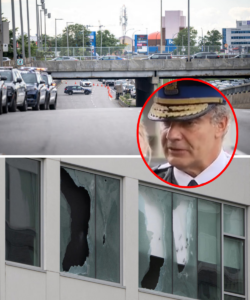
The violence began at approximately 11:35 a.m., when emergency services received reports of an individual aiming a firearm from a window at a Hilton hotel. Law enforcement responded immediately, only to find themselves directly in the line of fire. Jacob Coutu, a construction worker on-site, recounted the harrowing moments when the morning stillness was broken by gunfire. He recalled: “We saw cops getting in a gunfight, getting shot down.” He estimated that between 30 and 40 shots were fired during the chaotic exchange.
Montreal Police Chief Fady Dagher, speaking with a heavy heart at a press conference, confirmed the loss of the officer. He somberly remarked: “It’s a very, very sad day. It’s a nightmare.” In addition to the fallen officer, another colleague remains in stable condition after sustaining serious injuries, while a civilian was also left with minor wounds. Even more heartbreaking, a second civilian was killed during the incident, though investigators are still working to determine the origin of the fatal shot.
Motives and the “Incel” Ghost
Perhaps the most troubling aspect of the tragedy is the potential motivation behind the shooter. According to Radio Canada, the attacker—who was ultimately killed by responding officers—released a “manifesto against women,” a document filled with the violent, misogynistic rhetoric characteristic of the “incel” subculture found online. While authorities remain cautious about officially confirming the motive, the apparent connection has ignited serious concerns regarding the lethality of digital extremist movements.
Québec’s Domestic Security Minister, Ian Lafrenière, emphasized that the shooting is currently being treated as a “domestic case” rather than an act of terrorism: “It was not considered as a possible terrorism attack, but everything has been put in place to make sure it was not linked to something else.” However, this distinction raises complex questions about where the line is drawn between individual violence and ideological terrorism.
A Community in Mourning
The shooting occurred in an area with a significant population of Lubavitcher Hasidic Jews, leading to immediate fears that the community might have been targeted. Zalman Erdvin, who was praying at a nearby synagogue during the attack, described the terror of being locked down for three hours. “I hope they weren’t targeting Jewish people,” he said.
Leadership across the board issued statements of solidarity. Montreal Mayor Soraya Martinez Ferrada expressed her condolences: “My deepest condolences to the family, loved ones, and colleagues of the police officer who died in the line of duty in Côte-des-Neiges. My thoughts are also with all those affected by this tragedy.” Prime Minister Mark Carney added his gratitude: “My thoughts are with the victims, their loved ones, the first responders, and the entire community of Côte‑des‑Neiges. My gratitude is with our courageous police officers whose heroic dedication protects our communities.”
Personal Perspective: A Wake-Up Call for an “Ideological Pandemic”
The Montreal tragedy is more than a mere criminal case; it is a siren call regarding the consequences of online hate forums. When a young individual can translate toxic ideologies from internet echo chambers into real-world violence, transforming a hotel into a battlefield, it ceases to be a private issue and becomes a profound challenge to societal security in the digital age.
The fact that the suspect is dead and was “assessed as not being fit for interview” leaves a chapter of the investigation unfinished, creating a sense of closure that feels hollow. Has society done enough to counteract these “ticking time bombs” fueled by poisonous ideologies? As security shields are pierced by such violence, we must confront an uncomfortable truth: the greatest danger does not always come from the barrel of a gun, but from the poisonous thoughts festering in the shadows of social media. The sacrifice of this police officer is a painful reminder of the exorbitant price society pays when we fail to intervene against these radicalizing forces in time.